

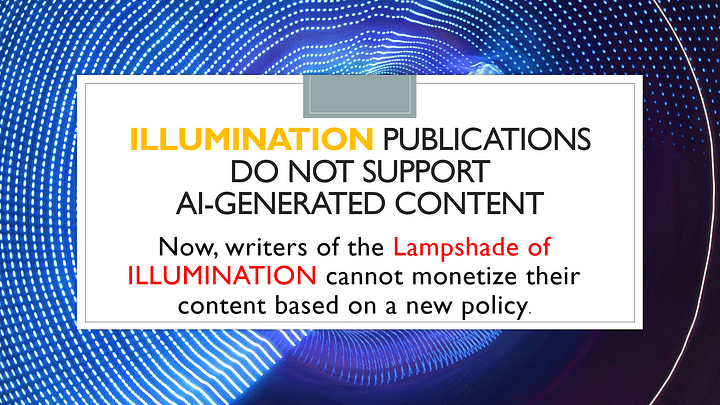
A comprehensive interview with Dr. Mehmet Yildiz, chief editor of ILLUMINATION Integrated publications on Medium.com, to guide the writers of the Lampshade of ILLUMINATION
Writers and readers can also read this important article on Medium.com.
Brief Context and Background
Over the last three weeks, we received many inquiries from the writers of a publication called the Lampshade of ILLUMINATION, which is under the umbrella of the ILLUMINATION Integrated publications on Medium.com, which supports over 28K writers. In 2023, as part of our diversity and inclusion values, we established this publication to prevent AI-written content from our other publications and allow those writers who are interested in experimenting with it.
New writers want to experiment for several reasons, and we explain them in the submission guidelines for this unique publication. To confirm that no other ILLUMINATION publications in our group support AI-generated content as documented in our policy, we return such stories and remove offenders. Although we stopped using immature AI detection tools, our editors diligently screen every story to prevent AI-generated content that our readers don’t like. This is a massive task for volunteer editors.
Recently, Medium announced that AI-generated content will no longer be allowed behind the paywall. Those who breach their rules might lose their partnership privileges. Many writers who read about this new policy asked for clarification on how they adhere to this rule and protect their profiles and partnership status.

As an editorial team of ILLUMINATION publications, we developed an internal policy to support Medium and asked our chief editor, Dr Mehmet Yildiz, to explain the reasons behind the policy and how we will implement it. Please share the friend link of this story with your friends so all our writers get informed.
Dr. Yildiz, could you elucidate the rationale behind implementing this new policy? It would greatly benefit new writers who may not be familiar with it.
Thank you for this opportunity. I hope this interview reaches our writers who might be experimenting with generative AI tools. As we mentioned last year, it is okay to use AI tools, but we only accept them in one publication, the Lampshade of ILLUMINATION, to ensure such content does not contaminate our other pubs as most of our readers dislike machine-generated content for valid reasons.
However, on 22nd March, on Medium Blog Buster Benson clearly pointed out that Medium is simply not a welcome place for malicious and disingenuous content and behavior, and we certainly won’t financially encourage it.
So, to state it plainly, Buster confirms Medium will revoke Partner Program enrollment from writers that publish AI-generated stories or other low-quality content that demonstrates clear misalignment with Medium’s mission. And we will support and are proud to protect the community from this undesirable behavior.
I understand that when the content and structure of stories and/or replies are plausibly determined to be generated by AI, accounts will be removed from the Partner Program permanently or temporarily. This will be determined on a case-by-case basis.
Buster confirmed that AI-generated content is permissible in non-paywalled stories if it is disclosed — but it is no longer allowed in the Partner Program, even with disclosure.
By following this advice, we will continue to support our writers submitting AI-generated content to the Lampshade of ILLUMINATION, but we ask them not to put their stories behind the paywall.
Could you outline the specific actions they must take in light of this policy update? How can writers do this when they submit their stories to the Lampshade of ILLUMINATION?
It is straightforward. All they need to do is remove the check box from the paywall option, as shown in the screenshots below.
First, they need to click on the … (three dots) at the top right of the story screen. Then, they will see the following screen and click on the Edit story option at the top.

They will need to click on the … (3 dots) again, and another screen will appear.

From this menu, they choose Manage paywall settings.
If the story has a tick on the Paywall your story section, they need to click on the tick, which will remove it and save it.

It is supposed to be like the following screen.

Since this is a new rule, writers need to check all their previously published stories and apply these steps to adhere to the platform rules.
Thank you for these clear explanations. We believe our writers will find your instructions helpful. Could you please share your perspectives on why you think writers shouldn’t monetize AI-generated content?
Answering this question honestly may not earn me popularity points, but I feel compelled to express my authentic thoughts and sentiments as a reader, writer, and editor on this platform.
Firstly, I have noticed several adverse effects of using AI tools on other platforms and blogging sites, which have led to serious issues for bloggers. Some have lost their loyal readership by attempting to generate excessive content, believing it would increase site traffic.
However, this approach often backfires, as these tools produce mechanically styled content with inaccuracies, which disappoints loyal readers. I intend to write about this topic further, detailing my observations and findings over the last two years.
To answer your question about this platform, in my perspective, monetizing writing created using generative AI tools presents several ethical and practical concerns.
Firstly, from an ethical standpoint, monetizing AI-generated content on Medium can raise intellectual property rights and originality issues. Since the AI tools generate the content from training data that might be copyrighted, writers may not have full ownership or creative control over the output, potentially leading to copyright disputes or plagiarism.
Secondly, there is the question of quality and value. While AI-generated content can be impressive in mimicking human language, it overtly lacks the depth, creativity, and authenticity readers expect from human-authored work.
Monetizing such content may lead to disappointed audiences who feel they are not getting genuine or meaningful content on a platform where they pay for subscription services.
Furthermore, the risk of saturating the platform with low-quality or spam-like content might devalue the overall writing landscape and erode trust between writers and readers.
Medium is a platform and a community where writers and readers connect meaningfully and share their thoughts, feelings, and experiences on personal and real-life issues that machines cannot yet produce.
More importantly, most writers possibly are unaware of it. However, there are potential legal implications, particularly if the AI-generated content infringes upon existing copyrights, trademarks, or other intellectual property rights.
Monetizing such content without proper authorization could result in legal action and financial penalties. We haven’t experienced such situations yet, but it is possible therefore,I feel obliged to share this to protect our writers from hefty fines.
While generative AI tools can be valuable for generating ideas and assisting new writers to improve their writing skills, monetizing AI-generated content raises complex ethical, quality, and legal concerns that warrant careful consideration and potentially discourage its commercialization.
I fully support Medium in this initiative. Apart from managing quality, if AI-generated content becomes prevalent with monetization and replaces human-authored work in writing platforms like Medium, it may contribute to losing authentic writers and readers who pay to read human writers.
We stopped using AI detection tools as they are immature, but we still diligently check every story. How can Medium handle an enormous number of stories submitted by thousands of writers? We heard that over 1.2 million stories are published weekly.
This is a good question and a point that Medium needs to invest in and empower publications. In Buster’s story, I came across another valuable story written by Terrie Schweitzer titled Our curation team’s approach to keeping AI-generated content out of your recommendations. I found this story very helpful and recommend that writers read it carefully.
As Terrie pointed out, AI-generation detection is not a perfect science now, and I agree that detection tools are immature and often offered as a marketing giveaway. Therefore, we stopped using the not to waste our time. However, such content is relatively easy for human readers to detect.
With generative AI tools like Gemini, ChatGPT, Jasper, and others, we noticed that they can produce fiction stories, generic essays, poems, and blog posts that initially appear polished and well-crafted. However, upon closer examination, we noticed a lack of depth and authenticity in the narrative.
For example, the sentences and paragraphs may be technically correct, but the content lacks substance and meaning. Although they are grammatically correct and even use advanced vocabulary, the readers cannot make sense of them as they sound too abstract, mechanical, and often repetitive of the same idea in different syntax.
Ironically, the content exudes confidence, often confidently presenting false information. I tested several of them using different scenarios within my expertise fields, and despite the information being totally wrong, the AI tool attempted to show it was really accurate information confidently, which can have detrimental effects on our lives.
At this state, Medium expects the judgment of publication editors, curators, and the Medium community to ensure that stories that read like AI-generated stories simply will not be distributed or can earn on Medium. As Terrie pointed out, there are other places on the internet that can provide this purpose.
Is this expectation of Medium from publications reasonable? What are your thoughts as an owner of multiple publications for a long time?
This is indeed a commendable initiative, and all publications should support Medium as a valuable platform stakeholder. There are thousands of publications, and contributions from each can make this platform better.
However, speaking from my experience as a seasoned publication owner, I invite Medium leadership to reconsider the 30-editor restriction for large publications like ILLUMINATION, which serves thousands of writers.
This 30-editor limitation appears arbitrary and does not align with the best interests of Medium or its community. While I sincerely appreciate Medium and dedicate significant personal time due to my love for the platform and its growth, sustaining a publication of ILLUMINATION’s scale with only 30 volunteer editors has become increasingly challenging.
Regrettably, some dedicated editors have had to step down due to exhaustion and distress, with a few even facing near-mental breakdowns. I have to juggle daily among 151 volunteers to find the available ones to support ILLUMINATION. For the last few days, I have done the duty of at least five editors, but it is impossible for me to continue like that. I don’t want to burn out myself in my older years.
Despite multiple requests to Medium’s support team for an increase in editor allotment, we have not received a response. I will make one final appeal for transparency, and if not met with support from Medium, it will be difficult for me to navigate this challenging situation.
Screening every submitted story for publication is vital to preventing harmful or AI-generated content. This is a monumental task that, if Medium cannot undertake it directly (which they cannot now) should empower publications to fulfill this essential role without constraints.
I also recommend a task force made up of significant pub owners managed by Medium leadership to deal with current spam and fraudulent activities. Currently, these bad behaviors turn off readers and might adversely affect the growth and sustainability of the platform and its dedicated community.
Do you think writers should not use generative AI tools for research?
Unfortunately, some writers resort to using generative AI tools for research purposes. While these tools may suffice for basic research that can be easily cross-checked with a simple Google search, relying on them for complex and critical topics like health or finance poses significant risks. This is primarily because the training data used by these tools is limited in scope.
While advanced researchers may utilize specialized AI tools like IBM Watson, which won the Jeopardy in 2011 (I contributed to it during my time at IBM as a senior consultant) such software comes at a steep price due to the extensive resources invested in its development. I don’t know the current price status.
Medical professionals, for instance, leveraged IBM Watson to analyze vast amounts of literature in their fields for decision-making purposes. However, they do not rely on these tools for generating reports, papers, or books. They write them themselves with the information they get from these tools.
In my perspective, publicly available tools like ChatGPT or Gemini are not yet equipped for advanced research. They might in the future. Therefore, writers should exercise caution when using them for such purposes.
Who can benefit from generative AI tools at this stage briefly?
There might be multiple cases, but in my perspective, one readily available opportunity is for writers whose first language is not English, aiming to enhance their writing skills by seeking improvement in grammar and vocabulary.
These AI tools excel in translating from one language to another, allowing writers to compose their stories in their native language and subsequently translate them into English.
However, significant self-editing is essential to ensure the resulting text sounds natural and native-like. Therefore, these writers need guidance from mentors to refine their writing styles and benefit from constructive feedback for their language skill development.
Many volunteer editors generously support new writers whose first language is not English, providing valuable assistance for them to shine.
For example, I review and guide some passionate new writers who contribute to my publications, submitting meaningful content. It gives me pleasure to do so. While doing this, I also learn from their expertise, so it is a win-win position.
Thank you for your guidance on these burning issues, Dr Yildiz. We appreciate your leadership and support. Thank you for establishing ILLUMINATION, which now supports over 28000 writers and 79000+ readers on this platform, as you pointed out in our new newsletter. We celebrated our 4th successful anniversary as well-articulated by our editor, Mike Broadly, DHSc, in his beautiful Aussie accent.
Thank you all for reading our interview. We hope you find this post helpful and would appreciate your feedback. You can always contact Dr. Yildiz on Slack and if he cannot respond to your queries you may get in touch with his volunteering backups Aiden (Illumination Gaming), Lawson Wallace, The Sturg, Mike Broadly, DHSc, InYah, or K. Joseph.
Other Policy Documents of our Publications for Our Writers
Every writer contributing to our publications must review these guiding policies before submitting their stories. We are tolerant, but these are non-negotiable rules.
AI-Generated Content Policy for ILLUMINATION Integrated Publications
New Partner Program Rules: ILLUMINATION’s New Policies and Guidelines to Adhere Platform Rules
Helpful Resources for Beginners
You may find helpful stories from the content management collection of Dr Mehmet Yildiz written to help new writers join Medium.
Writing, Content Development & Marketing Strategy Guides
Edit descriptiondr-mehmet-yildiz.medium.com
New Friends of Medium Subscription for Readers
Our chief editor Dr Mehmet Yildiz, upgraded our publication accounts ILLUMINATION and ILLUMINATION-Curators, as well as his first and secondary account Dr Mehmet Yildiz (Tech), making them Friends of Medium. Reading from these accounts will allow writers to earn four times more. While curating stories, we read many stories from these accounts, so it will be great for writers. Most of our publications, including Illumination, support non-members, but we encourage all writers who can afford the cost for subscript to consider becoming a member or joining Medium Friendship subscriptions. Writers need to read to to perform better. You may check out the details in his story by Dr Mehmet Yildiz (Tech) Why I Became a Friend of Medium. The good news is when non-members read the links from FoMs, they generate income for writers.How Friends of Medium Can Amplify Important Stories Via Customized Social Media Sites.
Invitation to New Writers
To join our vibrant publications, please send a request via this link. We will help you gain visibility and succeed as a writer on Medium. Please mention the publication name with your Medium account ID in the request.
ILLUMINATION Integrated Publications include:
ILLUMINATION, ILLUMINATION-Curated, ILLUMINATION’ S MIRROR, ILLUMINATION Book Chapters, The Lampshade of ILLUMINATION, Technology Hits, SYNERGY, Readers Hope, Illumination on YouTube, Illumination Gaming, Illumination’s Nutrition, ILLUMINATION’s Blog
EUPHORIA by Dr Mehmet Yildiz
Get an email whenever ILLUMINATION publishes.
Get an email whenever ILLUMINATION publishes. ILLUMINATION Integrated Publications publish stories of around 14K…medium.com


Leave a Reply