

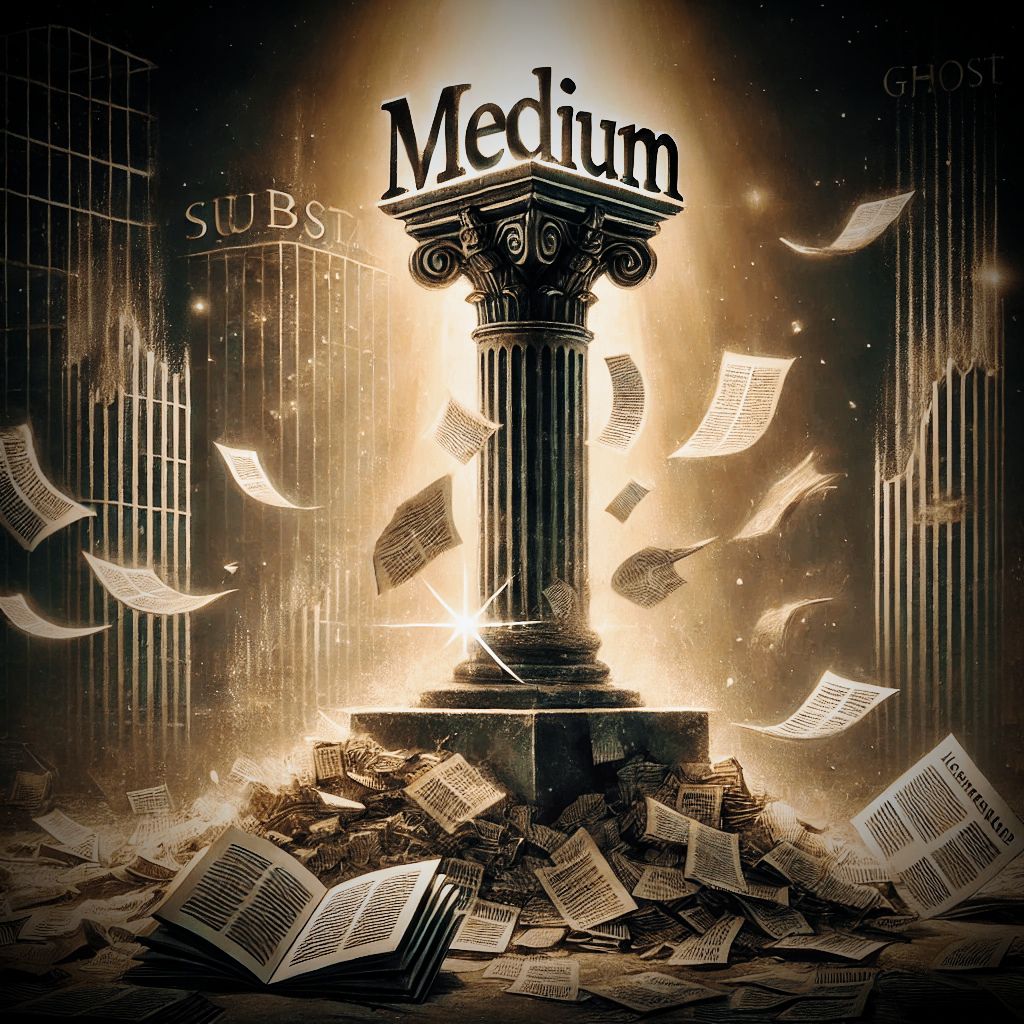
The platform has been a haven for writers and readers for a long time, and an attachment to it was developed. It was where life stories, thoughts, and views met—a virtual space where salt-of-the-earth became storytellers. However, at the commencement of the current year 2025, there has been a lot of second-guessing the prospect of the site. January has surfaced the concerns most, which has led to the point of formulating opinions of whether the Medium can still keep to the spirit of the initial pronouncement.
The Emergence and Adoration of Medium
Medium, in a world where it is often one of the most neglected problems, was created from a single but firm vision to make a place for everyone, irrespective of whether they were erstwhile ascorbic bananas to rookie storytellers, to share their stories without the traditional leeway of publishers. The website featured a user-friendly, natural, yet attractive interface with a partner program that came with the attraction of a financial reward.
Consequently, Medium was promptly recognized as a home of new and independent voices. When it was at its peak, the platform was totally authentic. Authors got not only an audience but also a community—a wonderful mixture of creative latitude and real communication. As a result, readers gained an abundance of views from different angles, from intensive personal essays to investigative accounts. Yet, even the kindest lights go out, and the web’s polish has been waning.
January 2025: The Breaking Point
It is not an exaggeration to say that January has been the month that brought Medium to the brink. Points to be discussed in the form of a list are given below:
1. Writer’s Income has Dropped:
Medium’s Partner Program, a program that was acclaimed in the business world for its correctness, has been a big issue. Writers’ payments have reduced from week to week for the last several months. This change was distinctly visible when in January 2025 the whole proceeding was marked by an irreversible downward sliding. For their strong and hard work in creating the content for the website, most of them still find among them those poor guys who complain about the poor compensation. A lot of them, who were discouraged as a result, went to the other platforms or set out to be independent publishers to make their earnings. Such financial differences are the most demoralizing among small creators who mainly depend on Medium for their living. Despite the positive results of the subscriptions, the redistribution model has left many subscribers with a feeling of being underpaid.
2. Reader Fatigue and Algorithm Woes:
There is a Medium’s algorithm that is intended to lift quality content to the surface; on the contrary, it has subdued the diversity. Many authors complain of their articles being submerged by annoying clickbaiting slogans that grip and hitherto dominate the reader’s attention. The situation worsens day by day with the platform redirecting viewers’ attention towards the flashy but low-quality content instead of meaningful propositions.
For the reader, the fusion of boring content is a torturous experience. Most of the users of the medium platform are, however, troubled by not being able to find those high-quality articles, which probe the boundaries of common understanding, that they used to be thrilled by. This decrease in reader engagement forms a circle of negativity, causing the writers to earn less and the platform to face a major drop in attraction.
3. The Erosion of Community:
Once, Medium was a place where the reader and the writer would have conversations that mattered. The main focus now is on the subscriptions and money-making rather than the building of this model of connection. Authors describe their affiliation becoming more and more rarified as they are reduced to numbers on a screen.
The downward slope of the community experience is very noticeable in commenting sections. A place that used to be vibrant and full of exchange is now a place where some articles barely get attention and their authors feel like nobody listens to them. The loss of this collective spirit will eventually threaten the foundation of Medium.
4. Competition Gaining Ground:
While Medium is failing, alternative platforms such as Substack, Ghost, and even Patreon are gaining momentum. These platforms grant more autonomy over audience engagement and revenue to attract creators who are wary of Medium’s unstable direction. One of Substack’s examples, writers, get the ability through the direct-to-subscriber model to grow a faithful follower community and also hold a more significant share of their earnings. The open-source structure of Ghost is a draw to those who prefer customization and independence. These rivals are making the most of Medium’s blunders by providing writers with viable choices.
5. Leadership’s Disconnect:
The lack of response from Medium’s management has only added more trouble. Writers have aired their grievances—about profits, visibility, and community—but they are convinced that their input goes unnoticed. This lack of transparency and responsiveness has expanded the gap between the platform and its users. The authors are demanding increased accountability and open communication. The user base at Medium is left with no direction or a roadmap, and this makes them become rudderless.
Is This the End of Medium as We Know It
Although January 2025 brings immense hurdles, we shouldn’t be in a hurry to wipe out Medium. The platform still has a big number of users, and moreover, the foundation for the reconstruction is there. Still, a rebirth requires an aggressive yet strategic approach by Medium to the following:
Revamping the Partner Program: Writers ought to be remunerated in accordance with their impact. Medium should rethink its payment model to ensure fairness and sustainability and introduce a better incentive regime for the creators to keep them motivated.
Prioritizing Discovery: Medium can help readers find the David and Goliath relationships if it implements more intelligent algorithms and curation tools. For example, curated collections and editor’s picks could potentially become the driving force in the process of reversing the quantity-over-quality direction of the platform.
Rebuilding Community: Medium has to rekindle the feeling of belonging that once was characteristic of the platform; it has to be about writers and their readers, not a content matter of transaction. The functions such as community forums, better comment systems, and writer-reader events could put some noise back to the platform.
Engaging with Creators: The direct, clear, timely, and honest messages from the top management are the key. Only by writers and readers being actively engaged and appreciated will Medium be able to reclaim their trust. Periodic updates, questions and answers, places, and rounds of collective feedback could make this bond more solid.
A New Chapter for Online Publishing
If Medium is not flexible with changes, it is anticipated that it will no longer be an integral part of the digital publishing world. The occasion itself can be a period of invention. The relatively new platforms might take lessons from Medium’s mistakes and, in their way, create stronger and more authentic communities.
Writers will never give up either. Storytelling, essentially, is neither confined to platforms nor does it rely on technology; its core is humans needing to connect, to comprehend, and to be understood. Either through Medium or other smaller platforms, expressions of artists will continue to be heard, thus ensuring that the art of writing continues.
January 2025 is a turning point not only for Medium but for the publishing worldwide. Whether Medium can live on or grow as a life-giving factor for the narratives it tries to care for is not the issue right now. The following few months will be crucial, and it is just a matter of time if Medium can find its way out of this impasse again to regain back its former reputation.


Leave a Reply