

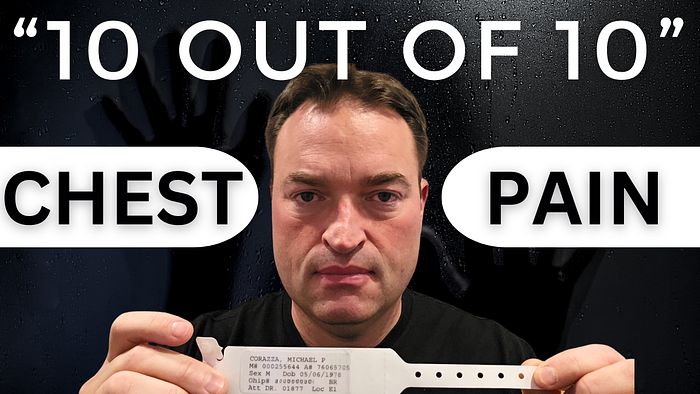
A Year of Chest Pain Fell Through the Cracks
Image created by author.
Warning: I outline explicit details surrounding the events before, during, and after my cardiac arrest, which may be triggering for certain individuals. Viewer discretion is advised.

“Monica, the pain is a 10 out of 10!”
Thanks for reading Mike’s Substack! Subscribe for free to receive new posts and support my work.
I have no recollection of anything from earlier in the day, Feb 4, 2020, until my memory resumes on Feb 10.
The story I’m about to tell you is a culmination of details I accrued weeks, months, and even years after that fateful night. Even now, I still discover new things that help me fill in the missing pieces of my story.
A Brief History
Before delving into my cardiac experience, it’s crucial to acknowledge the events leading up to that significant night.
Throughout my adult life, I have struggled with clinical depression and various anxiety disorders, some of which have led to panic attacks.
Chances are, some of you have experienced a panic attack before. Those who’ve endured severe ones like mine have likely found themselves catastrophizing, fearing they were suffering from a heart attack.

In the lead-up to the cardiac event, there were numerous occasions spanning my teens, twenties, and thirties where the symptoms in my chest alarmed me enough to dial 9–1–1.
Whether the paramedics arrived at my doorstep or I sought help at the ER, the explanation I received was usually the same: “It’s just anxiety.”
I was young, typically active, and reasonably fit. I was a non-smoker with no history of high blood pressure or cholesterol issues. Therefore, I understand their assessment.
Admittedly, I did have a longstanding issue with my heart’s accelerated rhythm since my youth, but that’s a whole different story you can read more about here.
I Spent Most of the 2019 Year Fearing the Worst
In 2019, my anxiety surged due to chest symptoms, despite multiple reassuring tests like EKGs and blood work. This fear of a heart attack fueled anxiety attacks, worsening the symptoms in a relentless cycle.
Despite attempting to remain active, exertion only heightened my chest pain, straining my relationship with my wife, who grew frustrated with my persistent complaints despite doctor reassurances.
In the summer of 2019, my doctor ordered a stress echocardiogram due to worsening symptoms. Surprisingly, I managed the test well, but doubts lingered regarding its accuracy in capturing my symptoms.

Despite negative test results, my chest pain persisted, intensifying my anxiety. I even faced being labeled a hypochondriac by a medical professional.
By early 2020, overwhelmed by anxiety, I ceased being active to avoid triggering chest pain.
During a family outing to an NHL game in January 2020, I encountered significant chest discomfort and shortness of breath, foreshadowing the cardiac event that would strike just days later. It felt like I could have easily become part of the pre-game show!
When your fear of death becomes a reality.
I have shared my story with many people in the last four years. However, this is the first time I’m not only recounting my cardiac event in great detail in written form but also publishing it online for the general public.
I’m stressed as I type this because I feel the pressure to adequately explain the magnitude of what happened that night.
Once again, I have no memory of the following events.
It was a routinely cold evening on Feb 4, 2020. Just after 11:00 pm, my wife Monica and I had retired to bed. A short time later, I woke her up. “Monica, I have chest pain.”

Half awake, she muttered, “You ate wings; it’s gas. You’re fine. Go back to bed!” (I had gone for dinner earlier that night with a great friend named Kevin, who is married to my wife’s cousin and happens to live down the road).
“Just Do Your Breathing Techniques”
Not long after she fell back asleep, I got her attention, complaining again of chest discomfort. Thinking this was another panic attack, she encouraged me to employ some of my previously learned breathing techniques.
Soon after, things became more serious. “Monica, the pain is a 10 out of 10!” She immediately knew what I meant, recalling a story I told her when I made a 9–1–1 call in my 20s after feeling some scary sensations.
I explained that one of the dispatcher’s questions at that time involved rating “chest pain on a scale from 1 to 10.”
Seeing the words I chose that night, I realized I had never forgotten them. I’m glad I shared that story with Monica; thankfully, she remembered it too!
We quickly jumped out of bed, and she went to tell her mother, who was living with us at the time, that she was taking me to the hospital.
“I Feel Better”
As we were backing out of the driveway, I complained of an upset stomach. I got out of the car, went over to the front lawn, and began to vomit. It didn’t last long, to which I expressed that I was feeling a little better.
We quickly reassessed if I still needed to go to the hospital because Monica admitted afterward that she thought I just felt unwell due to overeating. She later explained that I had two bowls of cereal after I got home from dinner.
Wings and cereal? No wonder I wasn’t feeling good!
And Then It Happened

As I stood on the frozen, snow-patched lawn, I leaned over, feeling another wave of nausea wash over me. Without warning, my legs gave way, and I crumpled lifelessly to the ground.
There I was, lying motionless. Monica abruptly called 9–1–1 and quickly began CPR, which I later found out she had taken a refresher course only weeks before!
She maintained her CPR efforts diligently while keeping the dispatcher on the line. She persisted in administering compressions for several minutes.
False hope.
Monica’s recount sent shivers down my spine, particularly when she mentioned believing I was breathing again. The dispatcher’s swift clarification, “No, that’s just your air coming back up,” was chillingly matter-of-fact.
Despite the weight and numbness in her arms, Monica persisted with CPR, pouring every ounce of strength into the effort. She described the duration as feeling “like an eternity.”

It’s natural to wonder how we might react in such a dire situation, envisioning ourselves in Monica’s shoes, facing the lifelessness of a loved one. I’ve mulled over this scenario countless times, hoping for the same blend of swiftness and composure.
Over the course of many minutes, an array of emergency vehicles arrived upon the scene, including an ambulance staffed with three paramedics. One immediately assumed control and launched into action.
Sudden Cardiac Arrest
I don’t remember all the medical details, and I’m purposely leaving some out. Ultimately, they had to stab a needle full of a concentrated dose of medicine into my leg, as well as use a defibrillator multiple times.
*** Actual Image Of My EKG/ECG During Cardiac Arrest ***

I wasn’t fully stable, but the paramedics had little time to get me in the ambulance and to the hospital. Monica followed but arrived well before them.
She waited patiently outside, near the ambulance bay. Just before my ambulance arrived, she heard the PA system call out, “Code blue, code blue,” implying an urgent medical emergency, usually a cardiac or respiratory arrest.
I was quickly handed over to the ER staff. Monica was permitted to follow as they rushed me down to the basement. She waited in a room off to the side while I was brought into the catheterization lab, nicknamed the ‘cath lab.’
No Time To Spare For the Medical Staff That Night
The cardiologist on call, the nurses, and other staff in that room were in for an intense evening. I encountered four or five serious complications that somebody later explained: “Any one of them could have killed you, and combined, nobody survives that.”
To name a few challenges, I had a massive seizure shortly after they laid me on the operating table. My legs shot up, and when they went to pull them down, my upper body went upwards. In hindsight, just picturing this makes me chuckle. However, I’m sure it wasn’t funny at the time.
A large portion of the right side of my lower body was almost black. I was told a needle they had inserted had broken off during the seizure, causing massive internal bleeding.
‘Widowmaker’
While administering an emergency angiogram (a scan that shows the blood flow through the heart), the doctor could finally insert a total of three stents.

One was for a 70% arterial blockage, and the other two went into my main left anterior descending (LAD) artery, which was 100% blocked. This artery is nicknamed the ‘widowmaker’ because it carries almost 50% of blood to the heart muscle. The nickname makes sense if this becomes fully closed off.
Meanwhile, I was still in a challenging situation. My heart was not strong enough to beat on its own, so doctors had to use a balloon pump to assist.
In addition to my cardiac emergency, doctors placed me in a coma to protect my brain.
“Where is your family?”
At some point during the chaos, an ER nurse who had been updating Monica asked her where my family was.
When Monica explained that it was the middle of the night and she didn’t want to alarm anybody, the nurse, in a serious and concerned voice, said, “You need to call them now!”.
Monica later explained to me that she was in shock with everything that was happening. Although she knew the situation was dire, she didn’t expect or prepare for what the nurse would say to her next.
“I don’t think you understand; he’s probably not going to make it.”
Recounting this part of the story to me was tough for Monica, especially right after it happened. The idea of losing her husband and our boys not having their father anymore was still really fresh in her mind.

She proceeded to make some phone calls and reached my parents and one of my three older brothers.
In a later conversation about the incident, Monica revealed that our family had been allocated a secluded space where visitors could gather. This arrangement was never officially spoken of, but it felt understood that it typically occurred when the patient’s condition was deemed critical.
“He was right all along”.
After enduring hours of anticipation at the hospital, Monica was finally granted permission to see me. She had warned that nothing could prepare one for the harrowing sight of a loved one tethered to life support, unsure if they were on the brink of widowhood.
The scene that greeted her was overwhelming: a tangle of cables, wires, monitors, and incessant beeping. Yet, it was the image of me, motionless with tubes protruding, that struck her deepest.

My brother’s entrance into the room was fleeting, his emotions too raw to contain. Seeing his brother, who is ten years younger, clinging to life must have been profoundly challenging.
My mother, already grappling with dementia, found the ordeal particularly distressing. Our bond had always been tight, and seeing her ‘baby’ connected to machines undoubtedly tested her resilience.
As for my father, the situation weighed heavily on him. Over the years, I’d often turned to him during bouts of intense anxiety, but nothing could have prepared him for the gravity of this moment.
Enduring my complaints of chest pains and escalating anxiety in 2019 only exacerbated his frustration because, once again, he immediately recalled doctors saying I was fine before this event.
Exhausting times.
While I spent the first few nights in a coma, Monica was struggling to leave my side. People around her had to force her to go home to try and get some rest. Worrying about what was happening at the hospital, these attempts were futile.
Doctors used chillers and ice packs to keep me as cool as possible. Their biggest concern was my brain function due to the extended periods I was without oxygen.
My heart was doing better, so they removed the balloon pump. This was a small piece of good news, considering the growing concern regarding my neurological condition.
Once in a while, medical staff would lower the amount of fentanyl being given to see if my body would provide hints as to how I’d react while coming out of the coma.
However, every attempt caused my body temperature to climb. As a result, they maintained the fentanyl dosage and continued to cool me down by any means necessary.
“We’re unsure how long he will be like this.”
Monica was concerned about my time spent in a coma but more worried about the neurological ramifications. When she inquired with medical professionals, they couldn’t answer because they kept telling her the situation was very “delicate and complicated.”
Around the fourth day of my being in a coma, medical staff could see that Monica was under extreme duress due to the unknowns of the situation as a whole.
From Panic to Progress.
Doctors went into action and disconnected (or lowered) the fentanyl once again. However, this time, almost miraculously, my body temperature didn’t rise.

I’m unsure exactly how long it took me to become conscious again. Still, I believe I first began moving and eventually speaking approximately five days after I first went into a coma.
“I watched your brain boot back up!”
One of my dearest friends, Raz, rushed from New York, where he was residing at the time, to pay me a visit to the hospital. Regrettably, I have no recollection of encountering or conversing with him then. Nevertheless, I am eternally grateful for his compassionate gesture.
Raz recounted being present shortly after I regained consciousness. His fascination with witnessing the gradual reboot of my body and mind has stuck with me ever since. He observed as I gradually slipped into my familiar mannerisms and quirks, reclaiming my identity as Mike Corazza.
Awake, but not really?!?!
This still baffles me to this day. I awoke from the coma around the 6th day. However, my memory of being alive picked up on the 7th!
During a state I whimsically label as “awake but not really,” a neurologist administered tests while Monica and my father observed, assessing my cognitive function with a barrage of questions.
Surprisingly, I excelled, acing math problems, reciting the alphabet backward, and even tackling political quizzes, an area I typically struggle with. Monica and my father, admitting their own potential struggles, marvelled at my performance.
Despite my long-held insecurity about my intellect, I share this not to boast but rather to express my intrigue and confusion at my sudden proficiency. Weeks later, Monica revisited some of the questions, only to find my responses delayed or absent, leaving me baffled by the memory lapse.
Despite being awake, conversational, and passing cognitive assessments, I experienced an unexpected bout of temporary memory loss, dubbed humorously by my family as ‘Groundhog Day’ but clinically identified as Transient Global Amnesia (TGA).
As my condition persisted, Monica grew increasingly concerned and resorted to creative measures like writing reminders on a dry-erase board and placing sticky notes around the room. As the cycle of forgetfulness persisted, Monica voiced her worries to the medical team.

“To be honest, Mrs. Corazza, we’ve never had a person survive the multiple events Michael did. This whole situation is new for us as well, and we don’t know how long this will last or if things will improve.”
Monica’s anxiety escalated upon hearing the doctor’s uncertainty about my recovery, recognizing the daunting prospect of living with a husband who couldn’t retain memories for more than a few minutes.
While I draw a parallel to my mother, who is suffering from Dementia, I understand that my experience pales in comparison to her condition, which has progressed significantly over the years.
At this point in the story, I feel it’s important to remind you that I have NO memory of everything I’ve mentioned until now.
From going for chicken wings, collapsing on my front lawn, all the time spent in the coma, and even the day after being out of it. Nothing.
The last thing I remembered was going for breakfast with Monica and some of her coworkers on the morning of Feb 4 and sending some work emails later that afternoon.
The following events are where my memory picks back up.
Lucky day #7. Feb 10, 2020. The day I became ‘aware’ again.
I suddenly found myself lying down in a strange room. A person was standing over me, and as things became clearer, I realized it was a female nurse.

She quickly interrupted when I opened my mouth; “We’ve already gone over this. You’re in a hospital, Michael, and you survived a cardiac arrest.”
I can only imagine the look of shock and confusion on my face as I remember wondering if I had just woken up.
“You came out of a coma yesterday, but ever since, you’ve been having issues with your short-term memory. I’ve already explained everything to you multiple times, but you keep forgetting and repeating yourself.”
The above quote is from another article I wrote, “Learning to Love that I Had a Cardiac Arrest at 41,” which I encourage you to read here.
Adapting to a new routine.
Adjusting to a new routine proved challenging. Initially, it wasn’t easy to recognize familiar faces among the doctors and nurses I’d supposedly met before.
While I found solace in hearing about the support from my wonderful family and friends who visited, I couldn’t shake the guilt of not recalling them.
The transition brought numerous adjustments, notably the influx of medication. From a few pills for depression and anxiety, I was now swallowing over 15 daily due to my cardiac event.
Moreover, I had to adhere to a strict diet, restricting sodium, saturated fat, and sugar intake.
The realization that I lost a week.
Although countless healthcare professionals aided me during my ordeal, the nurse I mentioned earlier stands out as the first medical staff member I recall.
It’s astonishing that over four years have passed since that moment!
Fortunately, when the nurse clarified why I was hospitalized, my memory began to stabilize, and my overall perspective brightened. This starkly contrasted the grim circumstances of just a few days earlier.
More time was needed to recover.
As I progressed, I transitioned from the ICU to a less critical area on the cardiac floor. Following several days of tests, I was eventually discharged.
My hospital stay lasted just under 14 days. Remarkably, this occurred only a few weeks before the global Covid-19 pandemic lockdown in March 2020.
The timing leaves me wondering about the potential outcome under different circumstances.
My safety net was removed.
Upon finally being allowed to return home by the doctor, a mix of sadness and anxiety overwhelmed me. Monica, my last nurse, and I convened in a small room to review my discharge paperwork.
Instead of feeling joy about going home, I found myself feeling apprehensive. Given the recent circumstances, I was troubled by no longer being under medical care.
Perhaps it was the prospect of returning home to the scene of the ‘drama’ or the fear of potential complications without immediate medical assistance.
While doctors assured me of my well-being, it was hard to forget that this frightening episode had shattered previous assurances from 2019.
The months that followed.
Life at home after the event presented many new challenges. My physical and mental health-related struggles would go on to become worse than I ever thought possible.
Although I’ve aimed to keep this article focused on my cardiac arrest, one thing I’ll share here is that I was diagnosed with PTSD less than a year after the event.
Closing comments.
Above all else, advocate for your health! Don’t hesitate to seek a second opinion if you’re unsatisfied with a doctor’s diagnosis. Even if test results appear normal, but you still experience troubling symptoms or sense something isn’t right, speak up!
In hindsight, I regret not informing my doctor about my ongoing chest pain following the stress echocardiogram in late 2019.
Despite the test results indicating no issues, voicing my concerns might have prompted further evaluation, potentially revealing significant blockages and prompting necessary treatments and lifestyle adjustments.
This proactive approach could have spared me the traumatic experience that continues to affect me today, both physically and emotionally.
So many people to thank.
I can’t write a story about that time I collapsed on my front lawn without showing massive appreciation to all those involved in saving my life.
ACTUAL PHOTO When I met the paramedics 3 years later!

From the paramedics (above) to the ER staff, nurses, doctors in the cardiac unit, my mental health professionals, and, of course, my family and friends, for their ongoing support, I wish you all the most enormous “THANK YOU!”
I want to extend a heartfelt thank you to our dear friend Sue. Not only is she a dedicated nurse, but she’s also someone who truly looks out for us. We are immensely grateful for everything you’ve done, and we will always cherish your kindness. We love you!
Finally, I must express my gratitude to my wife, Monica, not only for her swift action on that fateful night but also for her unwavering support throughout the highs and lows of our journey together.
We sometimes wonder if we have a guardian angel or if they even exist. I learned a long time ago that mine is my wife, Monica.
“Monica, I love you”.

Until next time!
Click here to see my YouTube video regarding this event.
Interested in a 5-Day GRATITUDE CHALLENGE that may just help you feel less anxious and better yet, more positive/happy?
Click here to JOIN — It’s free for a limited time!*
🔥 Join the Community:
🌐 https://mikecorazza.com for more daily insights!
📬 Substack: https://substack.com/@survivormike
📸 Instagram: https://www.instagram.com/mikecorazza/
☕ Donate here: https://buymeacoffee.com to support this channel.


Leave a Reply