

Personal Perspective: Pursuing and sharing the unseen in a relationship
Written by Dr. Kenneth Silvestri
“If the future is to remain open and free, we need people who can tolerate the unknown, who will not need the support of traditional blueprints from the past.” —Margaret Mead
Empathy is popularly defined as “the ability to understand and share the feelings of another.” Research indicates that it is a vital force in creating better relationships and having a positive impact on our well-being and society. However, when viewed from an ecological perspective, empathy becomes much broader. It can provide a more in-depth understanding of our interdependency with others and the resources with which we coexist.
There is no doubt that empathy can have a transformational impact on our world. Helen Riess, author of The Empathy Effect, stresses that in this era “the ability to connect empathically with others—to feel with them, to care about their well-being, and to act with compassion—is critical to our lives, helping us to get along, work more effectively, and thrive as a society.”

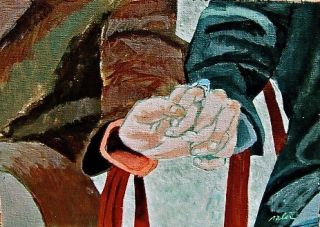
The Wedding
Source: (c) Natasha Rabin with permission
Being empathetic helps us recognize how to tend to the needs of others and is a significant gateway to healing conflictual wounds. Most of all, it encourages a way to mutually learn from each other. This is crucial, as Nora Bateson, President of the International Bateson Institute, believes, “if humanity can’t approach the complexity of our world with greater collective effort, we can’t meet the challenges we face now.”
The National Institute of Health reports that most people feel better emotionally when they are acknowledged and understood. Empathy supports the parasympathetic calm part of our nervous system There is little disagreement that empathy has a positive effect on us; however, is it used enough and consistently?
For all its benefits, empathy often fails to materialize just when we need it most. Jamil Zaki wrote in the Greater Good magazine that in the past, “Humans lived in tiny bands of hunter-gatherers, so that anyone you encountered was likely familiar, similar, and maybe even related to you.” All aspects of society were seen as naturally interdependent. This is no longer the case, yet it is in dire need of restoration. What the research only hints at is that empathy is often used superficially and is challenging to maintain in our hectic society.
Case Study
Jack and Michael have been together for over ten years. They came for couples therapy and as do most couples, with a presenting problem of “poor communication.” They described their Intimacy and communication as cordial and caring, but felt that they didn’t discuss or express their emotional issues. Both of their family of origin supported this legacy.
I had them take a turn using all they knew about being empathetic to address their goal of making a difference in their relationship, specifically in terms of having more profound communication. They were polite, kind, and reticent. This was their choreographic pattern. I then had them repeat the same exercise, but this time with a follow-up question: “How does this affect you?” after each response. The ensuing narratives, following the repetitive question of how it affected them, were vivid and warm in their descriptions of past experiences within various situations that spanned family dynamics, schooling, employment, and prior relationships. What was obvious when they were asked to paraphrase what was shared is that they had not heard these stories with such depth and emotion
Take Away
How can this be sustained? First, the positive effects of empathy are what is called a first-order change, which is attaining an immediate difference. However, a second-order change, described in the above case study, involved a means to sustain the initial benefits by exploring what was unseen in their relationship. It further expanded their understanding of what it takes to be more supportive of how we navigate ourselves through the different but interconnected contexts of our lives, i.e., schooling, media, economics, politics shopping, business, religion, etc. This results from the mutual learning that occurs from such heartfelt experiences, demonstrating how each story changes another’s story.

Father and Child in Konya Turkey
Source: Source (c) Natasha Rabin with permission
When empathy is an ongoing part of interpersonal relations, it is not only a way to maintain intimacy but also creates new possibilities for discourse. It encourages improvisational narratives that blossom into seeing what was previously hidden between us. It makes a wider ecological perspective, or what the ancient Greeks called Gaia—the whole being more than the sum of its parts. It is, as Helen Reiss further asserts, “After all, it’s the human bond that adds the music to the words in life.” We will benefit by exploring this collectively and through collaboration in a win-win manner with one another.
Here are some prompts to experience how to sustain and expand empathy. Use them with another or in groups. After each response, follow up with at least five “How did that affect you?” questions. Then have a mutual discussion using paraphrasing to provide feedback about what was heard.
Be cognizant of your nonverbal posture and tone. This exercise aims to demonstrate a more in-depth, lasting, empathetic understanding of what is unseen, unheard, and unknown in your relationships. It is designed to help us understand how we are interdependent with each other and the world we are part of.
How have you responded in different situations during your life when you were being misunderstood?
In what ways have there been times when you had difficulty being heard?
Can you describe in detail when you felt uncomfortable during an event, especially within the different institutions that surrounded you?
Give an example when you were criticized for tending to the needs of another.
How do you relate to someone who feels misunderstood?
How do you plan to use empathy to make a difference in your life?
Describe a grievance that has held you back from what you want to attain in life, and in what contexts has it occurred?
How have you dealt with loss and grief?
In what ways do you deal with forgiveness, knowing that you cannot change the past?
Using all of your senses (i.e., taste, smell, touch, sight), how is it to be with you?
*This article was previously published in my Psychology Today Blog in a slightly different version in June 2025
Here is some info about my background and contact details


Leave a Reply