

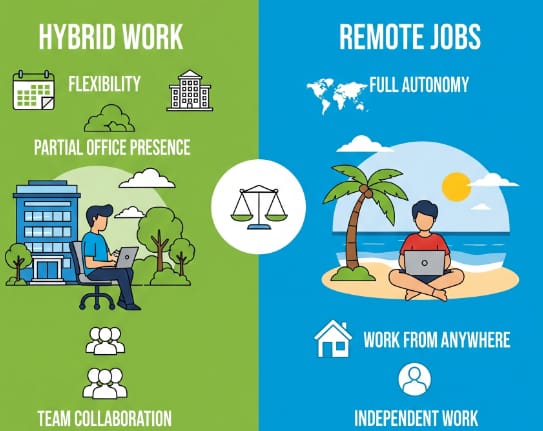
Hybrid Work vs Remote Jobs has become a central topic in today’s evolving work landscape. Remote jobs proved during the pandemic that employees could be productive from anywhere. Meanwhile, it combines the flexibility of remote arrangements with occasional office presence, offering the best of both worlds.
The debate around Hybrid Work vs Remote Jobs has intensified as companies adopt flexible work models. Remote jobs skyrocketed during the pandemic, proving that employees could deliver results from anywhere.
Employees and organizations are evaluating which model suits them best. Some value the autonomy of fully remote jobs, while others prefer hybrid work for occasional in-person collaboration. This article dives deep into Hybrid Work vs Remote Jobs, exploring benefits, challenges, and what the future holds for the modern workforce.
As companies evaluate productivity, collaboration, and employee satisfaction, understanding the differences between hybrid and remote work is crucial.
By adopting clear policies, leveraging technology, and embracing flexible work models, companies can maximize productivity and employee satisfaction.
For professionals and organizations alike, the work revolution is a reminder that the workplace is no longer bound by geography it’s defined by how effectively teams can collaborate, innovate, and adapt.
In this article, we explore Hybrid Work vs Remote Jobs, their benefits, challenges, and what the future may hold for the modern workforce.
You can read more blogs here.


Leave a Reply