

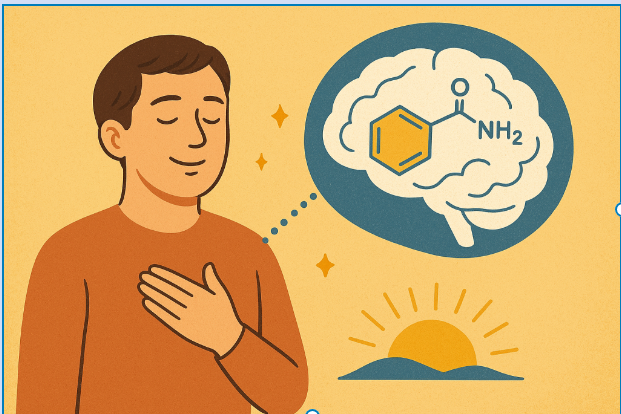
Here Are the Simple Daily Habits That Quietly Rewired My Brain Chemistry, Without Pills, Therapy, or Expensive Gadgets
Abstract: The author reflects on a transformative moment in a pharmacy break room in Oman, realizing that their dull feelings stemmed from a disconnect in brain chemistry, particularly linked to serotonin. They explore how daily habits can impact mood and overall well-being without relying on medication or therapy. The text emphasizes serotonin’s role as a key messenger in regulating various bodily functions, suggesting that small lifestyle changes can enhance mood and vitality. With a background as a pharmacist and researcher, the writer aims to share insights that inspire others to understand and improve their mental health through simple, personal adjustments.
My Serotonin Story
I still remember the moment. It was late afternoon, and I was sitting in the cramped break room of the pharmacy where I worked in Oman. The hum of the fluorescent lights, the murmur of my colleagues in the next room, and the smell of antiseptic and pill bottles all blurred into a kind of monotony.
I looked at the clock. The hours since dawn had stretched long. I felt flat, not sad exactly, just drained, more like a grey sky draped over me rather than the sharp emotional bottom of sadness. And then it hit me: I was bored, but more deeply than that. I didn’t feel alive.
In that bizarre in-between moment I realized: what if the reason I felt this way was not simply because I was tired, but because something in my brain chemistry was off?
And what if, somewhere between the racks of drugs and the counselling sessions with patients, I’d stumbled upon a small secret of mind and mood without fully realizing it?
Because you see, for years I had thought of mood as something intangible — a fog, a feeling, a vague “on/off”. But the more I read, the more I learned, the more I discovered that mood is grounded in biology.
And at the centre of that biology is a molecule that I now see as my accidental companion: Serotonin.
Today I want to tell you the story of how I hacked (in the sense of tinkered and discovered) my serotonin.
Not through a lab experiment, not through prescription pills (and I am not giving medical advice), but through small shifts, observations, and the quiet realisation that our chemicals, our biology, and our habits may be more connected than we think.
Because if you’re like me, a pharmacist, a scientist at heart, but also a human trying to find light in long days, this might matter.
The scientific insight, simplified
Let’s step back for a moment into the science, but I’ll keep it light. Imagine your brain as a sprawling city, full of streets, traffic lights, communication towers, couriers delivering packages. Now imagine that mood, focus, sleep, digestion, all kinds of functions in this city are managed by tiny messengers.
“One of the most important of these messengers is serotonin.”
Serotonin (also called 5-HT) is a chemical messenger that moves messages between nerve cells in your brain and also between your brain and body.
It plays a role in regulating mood, sleep, appetite, digestion, memory and even how your gut functions.
If I go back to the city, serotonin would be akin to a master courier company.
It picks up a parcel (a message) in Point A (say one neuron) and delivers it to Point B (another neuron or a receptor).
It also sets up new bridges by preparing other chemicals (like melatonin for sleep). If serotonin levels, transport or receptors are out of sync, messages may get delayed, lost, or mis-routed.
Here’s one simplified way to visualize it Read more…
Thank you for subscribing to my new newsletter on Substack, where I will be sharing my research and personal stories:
I’m a semantic scholar and researcher with over a decade of clinical experience, sharing real-world insights through the art of storytelling. My writing goal is to inform, educate, and inspire my readers.


Leave a Reply