

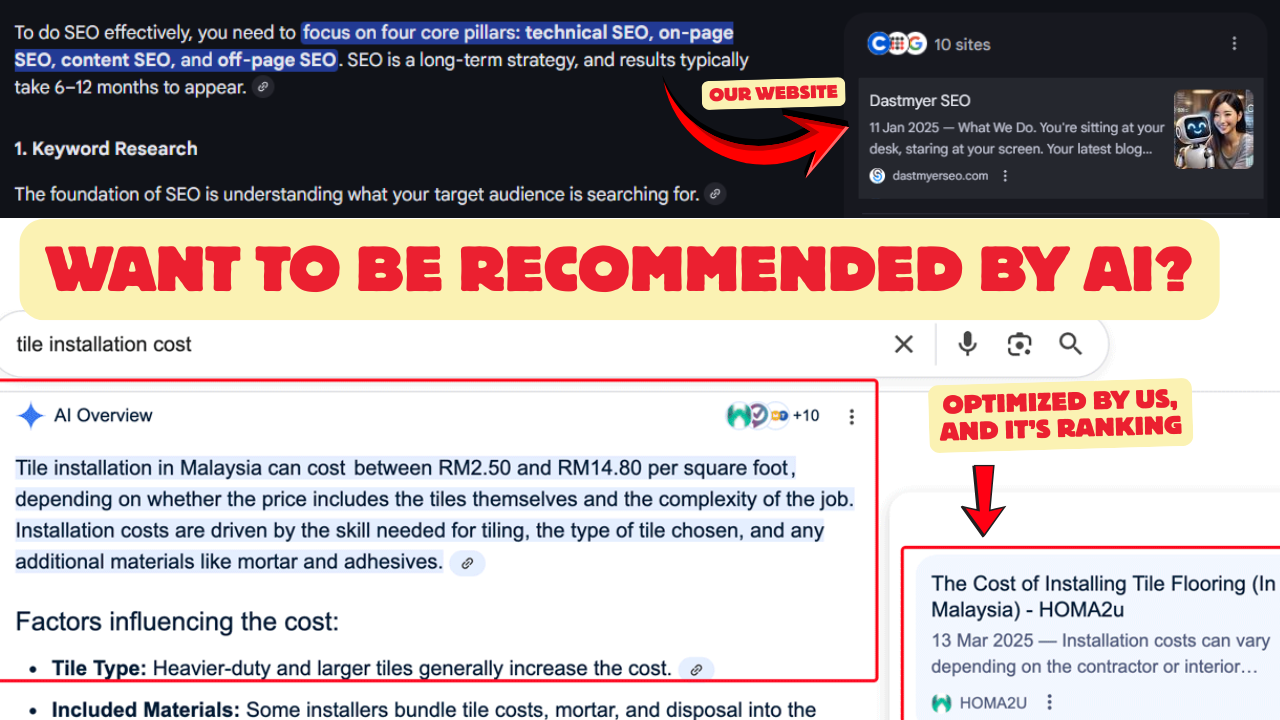
For a long time, online marketing was built around one idea: if you can get people’s attention, you win.
That thinking made sense when social platforms were the main place people discovered new brands, and when Google search results were the main way people researched services.
But the internet doesn’t work that way anymore.
More and more people now skip the whole browsing process and go straight to asking an AI tool for the answer they want.
Instead of scrolling through ten different blog posts, opening several tabs, comparing options, and reading long reviews, they simply ask ChatGPT, Gemini, Perplexity, Claude, or any other AI assistant, “What’s the best option for me?”
These tools respond instantly, often giving a short, direct list of recommended brands.

This is a big shift because whoever shows up in those recommendations is immediately seen as trustworthy.
People assume the AI has “done the research for them,” which means they rely less on traditional search results and more on whatever the AI mentions first.
Several reports have pointed out that AI tools are quietly becoming the first step in decision-making, replacing the long comparison stage people used to do on their own.
And when an AI tool confidently recommends a brand, users take that recommendation seriously.
This is why SEO is no longer about ranking on page one. It’s about being the brand that AI feels confident enough to mention.
This is often called Answer Engine Optimization (AEO), and it focuses less on tricking algorithms and more on building a reputation that an AI system can clearly recognize.
AI models don’t decide randomly which brands to recommend. They rely on signals from across the internet.
They look for clear, simple, helpful explanations on your website. They look for content that actually teaches something in a way normal people can understand.
They look for proof that your brand is real and that people trust you: things like interviews, mentions on other websites, consistent branding, clear expertise, and visible experience.

Backlinks also play a big role because they tell AI tools that other website owners trust you enough to link to your content.
A link is basically another website saying, “This source is reliable.” AI models treat backlinks as evidence.
And unlike paid ads or sponsored placements, backlinks can’t be faked easily.
Someone chooses to link to you because they actually think your content is helpful. AI uses that as a strong trust signal.
Another thing that matters is consistency. AI tools check whether your information is the same everywhere: your website, your social pages, your author profiles, and even other blogs that mention you.
If your brand looks stable and aligned, AI is more confident in recommending you. If your brand looks confusing or inconsistent, AI hesitates.
The interesting part is that this shift doesn’t only benefit big companies.
Because AI focuses on clarity, usefulness, and trust signals, smaller brands can appear in AI recommendations if they do a good job explaining things, building credibility, and earning natural backlinks.
In fact, many small websites are being recommended by AI tools because they answer questions more clearly than larger companies.
This is why brands today need to focus not just on getting attention, but on becoming recommendable.
AI tools are trained on the whole internet, and they look for the brands that contribute value, that answer real questions, and that consistently demonstrate knowledge.
If your brand does that well, you increase your chances of being mentioned when someone asks an AI for advice.
Now, on a practical note, there’s something I’m opening up for a short time.
I don’t usually do backlink collaborations because most of my time goes into client campaigns.
But occasionally, I come across website owners who genuinely care about building long-term authority instead of chasing shortcuts or quick tricks.
For those kinds of people, a mutual backlink exchange can be helpful.
Here’s how it works in simple terms: you get a do-follow link from my website (www.dastmyerseo.com), and in return, you link back to us from a relevant page on your site.

There’s no money involved, no complicated process, just a natural, honest exchange that benefits both sides by strengthening credibility.
Backlinks still matter, and they help AI understand which brands are trusted across the web.
I’m only accepting a few websites for this, and only if the content genuinely fits what we publish.
If you think your website is a good match, you can email it to lina@dastmyerseo.com.
Even though AI is changing how people look for answers, one thing hasn’t changed at all:
Authority still has to be earned.
And the internet still shows authority through backlinks, consistent information, clear explanations, and the trust that other humans give your brand.


Leave a Reply