

Why Winning the Morning Requires Conquering the Night
Curator’s Note: The article emphasizes that achieving a productive day begins the night before rather than at dawn. At 72, the author, Gary L. Fretwell, shares insights from his extensive career in higher education and identifies five habits he eliminated to enhance focus: avoiding late-night digital distractions, changing late-night eating habits, minimizing decision fatigue through evening planning, managing sleep environment temperature, and reducing blue light exposure before bed. Fretwell argues that these changes have led to sharper morning clarity, allowing him to engage more purposefully in his various roles. Ultimately, he asserts that evening routines significantly impact morning productivity.
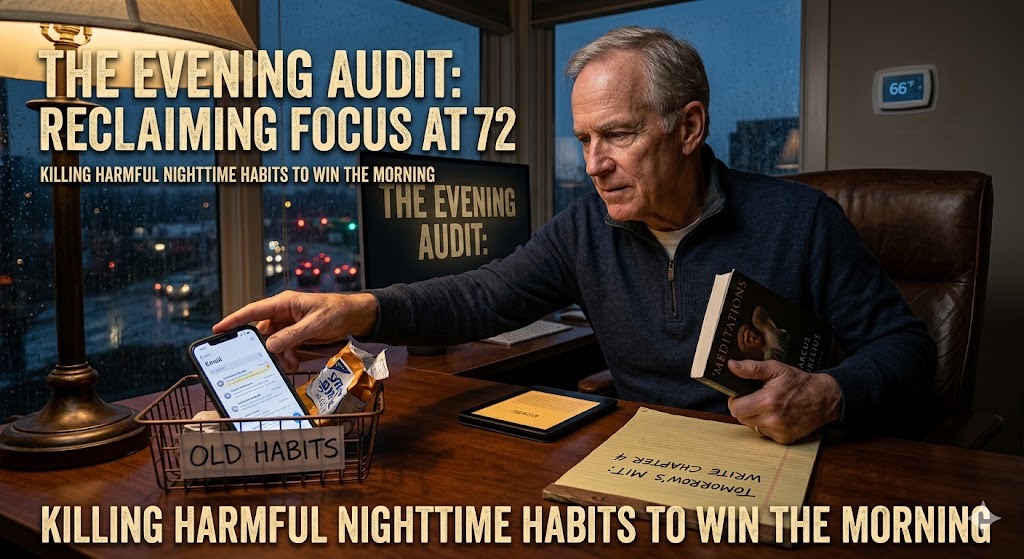
The battle for a productive day isn’t won at 6:00 AM—it’s won the night before. At 72, my focus is sharper than ever because I stopped letting these 5 ‘cognitive leaks’ drain my battery. Here is how I audited my evening to reclaim my morning. / Author created image using AI
The great irony of a long career in higher education is that we spend decades teaching others how to think, yet we often neglect the very environment that allows our own brains to function. After 43 years in the academic trenches, I’ve reached a startling conclusion: you do not win the battle for a sharp, focused day when the alarm sounds at 6:00 AM.
You win or lose that battle the night before.
At 72, I possess a sharper focus than I did in my forties. This clarity does not spring from a miracle supplement or a hidden fountain of youth. Instead, it results from a ruthless audit of my evening environment. I identified and eliminated the “cognitive leaks”—those seemingly harmless habits that drained my mental battery before the next day even began.
To protect the discipline I need for daily writing and leadership, I killed these five evening habits.
1. The “One Last Check” Loop
For years, I mistakenly believed that checking email or task lists before bed constituted “preparedness.” In reality, I invited “open loops” into my subconscious. When I viewed a request or a problem at 9:00 PM, I gave my brain a bone to chew on all night. This triggered cortisol and maintained a state of low-level “fight or flight.” Now, I close the digital world at least two hours before sleep. If a task does not appear in my manager by 7:00 PM, it does not exist until tomorrow.
2. The Blue Light Buffet
As I transitioned from yellow legal pads to the iPhone 16 Pro Max, I fell into the trap of late-night scrolling. We often underestimate how blue light impacts the aging brain. It suppresses melatonin and tricks the body into thinking it is mid-day. I replaced the screen habit with physical books or a Kindle set to the warmest light. This single change revolutionized my sleep quality.
3. The Late-Night Feast
Intermittent fasting serves as a cornerstone of my health, but I learned that the timing of the window matters as much as the duration. A heavy meal late in the evening forces the body to divert energy toward digestion rather than cellular repair and memory consolidation. By shifting my 17-20 hour fasting window to end earlier in the afternoon, I wake up feeling light and mentally agile rather than foggy and sluggish.
4. Decision Fatigue Foundations
The most productive version of myself makes zero decisions in the morning. I previously wasted precious morning willpower by asking, “What should I write today?” I killed the habit of “winging it.” Now, my evening includes a five-minute shutdown ritual. I identify the next day’s Most Important Task (MIT) and lay out my workout clothes. I move from sleep to action with zero friction.
5. Ignoring the “Internal Temperature”
In my younger years, I slept through anything. At 72, the margin for error has slimmed. I killed the habit of keeping a warm, “cozy” bedroom. Neuroscience confirms that a drop in core body temperature serves as a biological trigger for sleep. By lowering the thermostat and utilizing cold showers earlier in the day to regulate my system, I fall into deep, restorative sleep much faster.
The Result: A Sharper Second Act
Retirement should not represent a fading out; it should represent a refocusing. By killing these five habits, I protect my most valuable asset: my attention. Whether I am writing, leading a non-profit board, or mentoring MBA students, I show up with a level of presence that I lacked when my evenings remained chaotic.
The morning reflects the night. If you want to find your focus, stop looking at your alarm clock and start looking at what you do before you close your eyes.
Source Article: I’m 72, and My Focus is Sharper Than Ever: 5 Evening Habits I Had to Kill
About the Author
Gary L. Fretwell is the Editor of Illumination: Retirement, Aging and Legacy, a publication dedicated to helping high-performers navigate the transition from “Success to Significance.” Drawing on 43 years of leadership in higher education, Gary curates and crafts content that blends neuroscience with Stoic philosophy to architect intentional second acts.
As a #1 international bestselling author of The Magic of a Moment and soon-to-be-published Intentional Retirement, Gary doesn’t just write about purpose — he maps the neuroscience of it. His works serve as blueprints for cognitive clarity, blending Stoic philosophy with modern brain science to help a global audience decouple their identity from their titles and build a legacy that echoes. Whether serving as a Board President or mentoring the next generation of MBA thinkers, Gary’s mission is to help you step into the “Second Mile.”
Step into the Second Mile at garyfretwell.com.
For weekly deep dives into intentional living and cognitive clarity, subscribe to my Substack, The Wise Effort.
You can find my profile and follow my latest articles on Medium right here:
medium.com/@gary_fretwell


Leave a Reply