

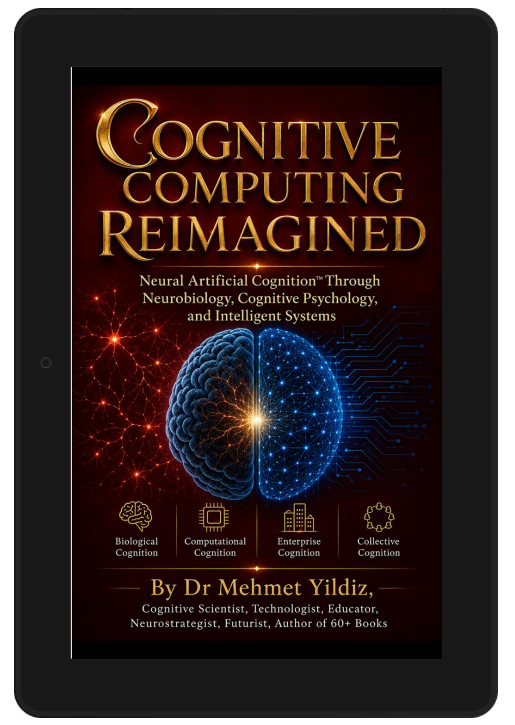
The Architectural Imperative for Bridging Biological Minds and Machine Systems in the Age of Artificial Intelligence by Dr Mehmet Yildiz – Review Essay
Curator’s Note: Dr. Mehmet Yildiz’s work, “Cognitive Computing Reimagined,” addresses the epistemological gap in artificial intelligence, where advancements in computational capability outpace understanding of cognition. This review essay by Dr Albert Jones introduces the Neural Artificial Cognition (NAC) meta-framework, advocating for a broader interdisciplinary approach that includes neurobiology and cognitive psychology. Dr Yildiz distinguishes between intelligence and cognition, emphasizing that advanced AI may not replicate the complex, interactive processes of human cognition. Instead of striving for human imitation, he posits that artificial systems should complement human abilities. This architecture prompts further inquiry into the necessary components for genuine cognitive processes in machines and encourages ethical considerations in human-AI collaboration.
Abstract
In the contemporary landscape of artificial intelligence, an important epistemological challenge has emerged: computational capability has advanced faster than consensus around the concepts used to describe it. Modern computational systems demonstrate remarkable proficiency in statistical pattern processing, linguistic generation, prediction, and task performance. Yet substantial scientific and philosophical debate remains over the extent to which such performance constitutes semantic understanding, grounded cognition, metacognition, or functional approximation of these capacities.
In Cognitive Computing Reimagined: Neural Artificial Cognition™ Through Neurobiology, Cognitive Psychology, and Intelligent Systems, Dr Mehmet Yildiz offers an interdisciplinary response to this conceptual problem. Through the Neural Artificial Cognition (NAC)™ meta-framework, informed in part by his Noēsis™ 6D Human Cognitive Architecture, Yildiz challenges the assumption that greater computational scale necessarily corresponds to richer cognition. His framework instead treats cognition as a multidimensional architectural phenomenon involving interacting biological, psychological, computational, contextual, and systemic processes.
This appraisal examines the theoretical contribution of NAC, its relationship to contemporary cognitive science and artificial intelligence, its potential implications for human-AI systems, and the scientific questions that remain as the framework progresses from conceptual synthesis toward operationalization and empirical investigation.
Introduction: The Epistemological Rift in Artificial Intelligence
The trajectory of modern artificial intelligence reveals an intriguing asymmetry. Our capacity to engineer increasingly capable computational systems has advanced rapidly, while fundamental questions concerning intelligence, cognition, understanding, consciousness, and agency remain unresolved across neuroscience, cognitive psychology, computer science, and philosophy of mind.
Large Language Models (LLMs) and emerging agentic systems can generate sophisticated human-like outputs, solve problems, summarize knowledge, produce software, and participate in extended dialogue. Such achievements are significant. At the same time, observable performance alone does not establish that the processes underlying these outputs are equivalent to biological cognition. Questions concerning semantic grounding, embodiment, persistent internal models, metacognitive awareness, adaptive contextualization, and subjective experience remain open to scientific and philosophical inquiry.
In Cognitive Computing Reimagined, Dr Mehmet Yildiz addresses this conceptual vulnerability by repositioning cognitive computing within a broader interdisciplinary context. Rather than treating cognitive computing primarily as another technical branch of artificial intelligence, he proposes an open meta-framework for examining intelligent and cognitive behavior across biological, computational, organizational, and hybrid human-machine systems.
The significance of this approach lies less in proposing another algorithm than in asking a more fundamental architectural question: What capacities, interactions, and organizing principles would an artificial system require before we could meaningfully describe it as cognitive rather than merely computationally capable?
The Foundational Distinction: Intelligence and Cognition
A central proposition in Yildiz’s framework is that intelligence and cognition should not be treated as synonymous.
Intelligence may be operationalized through task performance, problem solving, prediction, adaptation, pattern recognition, or other measurable capabilities. Cognition, by comparison, can be understood as the broader architecture of interacting processes through which information is perceived, selected, represented, remembered, integrated, evaluated, contextualized, and used to guide adaptive behavior.
Within this broader architecture are capacities such as:
- perception and selective attention;
- memory formation, consolidation, and retrieval;
- learning and adaptive updating;
- knowledge representation;
- reasoning and decision-making;
- contextual and temporal processing;
- metacognition and self-monitoring;
- affective and motivational regulation;
- predictive processing;
- task switching and executive control; and
- interaction with bodily, social, and environmental states.
From this perspective, contemporary AI systems may demonstrate remarkable forms of computational intelligence without reproducing the integrated cognitive architecture characteristic of biological organisms.
Failures outside training distributions illustrate one aspect of this distinction. Such failures may reflect limitations in generalization, causal modeling, contextual adaptation, persistent world models, metacognitive monitoring, or other capacities that biological cognition coordinates through interacting neural, bodily, developmental, and environmental processes.
Yildiz therefore encourages readers to evaluate advanced AI beyond performance benchmarks alone. The important question becomes not simply what a system can produce, but what architecture of processes enables it to perceive, represent, integrate, evaluate, learn, adapt, and act across changing contexts.
The Architectural Proposal: Neural Artificial Cognition (NAC)
To investigate this conceptual divide, Yildiz introduces Neural Artificial Cognition (NAC)™ as an interdisciplinary meta-framework rather than a single computational model.
NAC draws intellectual connections among neurobiology, cognitive psychology, artificial intelligence, computer science, systems thinking, and enterprise architecture. This interdisciplinary orientation reflects an important feature of biological cognition: cognition does not occur as an isolated information-processing event.
Human cognitive activity emerges through interactions among neural systems, bodily states, sensory signals, memory, emotion, attention, environmental conditions, previous experience, social relationships, and changing goals. From this perspective, cognition is simultaneously neural, embodied, temporal, contextual, adaptive, and relational.
This systems orientation distinguishes NAC from approaches that equate advances in artificial intelligence primarily with increases in model size, training data, processing power, or benchmark performance. Yildiz does not deny the importance of these advances. Instead, he questions whether computational scaling alone can reproduce the interactive capacities associated with richer forms of cognition.
Importantly, NAC extends beyond comparisons between the biological brain and machine learning. Across the book, Yildiz examines cognition as an interacting system of perception, attention, memory, learning, reasoning, metacognition, affective regulation, temporal awareness, adaptive action, and contextual integration.
He further extends this analysis beyond individual cognition toward agentic systems, enterprise and collective cognition, and human-machine collaboration. This broader systems perspective positions artificial cognition as an architectural research problem involving multiple interacting capacities rather than a single measure of computational intelligence.
Noēsis™ 6D Human Cognitive Architecture
One of the developmental reference models informing this discussion is Yildiz’s Noēsis™ 6D Human Cognitive Architecture.
Rather than representing cognition as a flat sequence from input to output, Noēsis™ describes human cognition through six interacting dimensions:
- Physiological Grounding: The biological and sensory foundations supporting cognitive activity.
- Identity and Emotion: Affective, motivational, and self-referential processes influencing perception, interpretation, and behavior.
- Metacognitive Emergence: The development of internal models, self-monitoring, reflection, and awareness of cognitive processes.
- Temporal Contextualization: The integration of past experience, present state, and anticipated future consequences into cognitive processing.
- Integrative Synthesis: The capacity to connect information across domains, perspectives, experiences, and levels of abstraction.
- Intuitive Coherence: Rapid integrative judgments emerging from previously established knowledge, experience, pattern recognition, and interacting cognitive processes.
The relevance of Noēsis™ to artificial cognition does not depend on assuming that machines must literally reproduce human cognitive development. Such an assumption would risk unnecessary anthropomorphism.
Instead, the architecture provides a comparative lens for asking which functional equivalents, if any, artificial cognitive systems might require. For example, could an advanced artificial system develop persistent contextual models, monitor its own reasoning, integrate temporal information, distinguish uncertainty from confidence, modify behavior through experience, and coordinate multiple cognitive processes across changing environments?
Through this 6D lens, Yildiz argues that scaling computational models alone is unlikely to reproduce the multidimensional organization associated with human cognition. The framework therefore redirects attention from computational quantity toward architectural organization and integration.
From Biological Cognition to Human-AI Cognitive Ecosystems
Another notable contribution of NAC is its movement beyond the isolated-machine paradigm.
Much contemporary discourse asks whether machines will eventually equal or exceed human intelligence. NAC invites a different question: How might biological and artificial cognitive capacities interact within larger cognitive ecosystems?
This perspective is particularly relevant to agentic AI, enterprise systems, collective intelligence, decision support, healthcare, scientific discovery, education, and other environments in which humans and computational agents increasingly participate in shared cognitive tasks.
Within such systems, the objective need not be biological imitation. Artificial systems may contribute computational capacities that complement rather than replicate human cognition. Humans bring embodied experience, social understanding, biological motivation, contextual judgment, values, and forms of meaning grounded in lived experience. Machines contribute computational scale, rapid retrieval, pattern detection, simulation, persistent processing, and access to large information spaces.
NAC therefore offers a framework for studying the architecture of cognitive symbiosis: systems in which biological and artificial capacities interact while their important differences remain visible.
This distinction also has ethical significance. Systems designed to support human cognition require mechanisms for transparency, accountability, uncertainty management, trust calibration, human oversight, and responsible agency. Cognitive architecture consequently becomes inseparable from questions of governance and ethics.
Critical Appraisal: Contributions, Constraints, and Open Questions
A notable strength of Yildiz’s framework is its interdisciplinary synthesis. By examining cognition through neurobiology, cognitive psychology, computer science, artificial intelligence, systems thinking, and enterprise architecture, NAC challenges disciplinary boundaries that can fragment discussion of complex cognitive phenomena.
This architectural orientation is particularly valuable at a time when public and technical discourse can equate improvements in AI performance with progress toward human-like cognition. NAC provides conceptual vocabulary for separating these questions.
Nevertheless, several scientific challenges remain. The first concerns operationalization. NAC is intentionally broad as a meta-framework. Its future scientific influence will therefore depend partly on translating its constructs into measurable variables, architectural requirements, comparative models, and falsifiable hypotheses.
Future investigation might ask which cognitive capacities are necessary or sufficient for particular forms of artificial cognition; how interactions among attention, memory, metacognition, temporal processing, learning, and adaptive behavior should be measured; and where biologically inspired designs provide demonstrable advantages over conventional computational approaches.
A second challenge concerns implementation. Current computing systems differ substantially from biological nervous systems in organization, energy use, plasticity, memory integration, signaling, and adaptation. This raises an important engineering question: how far can conventional computing architectures support increasingly state-dependent, adaptive, temporally integrated cognitive systems?
Neuromorphic computing, spiking neural architectures, memory-centric computation, and other emerging hardware paradigms may offer useful experimental avenues, particularly when energy efficiency, plasticity, asynchronous processing, and biologically inspired dynamics are important.
These technologies, however, should be regarded as research directions rather than prerequisites for artificial cognition. There is currently insufficient evidence to conclude that a particular hardware paradigm is necessary for cognition, and computational architecture should not be conflated with the unresolved biological and philosophical questions surrounding cognitive experience.
Similarly, quantum computing may contribute to particular computational problems, but there is presently no established basis for assuming that quantum processing inherently reproduces biological cognition or provides a necessary foundation for artificial cognitive systems.
These limitations do not diminish the value of NAC. Rather, they identify the next stage of inquiry: moving from interdisciplinary conceptual synthesis toward formal models, measurable predictions, experimental implementations, and comparative evaluation.
Positioning NAC Within the Wider Scholarly Landscape
NAC enters a scholarly landscape already enriched by several traditions that have challenged purely computational or disembodied accounts of cognition. Work on embodied and enactive cognition has emphasized the contribution of bodily states and environmental interaction to cognitive processes (Varela, Thompson, & Rosch, 1991; Wilson, 2002), while extended-mind perspectives have questioned the assumption that cognition must remain bounded by the biological brain (Clark & Chalmers, 1998). Predictive-processing and free-energy approaches have further examined cognition through hierarchical prediction, prediction error, action, learning, and adaptive regulation (Friston, 2010; Clark, 2013).
These traditions provide useful intellectual context for Yildiz’s proposal, but NAC should not be treated simply as another formulation of any one of them. Its distinctive ambition is architectural and integrative: to bring biological cognition, cognitive psychology, artificial systems, metacognition, temporal processing, agentic behavior, collective and enterprise cognition, and human-machine interaction into a common meta-framework. This orientation also places NAC alongside contemporary debates about the achievements and limitations of computational scaling.
Empirical scaling research has demonstrated substantial performance gains from increases in model size, data, and compute (Kaplan et al., 2020), while other scholars have cautioned against interpreting increasingly fluent linguistic performance as sufficient evidence of understanding or cognition (Bender et al., 2021). NAC contributes to this wider discussion by asking what additional architectural capacities and forms of integration might be required before increasingly capable artificial systems can meaningfully be investigated as cognitive systems.
Conclusions: Designing for Cognitive Symbiosis
Dr Mehmet Yildiz’s Cognitive Computing Reimagined offers a distinctive interdisciplinary perspective on one of the most consequential questions emerging from contemporary artificial intelligence: What do we actually mean when we describe a machine as intelligent or cognitive?
The book persuasively argues that observable performance should not be automatically equated with the multidimensional processes underlying biological cognition. Through the Neural Artificial Cognition framework, Yildiz redirects attention toward architecture, integration, adaptation, context, metacognition, embodiment, temporal processing, and interactions among biological and artificial systems.
The significance of NAC may therefore lie less in claiming that artificial cognition has already been achieved than in providing an architectural vocabulary through which the question can be investigated more systematically.
Its next scholarly challenge is empirical. Concepts proposed within the framework will gain scientific strength as they become operationalized, tested, challenged, revised, and compared with competing cognitive architectures and emerging AI systems.
For cognitive scientists, neuroscientists, AI researchers, enterprise architects, technologists, and digital ethicists, the book provides a conceptual framework for reconsidering the relationship between computation and cognition.
Perhaps its most consequential proposition is also its most restrained: the future of cognitive computing may depend less on making machines imitate human beings and more on understanding the different cognitive capabilities of humans and machines well enough to design responsible systems in which they can work together.
In that sense, the study of artificial cognition may ultimately teach us as much about the architecture of the human mind as it does about the future of intelligent machines.
References
Bender, E. M., Gebru, T., McMillan-Major, A., & Shmitchell, S. (2021). On the dangers of stochastic parrots: Can language models be too big? Proceedings of the 2021 ACM Conference on Fairness, Accountability, and Transparency, 610–623. https://doi.org/10.1145/3442188.3445922
Clark, A. (2013). Whatever next? Predictive brains, situated agents, and the future of cognitive science. Behavioral and Brain Sciences, 36(3), 181–204. https://doi.org/10.1017/S0140525X12000477
Clark, A., & Chalmers, D. J. (1998). The extended mind. Analysis, 58(1), 7–19. https://doi.org/10.1093/analys/58.1.7
Friston, K. (2010). The free-energy principle: A unified brain theory? Nature Reviews Neuroscience, 11, 127–138. https://doi.org/10.1038/nrn2787
Kaplan, J., McCandlish, S., Henighan, T., Brown, T. B., Chess, B., Child, R., Gray, S., Radford, A., Wu, J., & Amodei, D. (2020). Scaling laws for neural language models. arXiv. https://doi.org/10.48550/arXiv.2001.08361
Varela, F. J., Thompson, E., & Rosch, E. (1991). The embodied mind: Cognitive science and human experience. MIT Press.
Wilson, M. (2002). Six views of embodied cognition. Psychonomic Bulletin & Review, 9(4), 625–636. https://doi.org/10.3758/BF03196322
Yildiz, M. (2026). Cognitive computing reimagined: Neural Artificial Cognition™ through neurobiology, cognitive psychology, and intelligent systems. DigitalMehmet Publications. Google Books
Yildiz, M. (2026). Computación Cognitiva Reimaginada: La Cognición Artificial Neural¿ a través de la Neurobiología, la Psicología Cognitiva y los Sistemas Inteligentes DigitalMehmet Publications. Google Books
Yildiz, M. (2026). The Noēsis™ 6D Human Cognitive Architecture. ILLUMINATION / DigitalMehmet.
This review paper was submitted to JETN – Journal of Emerging Technologies in Neuroscience


Leave a Reply