

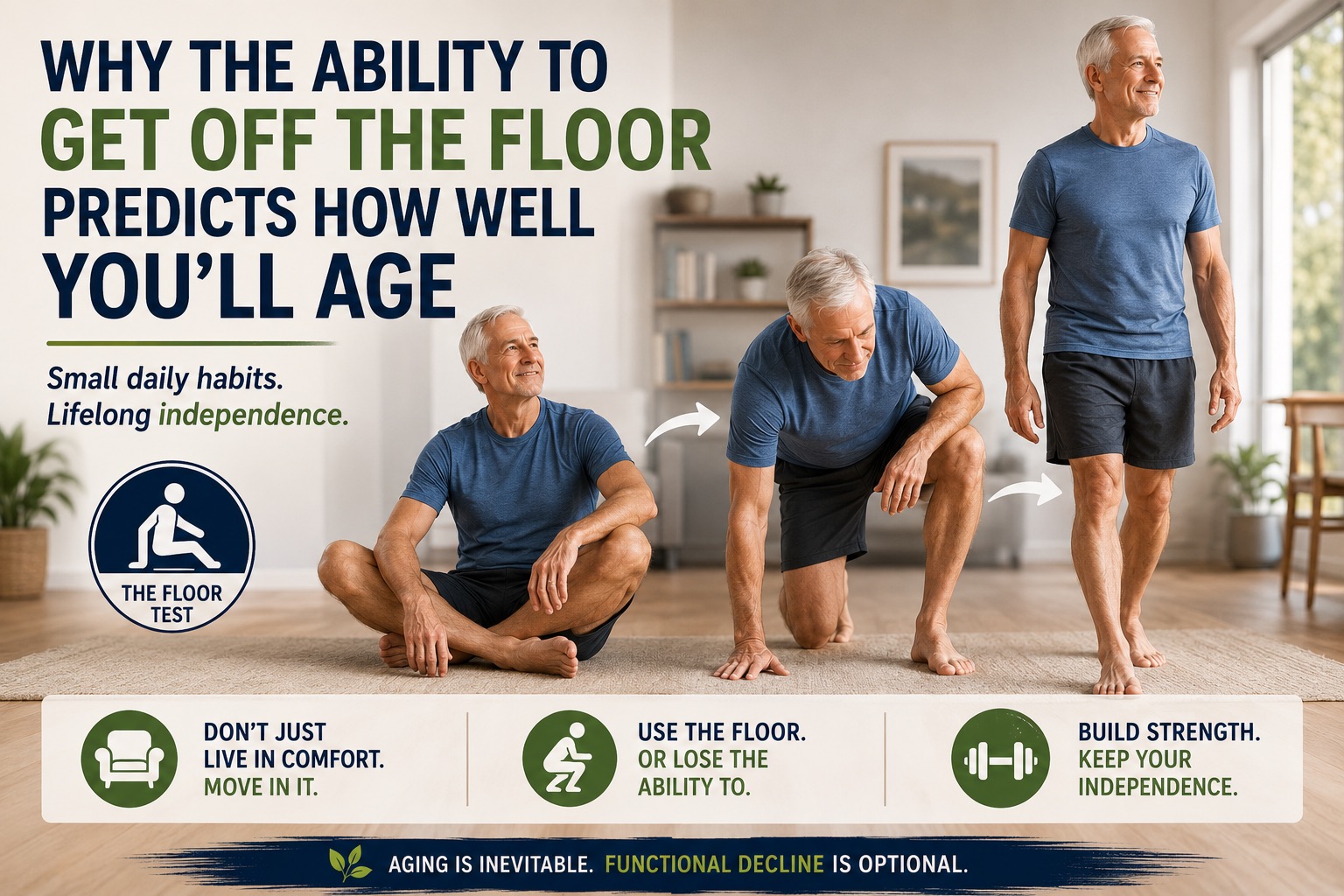
Why your ability to sit down and stand up without your hands is the ultimate predictor of functional independence.
Curator’s Note: The Sitting-Rising Test (SRT) is a significant indicator of functional independence, particularly as individuals age. Developed by Dr. Claudio Gil Araújo, this test assesses one’s ability to sit down and stand up without using hands or support, reflecting strength, balance, and coordination. Findings indicate that older adults with lower SRT scores face higher mortality risks. The article highlights three detrimental habits that reduce physical autonomy: reliance on ergonomic furniture, avoidance of the ground, and prioritizing passive cardio over functional strength. Encouraging floor interaction and targeted strength training can preserve mobility and enhance independence in older age. Getting off the floor is more than a mobility test. It’s a powerful measure of the strength, balance, and coordination that help preserve independence as we age./ Author created image.
Try a quick physical experiment right where you are. Stand with your feet crossed, lower yourself all the way down to a cross-legged seat on the floor, and then stand right back up.
Did you drop smoothly, or did you wobble? Did you need to push a hand against your knee, lean against the coffee table, or catch yourself with a palm on the carpet?
In preventive medicine and exercise physiology, this simple movement pattern is known as the Sitting-Rising Test (SRT). Originally studied by Brazilian physician Dr. Claudio Gil Araújo, the SRT scores participants on a scale of 0 to 10 based on how effortlessly they lower to the ground and rise again. Every time a hand, knee, forearm, or the side of a leg touches down for leverage, a point is deducted; half a point is docked for any noticeable loss of balance.
The study’s findings were profound: older adults with the lowest scores faced a significantly higher risk of all-cause mortality over a multi-year follow-up compared to those with high scores.
The test isn’t an arbitrary party trick. It acts as an aggregate measure of your physical health. To pass cleanly, you need a precise combination of lower-body muscular power, dynamic balance, core stability, and full range-of-motion flexibility in the hips, knees, and ankles.
Passing this test at 72 isn’t a matter of winning the genetic lottery. It is the direct consequence of eliminating three subtle, socially accepted habits that silently erode your physical autonomy.
Habit 1: The Modern Chair Trap (Living in 90-Degree Angles)
The built environment is designed to eliminate physical strain. We move from supportive car seats to ergonomic office chairs to plush living room recliners. Countertops and appliances sit at waist height so we rarely have to crouch or reach.
While comfortable, this lifestyle traps the human body in constant 90-degree angles. Over time, prolonged passive sitting causes the hip flexors to chronically shorten, turns off the gluteal muscles, and robs the lumbar spine and ankles of their natural flexibility. When you never ask your joints to move through their full ranges of motion, your body simply abandons the capacity to do so.
The Fix: Reintroduce Floor Living
You don’t need to throw out your furniture, but you should vary your postural diet. Spend 15 to 20 minutes each evening sitting directly on a rug or mat while reading, watching television, or unwinding. Alternate between sitting cross-legged, adopting a wide-straddle seat, resting in a 90/90 hip stretch, or holding a deep resting squat. This gentle, passive tension keeps connective tissues supple and hip capsules open without requiring dedicated workout time.
Habit 2: Complete Avoidance of the Ground
As people cross into their 50s and 60s, getting down to floor level shifts from a normal human movement into an event avoided at all costs. Many worry about looking awkward or fear they won’t be able to get back up.
The central nervous system operates on a ruthless “use it or lose it” principle. When you stop interacting with the ground, the neuromuscular pathways that coordinate weight shifts, unilateral leg drive, and ground-transfer mechanics begin to degrade. When a fall or trip eventually happens, the body lacks the reflex and baseline strength needed to recover safely.
The Fix: The Daily Ground Transfer Drill
Make touching the floor an intentional, non-negotiable daily habit. At least once a day, lower yourself entirely to the ground and find a way back to standing. Pay attention to how many points of contact you use today, and gradually work toward using one less hand or knee over the coming months. Consistently practicing the transition retrains the brain and rebuilds functional confidence.
Habit 3: Prioritizing Passive Cardio Over Functional Strength
Walking 10,000 steps a day is fantastic for cardiovascular health, blood pressure, and mental clarity. However, steady-state linear cardio does very little to counteract sarcopenia—the natural loss of skeletal muscle mass and fast-twitch power that accelerates with age.
Getting off the floor requires single-leg force production, rotational strength, and anti-rotational core stability. Walking in a straight line on flat pavement never challenges these specific vectors of movement.
The Fix: Train Functional Strength and Power
Anchor your routine with movements that mirror real-life demands:
- Reverse lunges and step-ups to build unilateral leg power.
- Goblet squats to maintain ankle and hip dorsiflexion under load.
- Farmer’s carries and planks to build structural core rigidity and grip strength.
Strength acts as an armor for your joints, turning floor transitions from a strained struggle into a smooth, controlled motion.
Chronological aging is guaranteed, but physical frailty is largely negotiable. By ditching passive comfort, embracing the ground beneath you, and building functional strength, you preserve the mobility needed for true lifelong independence.
Read the original piece on Medium:
About the Author:
Gary L. Fretwell is a #1 international best-selling author blending neuroscience with Stoic philosophy to help people build a life of lasting significance. He’s the author of eight books on intentional living and retirement, including the #1 bestseller The Magic of a Moment and Intentional Retirement.
On Medium, Gary founded and edits Illumination: Retirement, Aging & Legacy.
📖 garyfretwell.com · 📬 The Wise Effort on Substack · ✍️ Follow on Medium


Leave a Reply