

The most significant advantage of TAVI is that it is a less traumatic option and helps to fast-track the recovery in comparison to the contemporary, more invasive approaches, such as open-heart surgery.
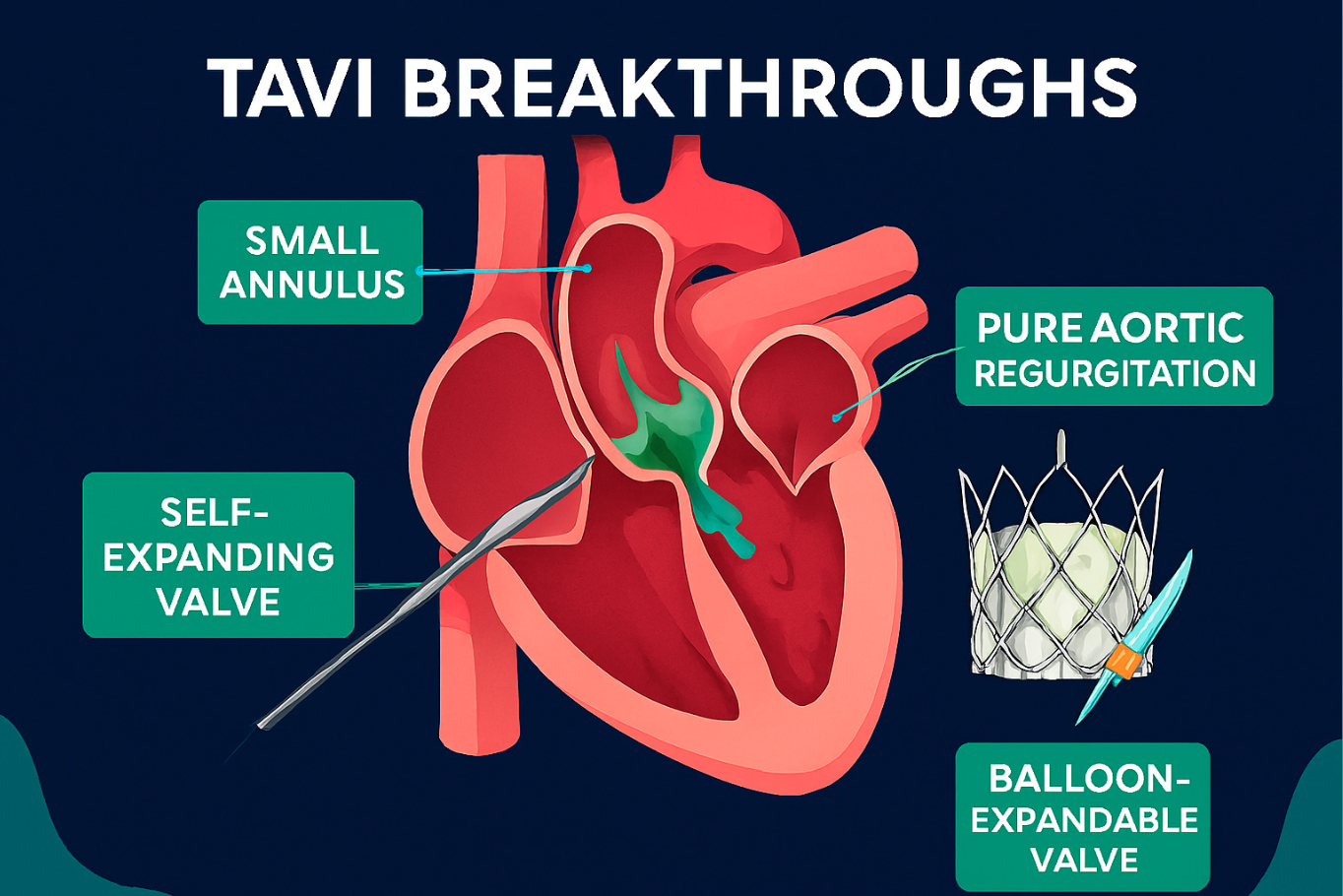
Transcatheter aortic valve implantation (TAVI) has been a significant transformation in the practical management of defective heart valves. TAVI is a minimally invasive intervention that suits all those with a small annulus or pure aortic regurgitation, particularly when such patients cannot opt for standard open-heart surgery due to other health complications. Mostly older women with symptoms of breathlessness or fatigue, or sometimes with severe symptoms, are not recommended to opt for extensive cardiac surgeries, and this is a tough moment for the caretakers when they start looking for other alternative options.
When we discuss heart valve disease, we now know that TAVI, a catheter-based procedure, has the potential to replace a defective valve with a prosthetic valve while bypassing the need for open-heart surgery. This procedure is often carried out through the femoral artery. With the advent of AI-guided approaches, it’s now possible to monitor, assess, and study aortic regurgitation and associated backward blood leakage with highly refined medical images. With the new machine learning approaches, it’s now possible to examine the small annulus or the narrowed opening, which further complicates the heart’s function.
The most significant advantage of TAVI is that it is a less traumatic option and helps to fast-track the recovery in comparison to the contemporary, more invasive approaches, such as open-heart surgery. The biggest challenge in such surgeries is to achieve reliable anchoring with the most appropriate prosthetic valve. The challenge is greater when the process cannot be standardized, as heart anatomies vary substantially between individuals. And the docking of the prosthetic valve across the small annulus requires targeted strategies with high precision.
Clinical studies have demonstrated the most significant occurrences of heart valve defects in Asian women and a high need for procedural planning and device individualization. Findings from the groundbreaking SMART study indicated that the use of self-expanding valves in TAVI not only minimized valve dysfunction but also improved hemodynamic performance. These outcomes were more pronounced in supra-annular positioning. They were found to be superior to those of balloon-expandable valves. But this is half a story. Scientific evidence also highlights that better position control during TAVI can be achieved with balloon-expandable valves. Studies also indicate that the implantation of balloon-expandable valves reduces the risk of pacemaker implantation.
A study known as SAPIEN 3 Ultra RESILIA revealed that TAVI has the potential to enhance sealing and reduce the occurrence of valvular leakage. Real-world analyses have called the insufficient effective orifice area of the prosthetic valve a significant challenge, leading to prosthesis-patient mismatch (PPM). The problem intensifies when severe PPM increases the risk of death by worsening the functional outcomes. The results from the TAVI-SMALL 2 study revealed that this challenge is more pronounced with balloon-expandable valves and independently predicts a significant reduction in survival rates. This is an eye-opener for interventional cardiologists, indicating that they must carefully select the device and examine the sizing to improve patient outcomes.
Evidence further reveals comparable 5-year durability of TAVI equipment and standard surgical approaches. Better hemodynamic outcomes are obtained with the use of the latest valves. Moreover, high technical success and improved safety have been reported with specialized equipment, such as the J-Valve and JenaValve Trilogy. The success story of TAVI doesn’t end here; the ALIGN-AR study has reported reduced clinical complications, 96% success rates, and 90% survival rates.
For patients with varied anatomy and those with a high risk of procedural complications, risk mitigation and valve sizing are now possible with the use of virtual reality simulations and CT-based risk assessment techniques. The high success rates with person-centred care are no longer a distant dream. The heart care processes are undergoing a revolution with multidisciplinary teamwork and machine learning approaches.
The best practice approaches rely on improving technical expertise, evidence-based risk stratification, care planning, and the deployment of dedicated healthcare teams to enhance the meaningful use of TAVI in high-volume clinical settings. To scale up and improve personalized heart health management, TAVI is undoubtedly an emerging scientific advancement.
You can visit the following free link to read the complete story: https://khalidrahman.substack.com/p/a-revolution-in-heart-health-management
This insightful podcast further simplifies the intricacies of the TAVI breakthrough: https://youtu.be/yNL6-ANOB-Q?si=3rBrPnenoENdS3X3
Best Regards,
Dr. Khalid Rahman
My Contact Details:
Email: doctorkhalid2011@gmail.com
Substack: khalidrahman.substack.com
Medium: medium.com/@doctorkhalid2011
LinkedIn: linkedin.com/in/dr-khalid-rahman-13a85895
HubPages: hubpages.com/@doctorkhalid
YouTube: youtube.com/@biotuberonline
Facebook: facebook.com/profile.php?id=100070454620199, facebook.com/khalid.rahman.18
The Digitalmehmet Content Ecosystem: digitalmehmet.com/meet-dr-khalid-Rahman
Blogger: https://sciencebackedevidencehealthwellness.blogspot.com/


Leave a Reply