

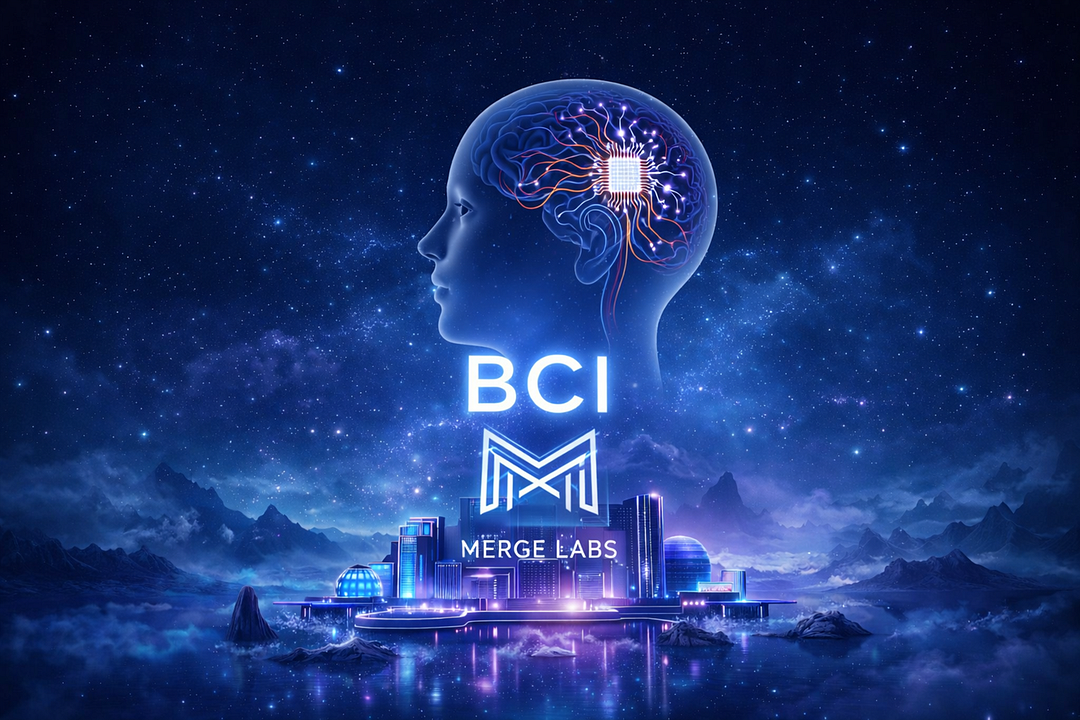
Cornerstone Analysis of Brain–Computer Interfaces for Technology Horizons 2050 and Beyond
Curator’s Note: This article examines the implications of OpenAI’s investment in Merge Labs, a brain-computer interface research lab, as a pivotal development in intelligence research. It traces the evolution of brain-computer interfaces over decades and highlights the convergence of neuroscience and artificial intelligence, emphasizing the significance of understanding cognitive processes at their biological source. Rather than relying on hardware, the focus shifts to the interpretation of neural signals. Merge Labs aims for non-invasive, adaptable methods to interact with neural systems, underscoring the importance of trust and ethical considerations. The future of brain-computer interfaces could redefine cognitive engagement, enhancing understanding without compromising individuality. This article was written by Dr Mehmet Yildiz, a technologist and cognitive scientist. We curated it for the readers of Digitalmehmet Content Ecosystem as a complementary reference source.
Purpose of This Article
I wrote this article to place a recent development in artificial intelligence and neuroscience into its proper long-term context: OpenAI’s investment in Merge Labs, a brain–computer interface research lab co-founded by Sam Altman. While the announcement attracted attention as a technology and business story, its deeper significance lies in what it reveals about the future direction of intelligence research itself.
Rather than reacting to headlines or speculating about near-term products, this article examines how brain–computer interfaces have evolved over decades, how artificial intelligence has matured to a point where it can engage with biological cognition, and why this convergence matters for human agency, cognitive health, and ethics. The focus is not on predictions, but on interpretation.
This piece is written as a long-form reference for readers interested in the future of brain–computer interfaces, human–AI interaction, and responsible technology development. It aims to support thoughtful inquiry across multiple time horizons, offering perspective through 2030, 2040, and 2050 for researchers, technologists, policymakers, and curious readers seeking clarity rather than speculation.
I have been researching brain–computer interfaces at the conceptual level since the early 1980s, as part of my informatics, computational linguistics, and cognitive science studies. I am the author of Technology Horizons 2050 and Beyond Cover Page. You can read the relevant story titled A Signal From the Future: When Artificial Intelligence Meets the Human Brain and Mind on Technology Hits publication on Medium.com.
When Intelligence Turns Inward
In early 2026, a measured announcement marked a turning point in the long history of human–machine interaction. OpenAI confirmed its investment in Merge Labs and announced plans to collaborate on scientific models to interpret neural activity in the human brain.
At first glance, this appeared to be another strategic investment in frontier technology. Yet viewed in context, it represented something more fundamental. For the first time, a leading artificial intelligence research organization openly aligned its future with the biological origins of intelligence itself, rather than limiting its focus to language, behavior, or external outputs.
This moment did not arrive suddenly. It was the result of converging trajectories: over a century of neuroscience, more than five decades of brain–computer interface research, and the recent maturation of large-scale artificial intelligence systems.
What made the announcement distinctive was not the capital involved or the individuals behind it. It was the direction it signaled. Artificial intelligence research is beginning to engage intelligence at its neurobiological source rather than merely modeling its surface expressions.
How Intelligence Learned to Look Inward
Brain–computer interface research is often portrayed as a modern phenomenon. In reality, its roots stretch back nearly a century.
In the 1920s, the first human electroencephalogram recordings demonstrated that mental activity leaves measurable physical traces. This single insight reshaped neuroscience. Thought was no longer purely abstract. It had signals.
Over the decades that followed, those signals became data. Data became interfaces. Interfaces became communication channels between neural systems and machines.
By the late twentieth century, researchers demonstrated that individuals could move cursors, control robotic devices, and interact with physical systems using only brain signals. What once belonged to speculative fiction became reproducible science.
In the early 2000s, brain–computer interfaces matured into assistive technologies. They enabled communication and mobility for people with paralysis, stroke, spinal cord injury, and neurodegenerative disease. At the same time, they began to function as scientific instruments for studying attention, learning, and neural plasticity.
A crucial lesson often gets lost in this history. Brain–computer interfaces were never primarily about control. They were about interpretation. Every major advance depended less on hardware and more on the ability to extract meaning from noisy, dynamic, deeply personal neural signals.
That challenge remains central today.
What Is Merge Labs and Why Its Mission Matters
Merge Labs is a research-driven brain–computer interface lab founded to explore safer, more scalable ways of connecting neural activity with computation. Rather than positioning itself as a consumer technology company, it presents itself as a scientific organization operating at the intersection of neuroscience, biology, physics, and artificial intelligence.
Sam Altman co-founded Merge Labs in a personal capacity alongside other scientists and operators. He is one of the founders and an equity holder, yet Merge Labs operates as an independent company with its own leadership, governance, research agenda, and investors. It is neither a subsidiary of OpenAI nor an entity owned or controlled by a single individual.
The lab’s mission addresses one of the most persistent challenges in brain–computer interface research: how to interact with neural systems while respecting biological complexity, minimizing physical risk, and remaining adaptable across individuals.
Public descriptions emphasize non-invasive approaches and the use of advanced computational models to interpret subtle neural signals. This places interpretation, learning, and safety at the center of its philosophy rather than hardware alone.
OpenAI’s investment adds an institutional dimension alongside Sam Altman’s personal involvement. While some commentators describe this relationship as unusual, it reflects a familiar pattern in frontier science. Research leaders often support parallel initiatives aligned with long-term scientific visions, provided governance boundaries and disclosures remain clear.
Within the broader landscape of brain–computer interface research, Merge Labs represents a hypothesis. It assumes that progress will depend less on physical proximity to neurons and more on improving how meaning is inferred from complex biological signals.
About the Future of Cognition
The current brain–computer interface landscape reflects two contrasting approaches.
One path is represented by implant-based systems such as Neuralink. This approach relies on surgically implanted electrodes placed close to neurons to achieve high-resolution signals. Its underlying assumption is that fidelity comes from proximity. The trade-offs include surgical risk, long-term biocompatibility concerns, and regulatory complexity.
The other path, pursued by Merge Labs and similar research efforts, explores non-invasive interaction with the brain. Public reporting describes ambitions involving ultrasound and AI-guided biological mechanisms rather than implanted electrodes. This approach accepts weaker raw signals in exchange for safety, accessibility, and scalability.
Both paths confront the same reality. The brain is not a static signal generator. It is a living, adaptive system shaped by learning, context, emotion, and physiology. Precision hardware alone cannot solve this problem. Interpretation always matters more than instrumentation.
Why Interpretation, Not Hardware, Becomes the Turning Point
This is where artificial intelligence changes the conversation.
Neural signals are probabilistic, context-dependent, and highly individualized. Extracting intent, attention, or meaning from them requires models that can learn across time, states, and individuals while respecting biological constraints.
Artificial intelligence enables a shift from treating brain–computer interfaces as simple signal-to-command pipelines to understanding them as adaptive cognitive systems. Advanced models can learn how neural patterns drift, how fatigue alters signals, how emotional states shape cognition, and how intention expresses itself differently across people.
A key realization emerges here. The central bottleneck in brain–computer interfaces has never been electrodes, headsets, or ultrasound. The bottleneck has always been meaning.
Artificial intelligence does not solve this automatically. Yet it finally offers tools proportionate to the complexity of the human brain.
Cognitive Health, Plasticity, and Real-World Impact
Decades of research already show that brain–computer interfaces can monitor cognitive states, support rehabilitation, and enable communication for people with severe disabilities. They assist patients with stroke, ALS, Parkinson’s disease, and spinal cord injuries.
These systems leverage principles such as neural plasticity and homeostatic regulation. Repeated, intentional activation reinforces neural pathways and supports recovery.
Beyond restoration, BCIs open new possibilities for insight. Memory support, learning feedback, attention monitoring, and fatigue detection move cognition from a black box into an observable process. Combined with advances in connectivity, including future terahertz networks, these systems may operate in near real time with minimal interference.
This does not imply effortless mind control or instant intelligence. It suggests something more valuable: feedback loops that help individuals understand and train their own cognition.
When Trust Becomes Infrastructure
As cognitive technologies mature, boundaries between researcher, platform, investor, and user inevitably blur. When technology touches the mind directly, trust becomes infrastructure.
Neural data demands the same seriousness as bodily integrity. Consent, agency, transparency, and privacy move from abstract principles to lived experience. Governance frameworks must evolve accordingly.
The future of brain–computer interfaces depends not only on scientific progress, but on the restraint and responsibility with which these systems are designed and deployed.
Beyond Science Fiction: The Discipline of Responsible Foresight
Popular culture has long imagined telepathic communication, memory recording, dream capture, and thought-driven exploration of space. These visions inspire curiosity, yet the real future of brain–computer interfaces is more grounded.
Its most meaningful impact lies in reducing suffering, restoring agency, supporting learning, and extending human capability without erasing individuality.
Market trends already reflect this reality. Growth is driven by healthcare, rehabilitation, and human–computer interaction rather than spectacle. Companies across neuroscience, medical imaging, and EEG technology demonstrate how BCIs integrate into clinical and research ecosystems rather than replacing them.
From the Near Term to Mid-Century: 2030, 2040, and 2050
From a 2050 perspective, this moment may be remembered as a conceptual shift rather than a technological one. Artificial intelligence began engaging intelligence at its biological source.
By the early 2030s, brain–computer interfaces are likely to remain specialized tools serving clinical, rehabilitative, and research purposes. Their primary contribution will be insight rather than adoption.
By the 2040s, as interpretation models improve and non-invasive methods mature, BCIs may function increasingly as mirrors. They will help individuals recognize cognitive fatigue, emotional overload, attentional drift, and learning readiness.
By 2050, the most enduring legacy of brain–computer interfaces may be philosophical. They challenge static definitions of intelligence and emphasize cognition as a living, adaptive process shaped by biology, experience, and environment.
The closer technology comes to the mind, the more it reveals how little control we truly have over thought and how much care is required to support it responsibly. The ambition shifts from enhancement to stewardship.
The Question That Remains Open
The central question remains unresolved by design.
When technology gains the capacity to sense, assist, and respond to thought itself, how do we ensure that it expands human agency rather than narrowing it? How do we respect silence, ambiguity, and the right to mental privacy as much as performance?
The answer will not come from engineering alone. It will emerge from collaboration between neuroscience, cognitive science, ethics, governance, and lived human experience.
The future of intelligence will depend less on the raw power of machines and more on the care with which we position them in relation to the human brain and mind.
In that sense, this moment marks neither a culmination nor a disruption. It marks a responsibility.
If this analysis helps clarify the direction of brain–computer interfaces and artificial intelligence, you are welcome to reference or share it with colleagues exploring the future of cognition.
About the Technology Horizons 2050 and Beyond

What will the world look like in 2050 when emerging technologies in biology, artificial intelligence, quantum computing, and space exploration converge into one interconnected fabric of human and machine evolution?
In Technology Horizons 2050 and Beyond, I draw on five decades of work in technology, cognitive science, and global innovation to predict the coming five decades.
Yet this vision began far earlier, rooted in a childhood where I cultivated extraordinary imagination through cognitive enhancement methods, learned to think beyond the box, and developed the ability to view reality from both the microscopic and telescopic scales.
This dual perspective allows me to link scientific precision with metaphysical insight, creating forecasts that connect present-day breakthroughs with their long-term implications.
Going beyond technical analysis, the book is a synthesis of rigorous research, scenario planning, and intuitive pattern recognition, an approach that anticipates shifts others may overlook. I map the future of technology not only through the lens of engineering and economics, but also through the cultural, ethical, and philosophical questions it raises.
You will explore thirty interconnected domains shaping the future: regenerative medicine and biotechnology, bioprinting and nanotechnology, advanced genetic engineering, the Internet of Bodies and planetary connectivity, intelligent automation and the future of work, artificial general intelligence, neuromorphic computing, quantum computing and AI integration, smart cities of the future, tokenized economies, immersive realities, space colonization and planetary defense.
Each chapter follows a three-stage foresight model—2030 Outlook, 2040 Transition, and 2050 Vision—providing a roadmap from today’s innovations to the transformative systems that will redefine life, work, and human potential over the next half-century.
This book goes beyond speculative science fiction. It is grounded in current research, industry developments, and practical foresight, making it a credible and indispensable resource for thought leaders, entrepreneurs, artists, technologists, policymakers, and philosophers who seek to understand the future of human-machine evolution.
Whether you are building the next breakthrough company, shaping policy for emerging technologies, investing in frontier science, or exploring the deeper meaning of human evolution in an age of machines, this book offers both a strategic guide and a creative provocation.
The future will not wait for us to be ready. It will unfold in the minds of those who dare to see it before it arrives, who can stand at the intersection of science and imagination, and who have the courage to turn the improbable into the inevitable. This book is an invitation to be among them.
I have written many stories explaining the fundamental requirements of the brain, mind, and nervous system, with nuances in previous stories, so I link them as a reference here:
Here’s How to Make the Nervous System More Flexible and Functional
Here’s How I Train My Brain Daily for Mental Clarity and Intellectual Productivity.
You can find many relevant stories about brain health and cognitive performance on this list: Brain Health and Cognitive Function.
Thank you for reading my perspectives. I wish you a healthy and happy life.
I am pleased that my three new books, What the Brain Needs, Why We Fail, and How We Can Fix It, Ketosis + BDNF: The Healing Molecules That Saved My Life, and Cellular Intelligence, were published in December 2025 and are now available in many bookstores.
You can check out my FEATURED series of 50+ books on Amazon markets:
Substack Newsletter Mastery, Excellence, and Eminence Series
Some of my books are published at Apple Stores, Smashwords, Vivlio, Kobo, Barnes & Noble, BooksaMillion, Fable, or my discount bookstore.
If you are a writer, you are welcome to join my publications by sending a request via this link. I support 40K writers who contribute to my publications on this platform. Check out the recent update for the writers of my publications.
You can contact me via my website. If you are a new writer, check out my writing list to find some helpful stories for your education. You can also join my author platform as a guest blogger.
I invite you to subscribe to my publications on Substack, where I offer experience-based and original content on health, content strategy, book authoring, and technology topics you can’t find online to inform and inspire my readers.
Healthspan Mastery (NEW)
Get an email whenever Dr Mehmet Yildiz publishes. He is a top writer and editor on Medium.
dr-mehmet-yildiz.medium.com
Check out Free Blog Posts by Digitalmehmet Contributors. Here is the link to my FREE personal blogs. Now you can read our blog posts via a Flipboard Magazine for convenience.


Leave a Reply