

And Why Does It Matter for Technology Executives
I Created the JUDGMENT™ Framework as the Operating System of Executive Technology Leadership
Curator’s Notes: This free essay introduces the JUDGMENT™ Framework, designed to guide technology executives, particularly aspiring CTOs, in transitioning from technical authority to effective leadership. Documented in the upcoming book, “From Technical Authority to Trusted Executive Judgment,” the framework emphasizes the importance of sound judgment amid uncertainty, rather than merely technical expertise. The author highlights how successful CTOs must navigate decision-making, ethical considerations, and emotional regulation while sustaining trust and clarity. JUDGMENT™ encapsulates key capabilities essential for today’s technology leaders, distinguishing those who foster organizational coherence amidst complexity and chaos, ultimately showcasing the evolution of technology leadership. This story was written by Dr Mehmet Yildiz, a seasoned technologist and cognitive scientist who also led the ILLUMINATION Integrated Publications on Medium, Substack, and Patreon.
Dear Subscribers,
I recently documented the JUDGMENT™ Framework in my upcoming book, From Technical Authority to Trusted Executive Judgment: How to Become a Sought-After CTO (Chief Technology Officer). In this piece, I will summarize the core ideas behind the framework and explain why it has become a critical capability for modern technology executives.
For those interested, first I’d like to explain the scope of the book. Otherwise, you can skip this section.
An Introduction to From Technical Authority to Trusted Executive Judgment: How to Become a Sought-After CTO (Chief Technology Officer).

Many capable technologists reach senior roles with deep technical expertise, strong delivery records, and years of hard-earned experience. I have met and worked with many of them. Yet only a small number become CTOs that founders, boards, and investors actively seek out, rely on, and invite back across multiple organizations. I wrote this book to explain why.
In my experience, becoming a sought-after CTO has very little to do with knowing more technologies, frameworks, or tools. It has everything to do with judgment under uncertainty, pressure, and incomplete information. At the CTO level, technical certainty is not the constraint. The real challenge is helping organizations make decisions that remain coherent as conditions change.
I wrote this book for experienced technologists, architects, engineering leaders, and aspiring CTOs who sense that the role requires something fundamentally different from senior technical mastery alone. I focus on the natural transition from being valued for answers to being trusted for decision framing, from optimizing systems to preserving optionality, and from personal excellence to organizational clarity.
While my primary audience is experienced technologists and aspiring CTOs, I also wrote this book for HR leaders, executive recruiters, and hiring managers responsible for identifying senior technology leadership. I offer a clearer lens for distinguishing technical excellence from executive-level judgment, and for recognizing the qualities that make a CTO effective, trusted, and sought after.
Throughout the book, I draw on my decades of experience across large enterprises, startups, advisory roles, and board-level engagements. I focus on what is rarely articulated explicitly: how CTOs influence direction without dominating, how they balance speed with sustainability, how architecture becomes a system of choices rather than a diagram, and how credibility is built through calm, disciplined thinking rather than confidence theater.
I do not offer rigid frameworks or technology prescriptions. Instead, I examine and discuss how sought-after CTOs think. I explain architecture as a decision system, cloud as an operating model, data as a long-term asset, and security as a leadership responsibility. I address emerging technologies such as AI not as inevitabilities, but as domains where timing, evidence, and restraint matter as much as innovation.
I also treat the human dimension of the role with equal seriousness. I explore how CTOs work with strong engineers without undermining them, how they mentor technical leaders to think strategically, and how developer experience usually reveals deeper organizational issues long before metrics do. I examine the emotional demands of the role, including how CTOs are remembered during incidents, crises, and moments of scrutiny.
A dedicated section focuses on fractional and advisory CTO roles, where ambiguity and misalignment can easily undermine impact. I explain how decision rights, boundaries, cadence, and exit criteria determine whether these engagements create leverage or confusion. I also address the CTO’s role at the board and investor level, including how to translate technology risk into business language, support fundraising responsibly, and recognize when an organization has outgrown a fractional model.
Throughout the book, I return to one central theme: trust. Not trust built through visibility or self-promotion, but trust built naturally through consistency, clarity, and proportion. Trust that compounds over time and leads to repeat engagements, long-term relationships, and a reputation that outlives any single role or system.
This is not a book about becoming visible. It is a book about becoming reliable. For those who want to be invited into the most consequential conversations when certainty is low and stakes are high, this book offers a clear, grounded perspective on what it truly means to become a sought-after CTO.
The book is now available for preorder at many bookstores via this landing page.
I introduced the book in a story on Medium.com. I link it here as a reference:
45 Years of Reflections from the Field and Empowered by the JUDGMENT™ Framework with Technological Evolution
Why I Stopped Chasing Frameworks and Started Naming Judgment in the Executive Technology Landscape
Over the years, students, protégés, and colleagues aiming for senior technology leadership kept asking me for frameworks. They wanted diagrams, checklists, maturity curves, and something concrete to hold onto when leadership became difficult. I understand the instinct. Complexity increases cognitive strain, and structure offers psychological relief. The human brain looks for patterns when uncertainty rises.
After decades across enterprises, startups, boardrooms, crises, and executive coaching engagements, I reached a different conclusion. The most effective technology leaders I have known did not succeed because they followed a framework. They succeeded because they exercised judgment that others trusted.
That observation sits at the center of this book. It also led me to articulate a unifying idea that runs beneath every chapter you have read so far. I call it JUDGMENT™.
Executive Authority Does Not Follow Expertise Anymore
For much of the last century, executive authority was built on expertise. Leaders advanced because they knew more. They held deeper technical mastery, stronger recall of detail, and superior command of their domain. In relatively stable environments, this model worked. Problems followed recognizable patterns. Experience accumulated predictably. Confidence felt earned.
Technology leadership followed the same path. The strongest engineer or architect rose, became the authority, and eventually led.
That world has passed.
Today’s technology executives operate under persistent uncertainty, accelerating change, distributed expertise, regulatory pressure, and geopolitical constraint. Information is abundant. Signals conflict. Answers multiply. Certainty fragments.
Expertise remains necessary, yet it no longer differentiates. What differentiates trusted leaders now is how they judge when information conflicts, incentives collide, and time constrains choice.
That is where JUDGMENT™ emerges.
What JUDGMENT™ Actually Captures

JUDGMENT™ captures the internal capabilities that distinguish trusted technology leaders from technically competent ones. It reflects discernment under uncertainty, proportional reasoning, ethical calibration, timing, narrative clarity, and emotional regulation. It describes how senior leaders integrate technical knowledge with human, organizational, and strategic realities to guide decisions that hold together as conditions change.
Rather than prescribing actions, JUDGMENT™ describes how effective executives think, sense, and act when stakes are high and certainty is unavailable. It is the shared discipline that underpins sound technology leadership across roles, industries, and economic cycles.
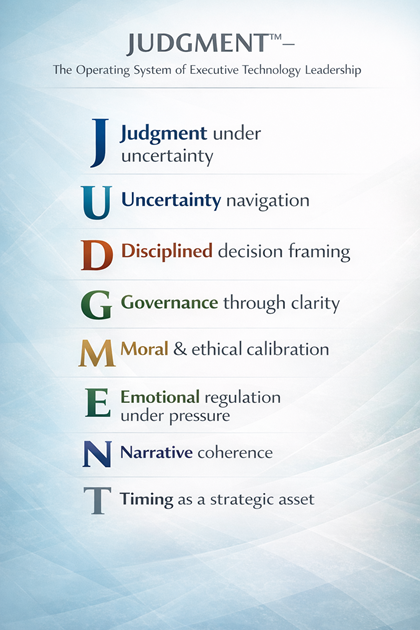
The acronym itself is intentional. Each dimension reflects a pattern I have observed repeatedly across CTO, CIO, Chief Digital Officer, Chief Data Officer, and CISO roles. Together, they form the internal operating system of executive technology leadership.
Judgment Is Not Intuition, and It Is Not Speed
When I speak of judgment, I do not mean intuition detached from evidence. I also do not mean decisiveness for its own sake.
From a cognitive and behavioral standpoint, executive judgment reflects a disciplined integration of analytical reasoning, emotional regulation, contextual awareness, ethical consideration, and anticipation of second- and third-order consequences.
Judgment appears when no option feels clean. It appears that technical truth must be balanced against organizational readiness. It appears that doing less preserves more value than doing everything that appears possible.
This is why judgment cannot be automated or delegated. It is exercised.
The JUDGMENT™ Acronym Explained
JUDGMENT™ is an intentional acronym. It reflects the core dimensions I have observed repeatedly in trusted technology leaders across CTO, CIO, Chief Digital Officer, Chief Data Officer, and CISO roles. Each letter represents a distinct but interconnected capability that shapes how executives think, decide, and lead when certainty is limited, and consequences matter.
The letter J stands for discernment in judgment under uncertainty. It reflects the ability to weigh competing signals, resist false certainty, and arrive at decisions that hold together even when information remains incomplete.
The letter U represents the capacity to operate with incomplete information without becoming reactive. Senior technology leaders rarely have the luxury of full data, and credibility depends on remaining composed and oriented while ambiguity persists.
The letter D refers to disciplined decision framing rather than solution dumping. It captures the ability to present choices, trade-offs, and consequences clearly, instead of overwhelming others with technical detail.
The letter G points to governance through clarity, not control. It reflects leadership that establishes clear decision boundaries, accountability, and intent, rather than relying on excessive oversight or bureaucracy.
The letter M highlights moral and ethical calibration embedded in everyday technical choices. It recognizes that ethics in technology leadership is not abstract, but expressed through data practices, security decisions, automation design, and architectural trade-offs.
The letter E captures emotional regulation under pressure. It reflects the ability to remain steady, measured, and constructive when stakes rise, signaling safety and confidence to others before any technical argument is evaluated.
The letter N represents narrative coherence. It is the ability to explain decisions in a way that others can follow, remember, and act on, allowing complex reasoning to travel across organizational layers without distortion.
The letter T stands for timing, the often overlooked determinant of whether technically correct decisions succeed or fail. It reflects sensitivity to organizational readiness, market conditions, governance maturity, and human capacity for change.
Together, these elements form the internal operating system of executive technology leadership. JUDGMENT™ does not prescribe actions or templates. It describes the integrated capabilities that allow technology leaders to guide decisions responsibly, communicate with clarity, and sustain trust as conditions change.
The Moment I Realized My Job Was to Absorb Complexity
Early in my career, I equated clarity with completeness. I believed that explaining the full technical picture would strengthen decisions. From a technical mindset, that assumption felt logical.
Over time, I observed the opposite effect. Leaders became cognitively overloaded. Discussions drifted. Risk perception increased rather than decreased. The room grew tense, not clearer.
From a neuroscience perspective, this was predictable. When complexity exceeds a group’s cognitive bandwidth, the brain shifts from deliberation to threat detection. Decision quality degrades precisely when leaders believe they are being thorough.
Eventually, I realized my role was not to transfer complexity. It was to absorb it. That insight reshaped how I understood authority.
How Judgment Shows Up Under Uncertainty
Senior technology decisions rarely arrive with full information. Data is partial. Signals conflict. Timelines compress. In these conditions, executives are not searching for certainty. They are searching for orientation.
People look for leaders who remain composed while holding unresolved questions. Emotional regulation becomes a leadership signal long before technical reasoning is evaluated.
Judgment reveals itself through proportion. Through language that acknowledges uncertainty without amplifying fear. Through recommendations that remain firm while allowing room for adaptation.
I have seen leaders lose credibility by overstating confidence. I have seen others lose momentum by over-qualifying every position. Strong judgment sits between these extremes. Boards sense it instinctively. Teams respond to it even when they cannot explain why.
Framing Decisions So Trade-Offs Become Visible
Executives rarely struggle because choices are unavailable. They struggle because trade-offs remain opaque.
Trusted technology leaders frame decisions in ways that reveal consequences rather than mechanisms. Instead of describing how systems function, they clarify what decisions enable, constrain, defer, or compound over time.
This aligns with how the human brain processes complexity. People reason better about futures, risks, and boundaries than about abstract system internals.
Over time, I noticed that the leaders most trusted by boards were those who consistently reduced cognitive load. Meetings shortened. Discussions sharpened. Decisions held together under stress.
This effect did not come from simplification. It came from judgment that respected the intelligence of the room while guiding attention to what mattered most.
Timing as a Leadership Signal
Technology leaders are surrounded by opportunity. New platforms emerge. Vendors promise acceleration. Innovation invites adoption. Knowing when to move has become as important as knowing how.
From a neurostrategic perspective, timing shapes how decisions are remembered. Premature action increases regret. Delayed action erodes trust.
I have seen organizations rush architectural change and create fragility. I have seen others hesitate until relevance quietly disappeared.
Judgment involves sensing readiness. Organizational readiness. Market readiness. Governance readiness. Ethical readiness.
Restraint can signal strength. Saying “later” often protects credibility better than saying “yes.”
Ethics Without Theater
Modern technology decisions carry consequences beyond balance sheets. Data practices shape trust. Security postures determine resilience. Automation influences identity and livelihood.
Ethical misalignment creates long-term friction even when short-term gains appear positive. Trust erodes quietly.
Trusted executives surface ethical implications naturally. Without theatrics. Without signaling. They connect ethics to risk, reputation, and sustainability. They integrate it into decisions rather than treating it as an afterthought.
During crises, this capacity becomes visible immediately. Judgment reveals depth long before any post-incident report.
Authority That Calms Rather Than Controls
The strongest technology leaders I have worked with rarely dominate conversations. They listen carefully, intervene selectively, and speak with precision. Their authority feels steady rather than performative.
From a cognitive standpoint, steadiness reduces threat perception. It creates psychological safety without sacrificing accountability.
Teams experience this as safety. Boards experience it as confidence. Founders experience it as a partnership rather than control.
This form of authority outlasts platforms, systems, and titles.
The Quiet Shift from Expert to Executive
In my coaching work, I often encounter a fear among highly capable engineers and architects. They worry that reducing technical expression will dilute identity.
In practice, the opposite occurs.
As leaders express judgment more clearly, influence expands. Expertise becomes visible through outcomes rather than explanation. Presence shifts from impressive to reassuring.
This transition requires internal adjustment. It involves releasing the neurological reward of demonstrating mastery and accepting responsibility for collective decisions.
That shift marks executive maturity.
Same Discipline, Different Titles
JUDGMENT™ applies across roles.
A CTO balances innovation, scalability, and timing.
A CIO modernizes without destabilizing operations.
A Chief Digital Officer orchestrates change across resistant systems.
A Chief Data Officer balances speed, governance, and trust.
A CISO translates cyber risk into choices leaders can act on.
Different mandates. Same discipline.
The question remains constant.
Does this leader help the organization decide well under pressure?
The Trace Leaders Leave Behind
Organizations remember how leaders made them feel during uncertainty. They remember whether discussions became clearer or heavier. Whether risk is felt as contained or amplified. Whether decisions held coherence as conditions changed.
Those memories shape reputation more than technical achievement.
JUDGMENT™ leaves a trace.
This book has explored architecture, data, AI, cloud, governance, and power dynamics. Each connects back to one premise.
Technology leadership at the highest levels is less about knowing more technology and more about helping others decide with confidence when technology complicates the picture.
JUDGMENT™ names that capability.
It refines expertise. It makes uncertainty navigable. And it renders complexity actionable.
When the next difficult decision arrives, and it will, what will others experience in the room?
More noise, or more clarity. More urgency, or better timing. More explanation, or sound judgment. That difference defines leaders who become sought after. It also defines the legacy they leave behind.
My upcoming book, From Technical Authority to Trusted Executive Judgment: How to Become a Sought-After CTO (Chief Technology Officer), is currently being distributed by Google Books and Play, Amazon, Apple, Kobo, and many more bookstores. I will also make it available at my discount bookstore on Digitalmehmet and the Technology Excellence and Leadership Network on Substack.
This book is a continuation of my previous book, published in 2019, titled “A Technical Excellence Framework for Digital Transformation Leadership: Transform enterprise with innovation, simplicity, agility, and fusion.”
ISBN: 9781393132851 Here is a sample summary chapter from the old book on this platform.
How to Be an Excellent Technical Leader
I summarize 26 key characteristics of excellent technical and technology leaders based on my leadership studies and…medium.com
Thank you for reading my perspectives. I wish you a healthy and happy life.
I am pleased that my three new health and wellness books, What the Brain Needs, Why We Fail, and How We Can Fix It, Ketosis + BDNF: The Healing Molecules That Saved My Life, and Cellular Intelligence, were published in December 2025 and are now available in many bookstores.
You can check out my FEATURED series of 50+ books on Amazon markets:
Substack Newsletter Mastery, Excellence, and Eminence Series
Some of my books are published at Apple Stores, Smashwords, Vivlio, Kobo, Barnes & Noble, BooksaMillion, Fable, or my discount bookstore.
I wrote many stories explaining the fundamental requirements of the brain and nervous system with nuances in previous stories, so I link them as reference here:
Here’s How to Make the Nervous System More Flexible and Functional
Here’s How I Train My Brain Daily for Mental Clarity and Intellectual Productivity.
You can find many relevant stories about brain health and cognitive performance on this list: Brain Health and Cognitive Function.
I also wrote several stories about ketosis and the ketogenic lifestyle, reflecting my experiences and literature reviews, which you can find in this list: Ketosis and Ketogenic Lifestyle.
If you are a writer, you are welcome to join my publications by sending a request via this link. I support 40K writers who contribute to my publications on this platform. Check out the recent update for the writers of my publications.
You can contact me via my website. If you are a new writer, check out my writing list to find some helpful stories for your education. You can also join my author platform as a guest blogger.
I invite you to subscribe to my publications on Substack, where I offer experience-based and original content on health, content strategy, book authoring, and technology topics you can’t find online to inform and inspire my readers.
Healthspan Mastery (NEW)
Get an email whenever Dr Mehmet Yildiz publishes. He is a top writer and editor on Medium.
dr-mehmet-yildiz.medium.com
Check out Free Blog Posts by Digitalmehmet Contributors. Here is the link to my FREE personal blogs. Now you can read our blog posts via a Flipboard Magazine for convenience.


Leave a Reply