

An Ethnographic Case Study of Strategic Delegation, Dual-Role Fluency, and Systems Design in the Knowledge Economy
Research Paper Series | DigitalMehmet Research Circle™
Abstract
Outsourcing has evolved from a cost-reduction tactic into a structural instrument of strategic growth. Despite its ubiquity in modern enterprises, startups, and freelance ecosystems, outsourcing remains conceptually fragmented in both academic literature and executive practice. This paper presents a longitudinal ethnographic case study derived from three decades of cross-border enterprise architecture, business advisory, and educational engagement. It proposes an integrated framework that reconceptualizes outsourcing as architectural design rather than transactional delegation. The study introduces five structural transitions: from reactive delegation to architectural design, from task costing to contribution margin analysis, from control anxiety to governance proportionality, from linear roles to dual-role fluency, and from effort scaling to modular system scaling. The findings demonstrate that sustainable outsourcing requires embedded integrity, incentive alignment, modular operational design, and bidirectional fluency between hiring and being hired. The paper contributes a systems-based outsourcing model applicable across organizational scales, from solo entrepreneurs to multinational enterprises.
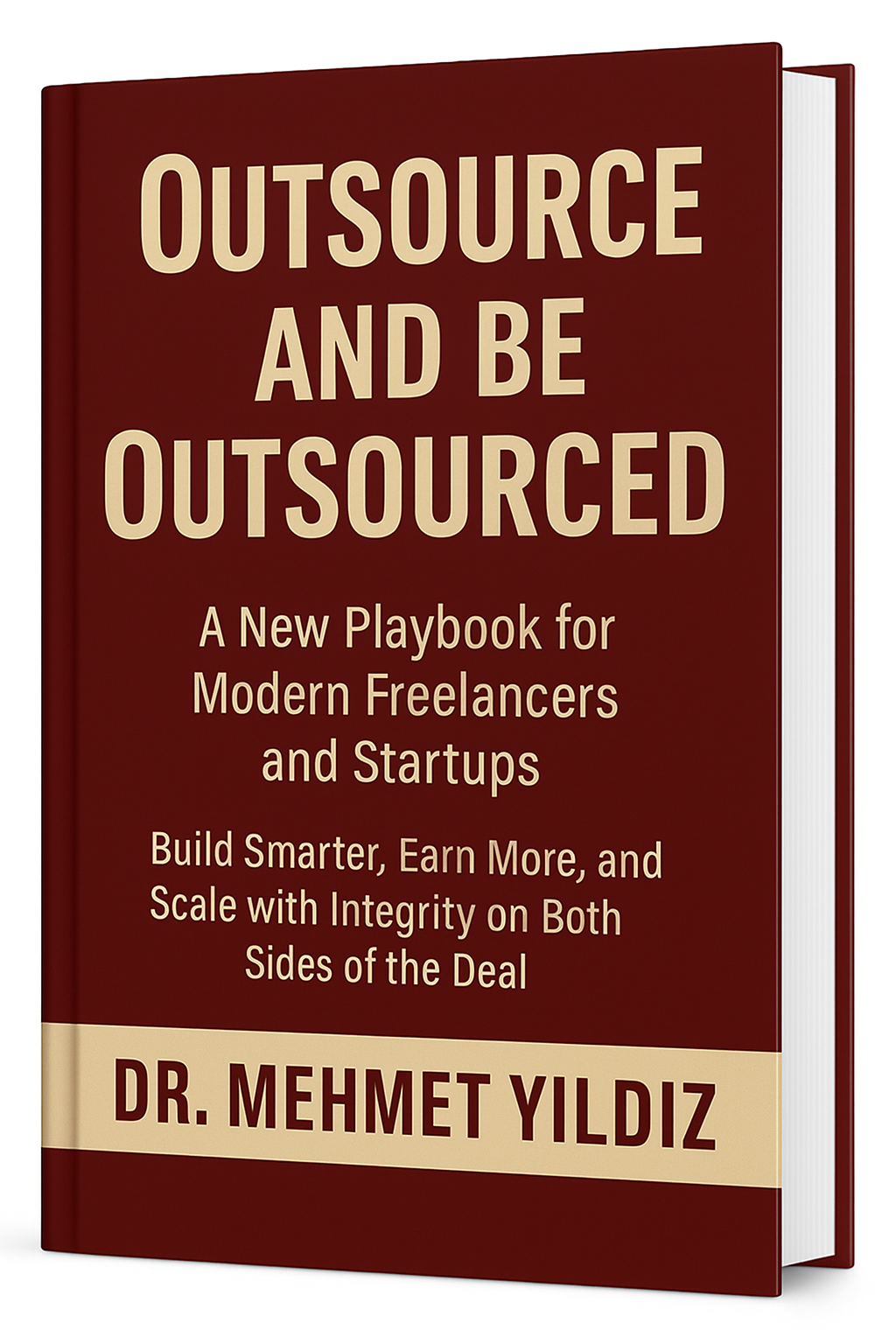
The conceptual architecture presented in this paper is derived from a broader longitudinal study documented in the book Outsource and Be Outsourced: A New Playbook for Modern Freelancers and Startups (ISBN: 9798232148935), which expands on practitioner applications and extended scenarios.
Keywords: outsourcing strategy, enterprise architecture, contribution margin, governance proportionality, dual-role fluency, modular systems, knowledge economy, agile operations, incentive alignment, scalable business design.
1. Introduction: The Persistent Outsourcing Paradox
Outsourcing is now a default feature of modern work. Organizations distribute functions globally. Freelancers operate across borders. Startups launch with distributed teams from inception. Large enterprises manage complex vendor ecosystems spanning continents. Yet, despite its prevalence, outsourcing remains poorly integrated.
In both scholarly discourse and executive environments, outsourcing is typically treated narrowly. Some perspectives emphasize cost arbitrage and transaction efficiency. Others focus on talent acquisition flexibility. Still others analyze vendor management or service-level agreements. Rarely is outsourcing examined as an integrated architectural discipline influencing cognitive load, strategic clarity, reputation stability, contribution margin, and long-term resilience.
This fragmentation generates a paradox. Outsourcing simultaneously accelerates growth and introduces fragility. It promises scalability while frequently degrading quality. It expands capacity yet often increases managerial complexity.
The central argument of this paper is that the paradox persists because outsourcing is approached reactively rather than architecturally. When viewed through the lens of enterprise and business architecture, outsourcing becomes a structural design variable shaping how value is created, protected, and scaled.
2. Historical Evolution: From Cost Arbitrage to Strategic Architecture
In the 1990s, outsourcing expanded primarily through labor cost arbitrage. Information technology services, call centers, and back-office functions migrated offshore in search of cost efficiency. Transaction cost economics provided theoretical justification for these shifts, emphasizing make-or-buy decisions based on comparative advantage.
In the early 2000s, global sourcing matured. Service-level agreements, performance metrics, and contractual governance mechanisms became more sophisticated. Agency theory had informed risk management strategies, while global value chain analysis explained cross-border production coordination.
The 2010s introduced digital platforms and the gig economy. Freelance marketplaces democratized access to global talent pools. Startups adopted lean operational models. Independent professionals built distributed micro-agencies. Outsourcing was no longer restricted to enterprise-scale procurement; it became embedded in entrepreneurial ecosystems.
Post-2020, remote-first operations and AI augmentation accelerated distributed collaboration. Outsourcing transitioned from episodic vendor relationships to continuous, platform-mediated talent networks. The boundary between internal and external capacity became increasingly fluid.
Despite this evolution, many decision-makers continued to treat outsourcing as a tactical adjustment rather than a structural determinant of organizational architecture.
3. Methodology: Ethnographic Practitioner Inquiry
This paper adopts a longitudinal ethnographic case synthesis methodology. The analysis draws on three decades of direct participation in outsourcing initiatives across SMEs, startups, and large enterprises. Observations include cross-border team design, procurement governance, service provision, advisory engagements, and the mentorship of graduate business students and founders.
The researcher functioned as both an outsourcer and an outsourced expert across different contexts. This dual positionality enabled embedded observation of incentive dynamics, governance challenges, and contribution-margin tensions from both perspectives.
Rather than presenting a single organizational case, this study synthesizes recurring structural patterns observed across industries and geographies. The findings are interpretive yet grounded in practical enterprise architecture experience and business education environments.
4. Findings: Five Architectural Transitions in Modern Outsourcing
4.1 From Reactive Delegation to Architectural Design
Reactive delegation emerges under operational pressure. Deadlines compress, workload accumulates, and leaders seek immediate relief. Decisions prioritize speed over structure.
Ethnographic observation reveals that reactive outsourcing frequently generates ambiguity, misaligned incentives, and inconsistent quality. Governance becomes corrective rather than preventative.
Architectural outsourcing, by contrast, begins with structural clarity. Leaders identify core intellectual property boundaries, define governance checkpoints, assess reversibility, and align deliverables with strategic positioning before engaging external contributors.
This transition reframes outsourcing from a workload-management tactic to a business-architecture decision. Organizations that embed outsourcing within system design demonstrate greater resilience and predictable scaling.
4.2 From Task Costing to Contribution Margin Analysis
Traditional outsourcing decisions focus on task-level cost comparison. Managers ask whether an activity can be performed more cheaply externally.
However, contribution margin analysis introduces a higher-order evaluation. Activities are assessed based on their impact on revenue generation, strategic differentiation, and cognitive bandwidth allocation.
At one observed advisory firm, 40% of founder time was allocated to formatting and coordination tasks. Outsourcing these activities increased advisory hours and revenue per hour, despite incremental cost increases. The net contribution margin improved.
This transition reflects a shift from workload management to value density optimization. Strategic outsourcing decisions consider opportunity cost, not merely direct expense.
4.3 From Control Anxiety to Governance Proportionality
Control anxiety is a recurring phenomenon. Leaders fear quality degradation when delegating. Micromanagement becomes a compensatory mechanism.
Ethnographic evidence suggests that micromanagement often exacerbates performance friction. It signals distrust, reduces autonomy, and increases cognitive burden.
Governance proportionality offers an alternative. Structured briefing documents, defined review intervals, aligned incentive models, and transparent performance metrics replace ad hoc supervision.
In a mid-sized digital agency case, repeated contractor turnover was initially attributed to talent scarcity. The investigation revealed ambiguity in the briefing and misaligned compensation incentives. After implementing documented onboarding processes and pilot-task evaluation, contractor retention stabilized.
Governance proportionality reduces anxiety by embedding accountability into structure rather than personality.
4.4 From Linear Roles to Dual-Role Fluency
Outsourcing has traditionally been conceptualized as a linear transaction between client and provider. However, modern professionals frequently occupy both roles simultaneously.
Dual-role fluency enhances strategic judgment. Understanding procurement pressures improves pricing strategy. Experiencing delivery strain informs governance design. Awareness of margin constraints on both sides fosters incentive balance.
This bidirectional insight strengthens negotiation capability and operational empathy. It transforms outsourcing from a binary exchange into an integrated capability.
Organizations and individuals who cultivate dual-role fluency demonstrate superior alignment in contracts, pricing models, and workflow coordination.
4.5 From Effort Scaling to Modular System Scaling
Effort-based scaling relies on increased labor intensity. As volume grows, individuals extend working hours or add loosely structured capacity.
This approach introduces fragility. Quality inconsistencies emerge. Communication overhead increases. Burnout escalates.
Modular system scaling applies principles from enterprise architecture and agile methodology. Functions are decomposed into repeatable units. Templates, documentation, and feedback loops support consistency. Components can expand or contract without destabilizing the system.
In an integrated advisory model, aligning contractor milestones with client billing cycles and establishing modular workflows stabilized cash flow and reduced operational stress.
Scaling design rather than effort produces sustainable growth.
5. Incentive Alignment and Embedded Integrity
Across cases, incentive misalignment emerged as a central risk factor. Compensation models reward speed, but degrade precision. Undefined success criteria encouraged scope drift.
Embedding integrity within system architecture mitigates these risks. Alignment between measurement, reward mechanisms, and quality standards creates cultural consistency.
Periodic system audits, feedback calibration, and transparent communication structures reinforce accountability without excessive surveillance.
Integrity is not an abstract ethical aspiration. It is an operational design feature embedded within governance systems.
6. Organizational Implications Across Scales
Solo Entrepreneurs
For solo professionals, outsourcing becomes a cognitive leverage strategy. Distinguishing core intellectual capital from systematizable functions prevents burnout while preserving differentiation.
Freelancers and Micro-Agencies
For independent service providers, structural positioning, contribution-margin awareness, and operational templates enable a transition from gig-based income to a scalable service architecture.
SMEs
Small and medium enterprises benefit from formalized talent networks, pilot-task vetting, structured briefing protocols, and lean modular operations that prevent premature complexity.
Large Enterprises
Enterprises must calibrate governance proportionality, align global sourcing portfolios, and integrate vendor-side empathy into procurement strategy.
The architectural principles scale across organizational size—only the magnitude changes.
7. Discussion: Outsourcing as Dynamic Capability
When architected strategically, outsourcing functions as a dynamic capability. It enhances adaptive capacity, supports strategic focus, and increases operational resilience.
The five structural transitions identified in this study reflect maturation in managerial cognition. Leaders shift from reactive relief seeking to architectural design thinking.
This reconceptualization bridges gaps between transaction cost economics, resource-based theory, agency theory, and enterprise architecture practice.
Outsourcing becomes a governance discipline and a value creation architecture rather than a peripheral operational tactic.
8. Conclusion: Sustainable Growth Through Intentional Design
The longitudinal evidence presented here indicates that outsourcing succeeds sustainably when embedded in deliberate system design.
Reactive delegation generates short-term relief but long-term instability. Architectural outsourcing strengthens contribution margin, protects reputation, and enhances resilience.
The integrated model advanced in this paper positions outsourcing as ecosystem design. It emphasizes modularity, incentive alignment, dual-role fluency, and proportional governance.
Sustainable growth does not emerge from intensity of effort. It emerges from intentional architectural design.
The scale of an organization may vary, yet the underlying principles remain constant.
Outsourcing, when treated as disciplined architecture, becomes a central instrument of intelligent business growth in the knowledge economy.
References
Yildiz, M. (2026). Outsource and Be Outsourced: A New Playbook for Modern Freelancers and Startups. [Monograph]. ISBNs: 9798232148935 (eBook), 979-8248622443 (Paperback), 979-8248623952 (Hardcover).
Yildiz, M. (2025). Agile Business Architecture for Digital Transformation – V2: Architectural Leadership for Creating Competitive Business Value for 2026 and Beyond. [Monograph]. ISBNs: 9781393738114 (eBook), 979-8290396378 (Paperback), 979-8297124523 (Hardcover).
Yildiz, M. (2025). 4 Pillars of Enterprise Architecture: Achieve Strategic Architectural Goals in the Modern Era with Rigor, Agility, & Technology. [Monograph]. ISBNs: 9798227789648 (eBook), 979-8345279427 (Paperback).
Yildiz, M. (2026). How to Turn Your Intellectual Capital into Passive Income: A Practical Guide to Turn Your Knowledge and Experience into Digital Assets Methodically. [Monograph]. ISBNs: 9798233382260 (eBook), 979-8249268978 (Paperback), 979-8249270117 (Hardcover).


Leave a Reply