

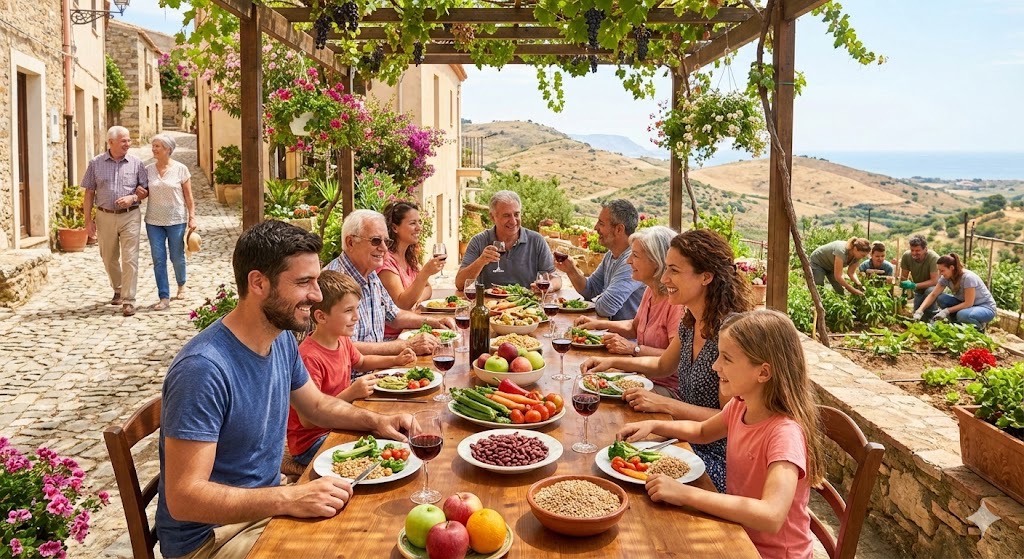
How to Live Longer, Happier, and Better
Curator’s Note: Researcher Dan Buettner identifies “Blue Zones,” areas where people live significantly longer, thriving into their 90s and 100s with low chronic disease rates. He emphasizes that only 20% of longevity is genetic; the remainder is influenced by lifestyle and environment. Key principles, known as the “Power 9,” include integrating natural movement into daily life, following the 80% rule in eating, having a sense of purpose, managing stress through relaxation practices, and fostering strong social connections. Adopting these habits can enhance quality of life and longevity, making healthy choices accessible within one’s immediate environment. This article was penned by Gary Fretwell, an author of multiple bestselling books on retirement.
What if the secret to living to 100 isn’t found in a laboratory or a high-priced supplement, but in the way you move, eat, and connect with your neighbors?
For decades, researcher Dan Buettner and a team of demographers have studied “Blue Zones”—geographical pockets of the world where people live statistically longer than anywhere else on Earth. From the sun-drenched hills of Sardinia, Italy, to the island of Okinawa, Japan, these populations aren’t just surviving; they are thriving well into their 90s and 100s with remarkably low rates of chronic disease.
The most startling discovery? Genetics only accounts for about 20% of how long the average person lives. The other 80% is dictated by lifestyle and environment. Based on years of research, Buettner identified nine common denominators, known as the “Power 9,” that explain the longevity of these cultures. Here is how you can apply those secrets to your own life.
1. Movement as a Way of Life
In the West, we often view exercise as a chore—something we “do” for an hour at the gym before returning to a sedentary desk. In Blue Zones, movement is “engineered” into daily life. Residents don’t run marathons or pump iron; instead, they live in environments that constantly nudge them into activity.
They garden by hand, walk to the market, and knead their own bread. This “natural movement” keeps their metabolisms high and their joints mobile without the stress of high-intensity workouts. The lesson for us? Find ways to move naturally every 20 minutes. Take the stairs, park further away, or trade your leaf blower for a rake.
2. The 80% Rule and the “Plant Slant”
When it comes to diet, Blue Zone residents follow two simple but profound rules. The first is Hara Hachi Bu, an Okinawan mantra that reminds them to stop eating when their stomachs are 80% full. This 20% gap is the difference between weight gain and maintenance.
The second is the “Plant Slant.” While not all Blue Zone residents are vegetarians, their diets are roughly 95% plant-based. Beans—including fava, black, soy, and lentils—are the cornerstone of nearly every centenarian diet. Meat is treated as a celebratory food, eaten on average only five times per month in small, deck-of-card-sized portions. By focusing on whole grains, tubers, and legumes, they fuel their bodies with high-fiber, nutrient-dense calories that prevent the inflammation linked to aging.
3. Finding Your “Why”
Longevity isn’t just about the body; it’s about the mind. The Okinawans call it Ikigai and the Nicoyans call it plan de vida. Both translate roughly to “why I wake up in the morning.”
Research shows that having a clear sense of purpose can add up to seven years to your life expectancy. Whether it’s caring for grandchildren, volunteering, or a lifelong hobby, knowing your role in the world provides a psychological buffer against stress and depression.
4. The Art of Downshifting
Even in paradise, people experience stress. However, Blue Zone centenarians have built-in rituals to “downshift” and shed that stress before it turns into chronic inflammation.
Sardinians enjoy a “happy hour” with friends; Adventists pray; Ikarians take a daily afternoon nap. In our fast-paced modern world, we often wear “busy-ness” as a badge of honor, but the longest-lived people know that slowing down is a biological necessity.
5. Connection is the Ultimate Medicine
Perhaps the most overlooked secret to longevity is the power of social connection. The world’s longest-lived people prioritize their “tribe.”
- Loved Ones First: They keep aging parents nearby, commit to a life partner, and invest time in their children.
- Belong: Most belong to a faith-based community. Research suggests that attending services just four times a month can add 4 to 14 years of life expectancy.
- The Right Tribe: They choose (or are born into) social circles that support healthy behaviors. Since health habits—both good and bad—are contagious, surrounding yourself with friends who value movement and healthy eating is one of the most effective things you can do for your health.
Creating Your Own Blue Zone
You don’t have to move to a remote Greek island to live like a centenarian. You can optimize your “Life Radius”—the area within a few miles of your home where you spend 90% of your time.
Start by making the healthy choice the easy choice. Keep a bowl of fruit on the counter, join a walking group, or volunteer at a local charity. Longevity isn’t about a single “magic pill”; it’s the sum of small, sustainable choices that make life not only longer but infinitely more joyful. As Dan Buettner often says, “If you’re healthy and feel valued, 100 will feel like 70.”
References:
One of the longevity researchers,
Dr Mehmet Yildiz, author of The Wisdom and Science of Graceful Aging, reviewed many scientific papers on longevity and specialized studies examining the lives of centenarians. Some were The Longevity Project, The New England Centenarian Study, The Okinawa Centenarian Study, The Framingham Heart Study, and Blue Zone Studies, which I covered in this story. You can check out his findings in this story titled 7 Longevity Patterns from the Lives of Centenarians.
Check out the details of my Bluezone observations in an article titled The 100-Year Architecture: Why Your Environment Outpaces Your DNA
About the Author
#1 international best-selling author Gary Fretwell maps the intersection of neuroscience and Stoicism to help leaders defeat low-value mental loops. From WGU faculty to non-profit leadership, Gary uses Prosoche to build lives of significance amid constant distraction. Author of The Magic of a Momentand Embracing Retirement, he focuses on human potential and Intentional Living.
Explore the Journey:
- The Interview: Read this comprehensive conversation with Gary on his transition from a global executive helping 1,000 institutions to a best-selling author.
- The Weekly Deep Dive: Join a community of intentional thinkers at his Substack, The Wise Effort.
- The Mission: Step into the Intentional Life and explore his full body of work at garyfretwell.com.
What if the secret to living to 100 isn’t found in a laboratory or a high-priced supplement, but in the way you move, eat, and connect with your neighbors?


Leave a Reply