

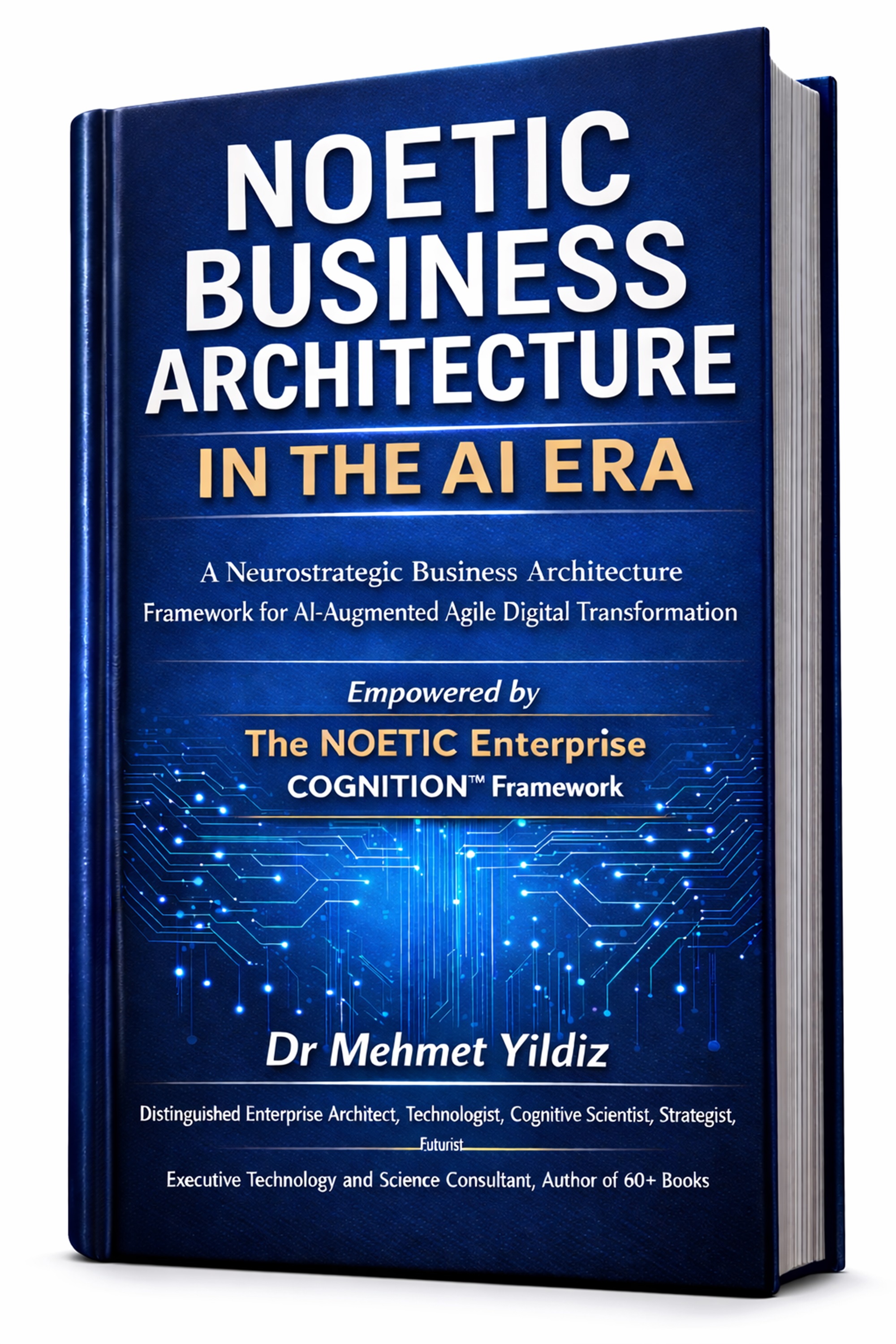
Insights from my new book, Noetic Business Architecture in the AI Era: A Neurostrategic Business Architecture Framework for AI-Augmented Agile Digital Transformation
Abstract
Artificial intelligence is reshaping how modern enterprises interpret information, make decisions, and organize their operations. As digital platforms, global data ecosystems, and algorithmic systems expand across industries, many organizations face a growing challenge: the traditional models used to align strategy, technology, and operations are no longer sufficient to manage the speed, scale, and complexity of AI-driven environments. Enterprise architecture and business architecture have historically provided valuable tools for structuring capabilities, guiding transformation initiatives, and coordinating technology investments. However, the emergence of intelligent systems that continuously generate insights and influence operational decisions requires a new architectural perspective.
This new book (ISBN: 9798233631672) introduces Noetic Business Architecture, a novel framework designed to help organizations operate coherently in the era of artificial intelligence. The concept builds on the recognition that enterprises increasingly function as cognitive systems in which information signals, human judgment, and machine intelligence interact continuously. Under these conditions, architectural thinking must evolve from static documentation of systems and processes toward the deliberate design of institutional intelligence.
Drawing on decades of professional experience in enterprise architecture, digital transformation, and technology strategy, the author presents a twelve-step Noetic Business Architecture framework that integrates strategy, capabilities, governance, decision systems, and human–AI collaboration into a unified model. The framework addresses critical challenges faced by modern organizations, including fragmented transformation initiatives, unreliable data signals, governance gaps in algorithmic environments, and increasing pressure on executive decision-making.
The book argues that effective business architecture in the AI era must enable organizations to interpret signals, coordinate capabilities, allocate attention, and maintain strategic coherence while operating in dynamic digital ecosystems. Through conceptual analysis and practical architectural guidance, it demonstrates how business architecture can evolve into a strategic discipline that supports intelligent enterprise design.
The Purpose of the Noetic Business Architecture Framework in the AI Era
By redefining the relationship between strategy, technology, and decision systems, Noetic Business Architecture offers executives, enterprise architects, and business architects a structured approach for designing organizations capable of learning, adapting, and governing artificial intelligence responsibly in the emerging algorithmic economy.
The year 2026 represents a pivotal moment in the evolution of modern enterprises. Artificial intelligence, digital platforms, and global data ecosystems are reshaping how organizations interpret information, make decisions, and coordinate operations at unprecedented scale. Across industries, leaders increasingly recognize that the architecture of the enterprise itself must evolve to keep pace with these changes.
For more than two decades, enterprise architecture and business architecture have provided valuable frameworks for aligning strategy, capabilities, technology, and governance. These disciplines helped organizations map value streams, design operating models, and guide large-scale transformation initiatives. When applied effectively, architectural thinking allowed executives to navigate complexity with structure and clarity.
Yet the operating environment surrounding modern organizations has changed dramatically. Digital transformation is no longer a discrete program or temporary initiative. It has become the permanent condition of contemporary enterprises. Cloud computing has expanded the scale of digital infrastructure. Data platforms generate enormous volumes of information. Automation technologies increasingly shape operational processes. Artificial intelligence introduces new forms of analysis and decision capability that operate far beyond the speed of traditional organizational structures.
These developments have created extraordinary opportunities. Businesses can analyze markets more rapidly, personalize customer experiences more precisely, and scale digital services globally with remarkable efficiency. At the same time, these same forces have introduced a new layer of structural complexity.
Organizations now operate within dynamic digital ecosystems where the boundaries between technology, operations, and strategy are increasingly blurred. Decisions that once unfolded over weeks or months may now occur within minutes or seconds. Artificial intelligence systems generate insights continuously, while executives must interpret those signals and act upon them within compressed timeframes.
This environment places unprecedented pressure on organizational decision systems.
Many business leaders recognize the tension intuitively. They observe transformation initiatives expanding across departments. Innovation programs launch new digital capabilities while legacy systems continue to operate in parallel. Investments in artificial intelligence, data platforms, and automation technologies accelerate across the enterprise.
Yet despite these investments, maintaining a coherent view of how the organization is evolving usually becomes more difficult, not easier.
Strategic initiatives may compete rather than reinforce a unified direction. Business capabilities become fragmented across organizational silos. Data signals intended to inform decision-making arrive with inconsistent reliability. Governance structures designed for slower operational cycles struggle to keep pace with algorithmic systems operating at machine speed.
These challenges create real pressure for executives responsible for guiding modern enterprises.
Chief Executive Officers must steer strategic direction in markets where competitive dynamics shift rapidly. Chief Information Officers oversee increasingly complex digital infrastructures while maintaining operational stability. Chief Data Officers and Chief Digital Officers seek to unlock value from data and artificial intelligence while simultaneously addressing ethical, governance, and trust considerations.
Meanwhile, business architects and enterprise architects face a different but related challenge. Architectural models and documentation can describe enterprise systems with precision, yet they do not always provide the clarity leaders need when navigating continuous transformation.
This gap between architectural insight and executive decision-making has become increasingly visible in the AI era.
Artificial intelligence amplifies this challenge further. AI systems process vast volumes of information, identify patterns, and generate predictive insights beyond traditional human capability. Organizations now rely on these systems to support decisions across supply chains, financial planning, product development, and customer engagement. In some cases, algorithmic systems directly participate in operational decisions.
These developments raise important questions for enterprise leaders. How should organizations govern algorithmic decision-making? How can executives ensure that AI-driven systems remain aligned with strategic intent? How can enterprises maintain clarity when decision processes involve both human judgment and machine-generated intelligence?
These questions extend beyond technology. They reach into the fundamental architecture of how organizations interpret signals, coordinate capabilities, and make decisions.
During my work with enterprises across multiple sectors over the past four decades, I repeatedly encountered a similar pattern. Technological limitations did not primarily cause many transformation challenges. Instead, they emerged from structural gaps in how organizations interpret information, align strategic intent with operational capabilities, and coordinate decision processes across complex systems.
In other words, the challenge was not technology alone. The deeper challenge involved the design of institutional intelligence.
Modern enterprises operate in environments where information flows continuously, decisions must be made rapidly, and technologies evolve constantly. Under these conditions, organizations require more than traditional architectural models or isolated transformation programs. They require coherent systems for interpreting signals, allocating attention, coordinating capabilities, and maintaining strategic clarity.
This realization gradually led to the ideas presented in this book.
The concept of Noetic Business Architecture emerged from the observation that business architecture must evolve beyond static modeling and documentation practices. Capability maps, value streams, and operating models remain essential tools. However, in the AI era, these tools must function within a broader framework that addresses how intelligence flows throughout the enterprise.
The word noetic refers to a form of understanding associated with insight, awareness, and structured cognition. In the context of organizations, it describes an enterprise’s capacity to interpret information, make coherent decisions, and adapt intelligently to changing conditions.
Noetic Business Architecture focuses on designing business systems that enable organizations to think clearly and act coherently within environments shaped by artificial intelligence, digital ecosystems, and continuous transformation.
This book introduces a structured approach to that challenge through the Noetic Business Architecture framework, a twelve-step model that integrates strategy, capabilities, governance, data reliability, and human–AI collaboration into a unified architectural perspective.
Each step of the framework addresses a structural discipline required for modern enterprises. These disciplines include translating strategic intent into coherent capabilities, ensuring the reliability of decision signals, mapping cognitive risk across complex systems, calibrating decision velocity, and establishing governance structures that function effectively in algorithmic environments.
Conclusions and Key Takeaways
The objective is not to replace existing architectural practices. Enterprise architecture and business architecture remain essential for understanding systems, capabilities, and value creation. Rather, the goal is to extend these disciplines to address the realities of AI-driven organizations.
In the emerging algorithmic economy, enterprises must learn continuously, adapt rapidly, and maintain strategic coherence while operating within complex digital ecosystems. Architectural thinking shifts from static structures to designing systems that support institutional learning and intelligent adaptation.
Throughout this book, I have tried to present these ideas in a way that balances conceptual clarity with practical relevance. The intended audience includes business architects, enterprise architects, digital transformation leaders, and senior executives responsible for shaping the strategy and operating models of modern organizations.
These professionals operate at the intersection of business design, technology evolution, and organizational governance. They carry the responsibility of guiding complex institutions through environments characterized by uncertainty and accelerating technological change.
I hope that the ideas presented here provide a structured perspective that helps illuminate challenges many readers already encounter in their daily work.
No framework can eliminate complexity entirely. Organizations will always face competing priorities, evolving technologies, and unexpected disruptions. However, thoughtful architectural design can help leaders interpret complexity more effectively and align their efforts toward coherent outcomes.
If the ideas presented in this book contribute in some small way to helping business leaders and architects bring greater clarity to their organizations, then this work will have fulfilled its purpose.
In the 40+ chapters of this book, we will explore these ideas in greater depth. The discussion begins by examining the structural limitations of traditional business architecture approaches in the context of AI-driven enterprises. From there, we will introduce the twelve-step Noetic Business Architecture framework and examine how it can help organizations design business systems capable of operating intelligently in the evolving AI era.
I offer these ideas with respect for the complexity of the environments in which many readers operate. If they assist organizations in thinking more clearly, deciding more coherently, and adapting more intelligently, then the concept of Noetic Business Architecture will have served its purpose.
Currently, this book is in preorder on Amazon and will be available via multiple bookstores on 30 June 2026. Landing page: https://books2read.com/noeticbusinessarchitecture
Related books:
Noetic Enterprise Architecture 3.0: A Neurostrategic Architectural and Business Framework for AI-Augmented Enterprise Design & Digital Transformation, ISBN: 9798233810435
Noetic Intelligence for the Future of Business: A Six-Dimensional Developmental Cognitive Architecture Integrating Neurobiology, Neurostrategy, and Artificial ISBN: 9798233685613


Leave a Reply