

On retirement, identity, and the part nobody warns you about
Curator’s Note: The article discusses the often-overlooked emotional challenges of retirement, highlighting the ‘Neutral Zone’—a period of lost identity and unacknowledged grief following the end of a career. The author emphasizes that many are unprepared for this emptiness, feeling a hollow sense of loss despite achieving their goals. The need for structure and belonging becomes apparent, as retirement can lead to a questioning of self-worth and purpose. The piece suggests that genuine closure rituals, like writing an Honoring Letter, can help navigate this transition. Ultimately, retirement is not merely an end but an opportunity for growth and self-discovery. This article was penned by Gary Fretwell, an author of multiple bestselling books about retirement.
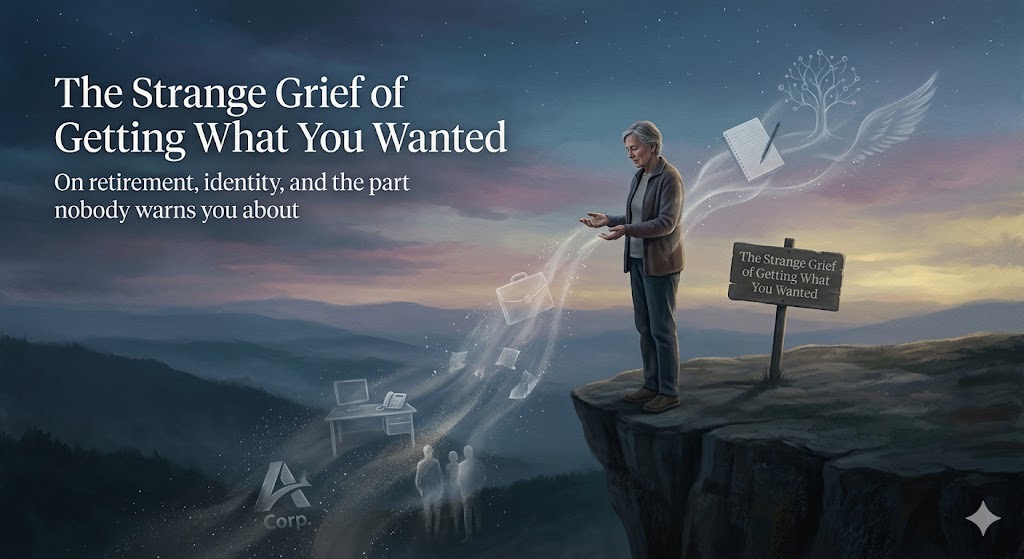
We build invisible structures to hold our lives up. When the career ends, the scaffolding vanishes. This is the ‘Neutral Zone’—the wilderness between who you were and who you are becoming. / Author created the image using AI
Nobody Prepares You for Tuesday
Not the farewell dinner, not the financial plan, not the first morning of sleeping in. The Tuesday — three weeks later, or three months later — when the novelty has faded, and the calendar is empty, and the silence in the house feels less like peace and more like a question you don’t know how to answer. You got exactly what you worked for. And something is wrong, and you can’t say what it is, and you definitely can’t say it out loud, because you’re retired — you’re supposed to be grateful.
That unnameable feeling is what this is about.
In Herman Hesse’s Siddhartha, the moment the protagonist finally escapes a life of striving — the city, the wealth, the woman — he doesn’t feel relief. He feels hollow. The external world had given him everything he asked for, and the internal world had nothing left to hold onto.
Most people read that as a story about materialism. It’s actually a story about scaffolding.
We don’t just live our lives. We build invisible structures to hold them up. Rhythms, roles, relationships, and the daily feeling of being needed. These structures are so familiar that we stop noticing them — until the day they’re gone. And then we are left standing in open air, wondering why the very thing we worked decades toward feels less like arrival and more like falling.
This is the hidden cost of retirement. Not financial. Not logistical. Something quieter and far harder to name.
The Grief Nobody Permits You to Feel
There’s a phenomenon psychologists call disenfranchised grief — the mourning of a loss that the world around you refuses to acknowledge. When someone dies, the rituals are in place. People bring food. Time slows. Society makes room for your pain.
But when a career ends — even one you chose to leave, even one that exhausted you — the world says: congratulations. Which means the grief goes underground. It becomes something to be ashamed of rather than processed. And unfelt grief doesn’t disappear; it just finds other exits.
The trap is that most people misidentify what they’re grieving. They assume it’s the job itself — the tasks, the title, the salary. But those are surface losses. What’s really gone is the architecture underneath: the automatic rhythm that told you when to wake and when to rest, the tribe that gave you a sense of belonging, the daily mirror of being depended upon. Strip all of that away at once, and you don’t just lose a job. You lose your coherent answer to the question: who am I, and why does it matter?
The ancient Stoics understood something relevant here. Marcus Aurelius, governing an empire while privately grappling with his own mortality, wrote obsessively about the difference between what is permanent and what is borrowed. Our roles, he argued, are always borrowed. The danger is living as if they are permanent — and then finding out, far too late, that you were not the role. You were the only person wearing it.
The Wilderness Between Who You Were and Who You’re Becoming
The transition expert William Bridges spent decades studying why so many meaningful changes fail. His insight was deceptively simple: we obsess over the new beginning and completely ignore the two stages that must come first — the Ending and the Neutral Zone.
The Neutral Zone is the uncomfortable wilderness between who you were and who you’re becoming. It is not empty. It is, in fact, extraordinarily full — full of old identity fragments, unresolved questions, and the specific kind of restlessness that arrives when something real is trying to emerge. But because we are trained — especially in high-achieving lives — to solve problems immediately, we treat the Neutral Zone as an obstacle rather than a passage.
We scroll. We over-schedule. We reach for the next project before the last one has been fully grieved.
Richard Feynman, near the end of his life, was asked what he thought the secret to a good existence was. His answer was characteristically simple: stay comfortable with not knowing. Progress, he believed, requires leaving the door to the unknown ajar. We close it too soon. We want the answer before the question has finished forming.
Retirement, at its best, is an invitation to leave that door open.
The Ritual of Letting Go
What actually works — and this is harder than it sounds — is ritual.
Not journaling as a productivity tool. Not reflection as another item on a checklist. A genuine act of closure: what you might call an Honoring Letter to the version of yourself who carried the full weight of Act One.
Write down what that person achieved — not the resume version, but the real version. The leadership shown in moments of crisis. The private sacrifices. The hard-won victories that nobody else fully witnessed. Then write down what they carried: the stress absorbed quietly for years, the failures that stung, the weight of responsibility that didn’t end at five o’clock.
And then — the difficult part — give yourself explicit permission to put it down.
This isn’t erasure. You don’t abandon a chapter you’ve finished; you complete it. And completing it is the only honest path to the next one. As Proust understood after writing a million words trying to recover the past, the real voyage is never about recapturing what was. It’s about finally seeing, for the first time, what actually is.
The people who genuinely flourish in their second act share one quality that has nothing to do with financial planning or hobby optimization. They are willing to sit in the discomfort of the in-between without immediately trying to escape it. They understand that the restlessness they feel isn’t a malfunction. It’s a signal. It’s the evidence of an identity that is not broken but unfinished — still becoming something it couldn’t become while the old scaffolding was in place.
Falling Is Sometimes Just the Beginning of Flight.
The great irony of a life well-lived is this: the very success that makes retirement possible is the same thing that makes it so disorienting. You built something real. It held you up for decades. Of course, the sudden absence of it feels like falling.
But falling, if you pay close attention, is sometimes just the beginning of flight.
This piece is adapted from Intentional Retirement — a guide to navigating the emotional, psychological, and purposeful dimensions of life’s second act.
ABOUT THE AUTHOR
Gary L. Fretwell is a #1 international best-selling author and a student of “Intentional Living.” By blending the rigors of neuroscience with the timeless wisdom of Stoic philosophy, Gary helps creators and leaders build a cognitive architecture of true significance.
As the author of The Magic of a Moment, Unlocking the Magic Daily Journal, and Embracing Retirement, Gary doesn’t just write about purpose — he maps the neuroscience of it. Whether he is serving as Board President for Prescott Meals on Wheels or mentoring the next generation of MBA thinkers at Western Governors University, his mission is to help you navigate the “Identity Ghost” and live an intentional life.
His upcoming book, Intentional Retirement, arrives in 2026 — a definitive field guide for those ready to move from “Output” to “Influence.”

Retirement isn’t about the quantity of your years; it’s about the gold you find in the transitions. My upcoming book, Intentional Retirement, is a blueprint for those ready to stop “filling the jar” with busyness and start designing a Second Act of true significance./ Image created by Nancy Fretwell
Step into the Second Mile: Connect with Gary’s latest insights at garyfretwell.com.
The Deep Dive: For weekly strategies on cognitive clarity and the architecture of a meaningful life, subscribe to Gary’s Substack, The Wise Effort.
Follow the Journey: Read over 100 deep-dives on transition and productivity at medium.com/@gary_fretwell.
You may also check out the summaries of my stories in my guest blogs.


Leave a Reply