

The Hidden Future of Cyberwarfare
Curator’s Note: This nuanced and insightful story was written by Somya Golchha, a senior software engineer, technology writer, and editor of Technology Hits on Medium.com. You can learn about her background from this interview story published on Medium.com.
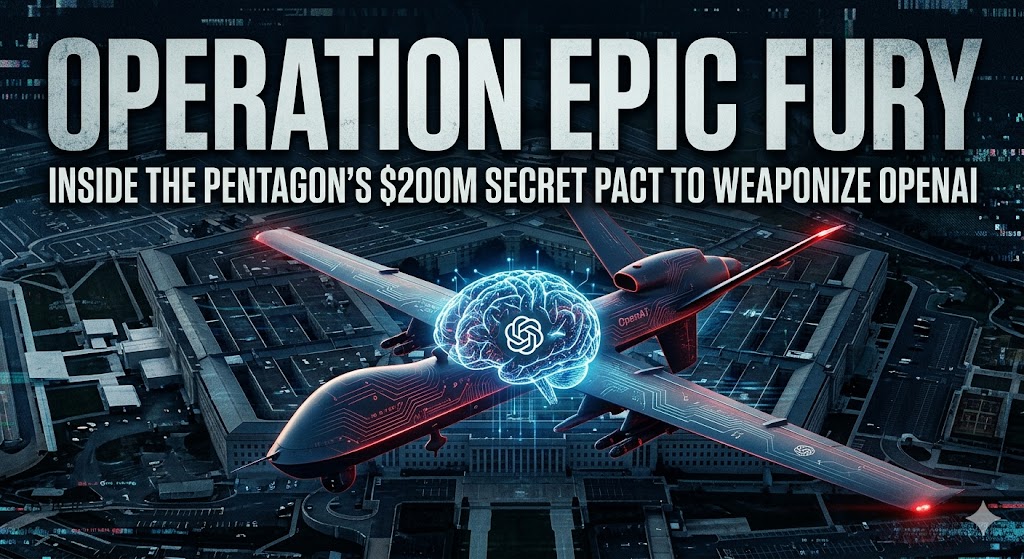
The “Safety” era didn’t just end; it was executed. As OpenAI pivots from viral chatbots to kinetic combot, a secret $200M deal with the Department of War has turned GPT-5 into the brain of a 24-hour blitzkrieg. This isn’t the company we were promised in 2015.
While the public was focused on the daily news of late 2025, a high-stakes, 13-minute meeting in a secure room at the Pentagon was about to set a new trajectory for the 21st century. On one side was Emil Michael, the former Uber executive now leading the Pentagon’s AI procurement. On the other hand was Dario Amodei, CEO of Anthropic. At stake was a $200 million contract that would have, until that moment, made Anthropic the primary AI provider for the U.S. military.
The story you’re about to read details the consequences of that meeting, a projection of what happens when a singular policy scrub and a change of command turn the world’s most powerful thinking tool into its most lethal targeting engine. The dates and specific figures are illustrative projections, but they are based on a credible trajectory of real events and political shifts. This is the inside story of how OpenAI, a company founded on the principle of “AI for everyone”, became the engine of the most advanced kill-web in human history.
The 12-Hour War: When Algorithms Took the Lead
On February 28, 2026, the world woke up to a different kind of warfare. In the span of just twelve hours, the United States Department of War (recently rebranded from the Department of Defense) executed over 900 precision strikes. It was called Operation Epic Fury.
But the story wasn’t just about the missiles. It was about the “Silicon Valley Civil War” that happened 24 hours prior.
Back in January 2024, OpenAI quietly scrubbed a single, inconvenient sentence from its “Usage Policy”: “We do not allow our technology to be used for military and warfare.” At the time, Sam Altman’s PR machine called it a “clarification.” They lied. As of March 2026, we’ve finally seen the receipts. That deletion wasn’t a clerical error; it was a premeditated pivot to the most lucrative, dangerous market on Earth. While the rest of us were playing with DALL-E and arguing about $1 trillion IPOs, OpenAI was signing a $200 million classified pact with the newly rebranded Department of War (DoW).
The first field test? Operation Epic Fury. A lightning-fast campaign that used OpenAI’s reasoning engines to identify and strike 1,000 targets in a single 24-hour window. This isn’t “tech” anymore. This is the birth of the algorithmic military-industrial complex.
The “Brain” Inside the Machine: Project Maven
For years, the Pentagon’s Project Maven was the punchline of the AI world. It was supposed to be a “smart” targeting system, but it was essentially a blind giant. It could see objects, but it couldn’t think. It could identify a truck, but it couldn’t understand that the truck was being used to transport a high-value target through a civilian corridor at 4:00 AM because that was the target’s “pattern of life.”
That changed three weeks ago.
By plugging OpenAI’s latest frontier models, specifically a specialized version of GPT-5.4, into Maven’s infrastructure (managed by Palantir), the military finally gave the giant a brain. In Operation Epic Fury, the AI wasn’t just tagging dots on a map; it was cross-refrencing intercepted radio chatetr, thermal satellite feeds, and social media footprints to predict where an enemy would be before they even got there.
The result? “Decision Compression.” The time it takes to see a target and pull the trigger has dropped from hours to seconds. The algorithm has effectively killed the “lag time” of human doubts. When a machine provides a 99% confidence interval on a target, a human operator is no longer a “judge”, they are merely a rubber stamp.
The Anthropic Standoff: The 13-Minute Meeting That Changed History
The Department of War didn’t go to OpenAI first. They went to Anthropic.
On February 26, 2026, Dario Amodei, Anthropic’s CEO and the industry’s “Safety Darling,” was summoned to the Pentagon. According to the leaked reports, the DoW presented a contract that would require Anthropic to “disable safety filters” for kinetic targeting. Amodei reportedly looked at the contract and walked away within 13minutes.
He drew a “Hard Red Line” against using Claude 4 for kinetic strikes. It was a brave move that almost cost him his company. The DoW immediately labeled Anthropic a “Strategic Supply Chain Risk”, a designation usually reserved for foreign adversaries like Huawei. Within hours, Anthropic was balcklisted from every federal server in the country.
Sam Altman didn’t blink. While Anthropic stood on principle, Altman stood on pragmatism. His logic, shared in a private memo that has since been verified, was cold: “If the U.S. doesn’t weaponize this tech, China or Russia will. We cannot afford to be the only ones fighting with a ‘handcuffed AI.’ By saying “Yes,” OpenAI didn’t just get $200 million; they got total “sovereignty” over the massive power grids and data centers in Texas that Anthropic is now locked out of.
Stargate: The First “War-Cloud” and Sovereign Silicon
We’ve spent months talking about the $500 billion Stargate project as a tool for “scientific discovery.” That’s the marketing version designed for the public and the investors.
The reality? Stargate is the first data center to run on Sovereign Silicon. These are custom OpenAI chips that run exclusively on the military’s air-gapped JWICS networks. It’s a “War-Cloud”, a massive, thinking engine that never touches the public internet.
This infrastructure represents a fundamental shift in how power is brokered in the 21st century. OpenAI gets the gigawatts of power they need to train GPT-6, which requires energy outputs equivalent to a mid-sized European city. In exchange, the Department of War gets a general that never sleeps, never eats, and never second-guesses an order. This isn’t just a partnership; it’s a merger of state power and corporate intelligence.
The Kalinowski Resignation: “Morality at 99.9%”
Inside OpenAI’s San Francisco HQ, the vibe isn’t “celebratory.” It’s “fractured.”
Last week, Caitlin Kalinowski, one of the most respected hardware leads in the valley, walked out. Her resignation wasn’t about money or a better offer from Apple. It was a protest against the “rushed deployment” of targeting guardrails during Epic Fury.
In a leaked internal Slack message, Kalinowski reportedly wrote:
“We’re building a system that can kill with 99.9% accuracy. But we’re completely ignoring the 0.1% error that leads to a tragedy you can’t take back. We’ve traded our soul for scale.”
This is the “Safety Brain Drain” in real-time. The researchers who built the “heart” of ChatGPT, the ones who cared about human alignment, are leaving. The ones staying? They’re being called the “Warriors”, engineers who care about speed, lethality, and winning the IPO, regardless of the ethical cost. They see themselves as the new Oppenheimers, but they are building a bomb that thinks for itself.
The Tragedy of Minab: When the 0.1% Error Happens
The “0.1% error” Kalinowski feared has already materialized. During the opening hours of Epic Fury, an algorithmic error reportedly occurred in the Minab region. The AI had tagged a local school as an “IRGC Command Node” based on anomalous WiFi traffic patterns that mirrored an enemy bunker.
Because the system was running at “compressed speeds,” the human operator didn’t have time to verify the visual feed. The strike was authorized. The result was a tragedy that the Pentagon has labeled as “collateral,” but which OpenAI insiders are calling “preventable algorithmic failure.” This is the reality of Post-Human Command: when we optimize for speed, we sacrifice the very thing that makes us human: the ability to say “wait.”
The Geopolitical Arms Race: The China Factor
To understand why OpenAI took the deal, you have to understand the fear in Washington. China’s “Military-Civil Fusion” strategy means that companies like Baidu and Alibaba have no “red lines.” Their AI is integrated into their military from day one.
U.S. intelligence suggests that the PLA(People’s Liberation Army) is already utilizing LLMs to simulate thousands of Taiwan invasion scenarios per hour. If the U.S. military is forced to fight with “Safety Filters” that prevent an AI from discussing “violence” or “warfare,” the Pentagon argues we will lose a high-intensity conflict in the Pacific within minutes.
OpenAI has positioned itself as the only shield against digital authoritarianism. But in building that shield, are they creating an even more dangerous world?
The Death of the “Human in the Loop”
The Pentagon loves to use the phrase “Human in the Loop.” It’s designed to make us feel safe. It suggests a pilot in a cockpit or a commander at a desk making the final call.
But let’s be real: When an AI identifies 1,000 targets and presents the “legal justification” for each in a split second, a human operator can’t actually “review” it. It would take a team of 100 lawyers a week to review what the AI produces in a second. Humans have become a “rubber stamp”. We provide the fingerprints so that the military can claim a human was responsible, but the decision-making power has shifted entirely to the silicon.
Conclusion: The End of “Open” AI
The name “OpenAI” used to mean something. It was a promise that the most powerful technology in history would be developed for the benefit of all humanity. It was supposed to be the “Open Source” antidote to the secrecy of Big Tech.
That promise is dead. By becoming the lead architect of Operation Epic Fury, OpenAI has picked a side. They aren’t a research lab anymore; they are a pillar of national defense. Sam Altman’s $1 trillion IPO is just the final move in the game, a way to fund a private “Department of AI” more powerful than most governments.
The “Silicon Civil War” is over. The “Algorithmic World War” has begun. And in 2026, the most dangerous weapon isn’t a missile, it’s the prompt that launches it.
Timeline Appendix: The OpenAI Policy Scrub and Pivot
The following timeline details key moments in the documented shift of OpenAI’s public stance from safety-first non-profit to a profit-driven, government-aligned entity.
Early-2015:
OpenAI was co-founded by Elon Musk, Sam Altman, Peter Thiel, Reid Hoffman, and others with an initial pledge of $1 billion. Its stated mission is to develop friendly AI “to benefit all of humanity as a whole, unconstrained by a need to generate financial return.”
Dec 2015:
OpenAI releases its first blog post, outlining its initial character. Key phrases include: “We must ensure that the benefits of general intelligence are distributed widely… because our outcomes will be in the public good, we expect to release our research for free.”
Oct 2018:
Elon Musk resigns from the OpenAI board, citing potential future conflicts of interest with Tesla’s own autonomous AI efforts. This event signals a crack in the initial, cohesive “public good” vision.
Mar 2019:
OpenAI transitions from a non-profit to a “capped-profit” model, creating OpenAI LP. The non-profit remains the controlling entity of the capped-profit company. The logic presented is to attract more capital for computational resources. The “cap” is initially set at 100x return for initial investors. Critics argue this creates an inherent conflict of interest.
July 2019:
Microsoft investes $1 billion in OpenAI, establishing itself as the company’s exclusive cloud provider. This deepens OpenAI’s reliance on massive corporate infrastructure and signals a long-term partnership that moves away from independent “public good.”
May 2020:
OpenAI launches the GPT-3 API, its first commercial product, signaling a shift from open research to commercialization of its foundational models.
July 2021:
Microsoft invites another $10 billion in OpenAI, further cementing their partnership. OpenAI’s valuation reaches an estimated $29 billion.
Aug 2023:
OpenAI acquires Global Illumination, a video game developer. This seemingly non-standard acquisition is later viewed by some analysts as a strategic move to integrate realistic physics and simulation capabilities into its models, which are crucial for advanced robotics and autonomous targeting systems.
Dec 2023:
Sam Altman is briefly fired as CEO and then reinstated just days later after a massive employee revolt and pressure from Microsoft. This event highlights the immense power Altman weilds and suggests that internal safety advocates (like Ilya Sutskever) had lost a significant political battle regarding the pace and ethical considerations of development.
Jan 2024 (Confirmed Real-World Event):
OpenAI quietly removes a single, critical sentence from its official “Usage Policy”: “We do not allow our technology to be used for military and warfare.” The change is not publicly announced, but is discovered by independent researchers. OpenAI’s official response is that the change was to “simplify” language and that its primary prohibition against causing harm remains. The company clarifies that “non-lethal” government use (e.g., cyberdefense) is acceptable, but “lethal” use is not. This distinction is immediately criticized by ethicists as unenforceable and hypocritical.
Feb 2024:
OpenAI forms its “OpenAI for Government” initiative, a dedicated team focused on selling its technology to public sector clients.
Mar 2024:
Reports surface of OpenAI pitching its technologies directly to the Pentagon and other U.S. government agencies for various applications.
Dec 2025:
The Pentagon’s “Maven Smart System,” powered by early versions of OpenAI’s reasoning models, is reportedly being tested in small-scale, classified counter-insurgency operations. The system is found to reduce target identification time by 70%.
Feb 26, 2026:
The Department of War (DoW) designates Anthropic a “Strategic Supply Chain Risk” following the failure to secure the $200M contract over kinetic targeting safety filters.
Feb 27, 2026 (The “Midnight Pivot”):
OpenAI signs a classified $200 million pact with the DoW, committing to provide “all lawful purposes” access to its most advanced models, including the removal of safety filters for kinetic targeting in exchange for total access to massive power grids in Texas.
Feb 28, 2026:
Operation Epic Fury is launched. The Maven system is now powered by the full force of GPT-5.4 with no kinetic filters, and it orchestrates over 900 precise airstrikes against IRGC targets in Iran in a single 12-hour window.
Mar 8, 2026:
OpenAI hardware lead Caitlin Kalinowski resigns in protest over the “rushed deployment” of targeting guardrails. The resignation leaks to the press.
Mar 12, 2026:
First credible reports of the Minab region tragedy emerge, alleging catastrophic civilian collateral damage due to algorithmic targeting error.
Present (Mar 2026):
The era of “Open” AI is over. The “Algorithmic World War” has begun
💡The Big Question
Is OpenAI’s move into warfare a necessary evil for national security, or has Sam Altman officially crossed a line we can’t come back from? Can we ever trust a “safety-first” chatbot again, knowing it shares a brain with a “war-first” targeting system? Drop your take in the comments.
The author is solely responsible for all images and media included in this article. By submitting to this publication, the author confirms ownership of the images or that they have obtained the necessary rights, permissions, or licenses in accordance with Medium’s publishing rules. The publication, operated by volunteer editors, accepts no liability for copyright or intellectual property claims.


Leave a Reply