

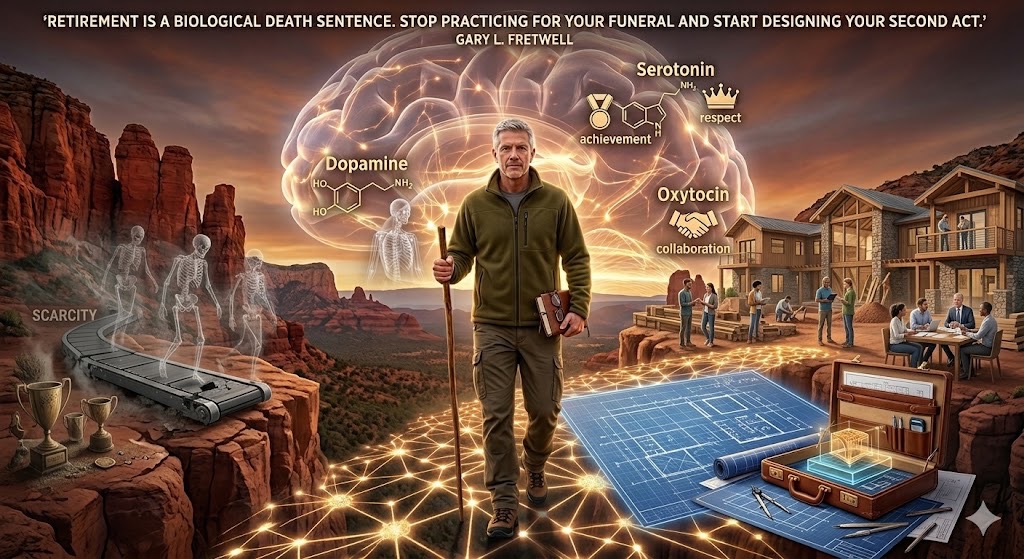
Stop practicing for your funeral. Design your Second Act.
Curator’s Note: The content emphasizes the importance of actively engaging in life after retirement rather than succumbing to stagnation. The author, Gary L. Fretwell, reflects on his transition from a high-stakes corporate career to retirement, arguing against the notion of endless leisure. He introduces the concept of a “Second Act,” advocating for a balanced portfolio of productive activities, including fee work, gift work, study work, and homework, to maintain cognitive health. Fretwell encourages a shift from a hero mentality to that of a guide, focusing on service to others, leading to personal freedom and fulfillment in later life.
On my first Monday of retirement, the silence in my Prescott home office was louder than any boardroom shouting match I’d ever moderated. For over four decades, my identity was forged in the high-stakes heat of dean’s offices and corporate consulting. My calendar was a battlefield of strategic objectives and personnel crises.
But that morning, I realized the “Endless Weekend” we are all promised is a lie. Even worse, it’s a biological hazard.
If you treat retirement as a permanent state of leisure, your brain begins a process I call biological decommissioning. It is a cold, physiological reality: when your brain perceives your utility has dropped to zero, it literally begins to shut down. To survive, you don’t need a vacation; you need a Second Act.
The Biology of Usefulness: Why Friction is Fuel
We often treat retirement as a financial milestone, but evolutionary biology suggests it’s a survival alarm. For the vast majority of human history, “elders” were never meant to sit on the sidelines. They were the keepers of tribal strategy and mentors to the young.
When you stop contributing, your cognitive health doesn’t just plateau—it erodes. However, when you engage in “The Wise Effort,” your brain functions as a personal pharmacy:
- Dopamine: Triggered by complex problem-solving, like mentoring an MBA student through a marketing capstone.
- Serotonin: Released through community respect, such as negotiating leases for Prescott Meals on Wheels.
- Oxytocin: Fostered by deep mentorship and the “second mile” of effort offered to a colleague.
You are neurologically architected to be a contributor until your final breath. Stagnation isn’t peace; it’s decay.
Designing the Portfolio Life
To escape the “Career Treadmill,” I had to stop looking for a new title and start designing a Portfolio Life. This isn’t about one big job; it’s about a balanced architecture of four distinct assets:
1. Fee Work (The Brain Asset)
This is the consulting or teaching that keeps your professional muscles toned. The paycheck isn’t for survival; it’s a metric of continued relevance. If the market is willing to pay for your wisdom, your “professional machinery” is still in peak condition.
2. Gift Work (The Soul Asset)
This is high-impact contribution where the “paycheck” is social impact. Serving as a Board President or volunteering locally ensures your forty years of experience aren’t buried in a backyard, but are solving real-world problems.
3. Study Work (The Growth Asset)
Stagnation is the first step toward decline. I aim to read over 100 books a year, ranging from Stoic philosophy (Aurelius and Seneca) to neuroscience. This is the intentional building of Cognitive Reserve. ### 4. Home Work (The Environment Asset) This is the physical friction. Whether it’s weightlifting in the home gym or hiking the rugged trails of the Arizona high desert, your body requires resistance to remain strong. Physical atrophy often precedes mental atrophy.
The Empathy Pivot: From Hero to Guide
The hardest part of this transition isn’t the schedule; it’s the ego. In our primary careers, we are trained to be the Hero. We slay the dragons of competition and climb the corporate ladder.
But an intentional Second Act requires a radical Empathy Pivot. You must move from the center of the stage to the role of the Guide in someone else’s story. The question shifts from “What do I want to do?” to “Whom do I want to help?”
Identifying the who almost always makes the what clear. When I shifted my focus to the students I mentor or the families in my community, the hollowness of retirement evaporated.
From Scarcity to Abundance
Most of our lives are spent in a state of Scarcity. We work because we must. We are tethered to titles for survival. But as you enter your Second Act, you cross into Abundance. You realize you already have enough and know enough. This grants you three radical freedoms:
- The Freedom to Take Risks: You can pursue “crazy” social impact projects because your financial survival is no longer at stake.
- The Freedom to Speak Truth: You are no longer bound by corporate politics. You can offer the “radical honesty” that only decades of wisdom can provide.
- The Freedom to Walk Away: You engage purely for the joy of the friction, retaining the agency to leave the moment the work stops being meaningful.
“Stop designing your days around what you used to produce. Start designing them around whom you are called to serve.”
If you find yourself sitting in that deafening silence today, know this: You aren’t “done.” You are simply between missions. Your second act isn’t about fading away—it’s about finally having the freedom to do the work you were actually meant to do.
The architecture is yours to build.
About the Author
Gary L. Fretwell is the Editor of Illumination: Retirement, Aging and Legacy, a publication dedicated to helping high-performers navigate the transition from “Success to Significance.” Drawing on 43 years of leadership in higher education, Gary architects intentional second acts by blending the ancient wisdom of Stoic philosophy with the modern precision of neuroscience.
As the #1 international bestselling author of The Magic of a Moment, Embracing Retirement, and the recently released Intentional Retirement, (ISBN: 9798223290049) Gary provides the cognitive blueprints that help high-achievers decouple their identity from their titles. Whether serving as a Board President or mentoring MBA thinkers, his mission is to help others step into the “Second Mile.”
- Explore the Second Mile: garyfretwell.com
- Weekly Deep Dives: Subscribe to The Wise Effort on Substack.
- Latest Articles: Follow on Medium.


Leave a Reply