

Why Aldous Huxley believed the secret to longevity isn’t discipline. It’s the one trait we abandon at thirty.
Curator’s Note: Aldous Huxley argued that the key to longevity lies not in discipline, but in maintaining a childlike openness. As adults transition from youthful vibrancy to adulthood, they often sacrifice curiosity for the comfort of routine. This psychological shift leads to stagnation and the dulling of enthusiasm. Huxley believed that to age well involves embracing intentional novelty—such as learning new skills and questioning established beliefs. By initiating curiosity rather than seeking mere efficiency, individuals can design a fulfilling “Second Act” in life, thus countering the decline associated with aging and enriching their experiences. This essay was written by Gary L Fretwell, an author of multiple bestselling books, including the recent Intentional Retirement edited by Dr. Mehmet Yildiz.
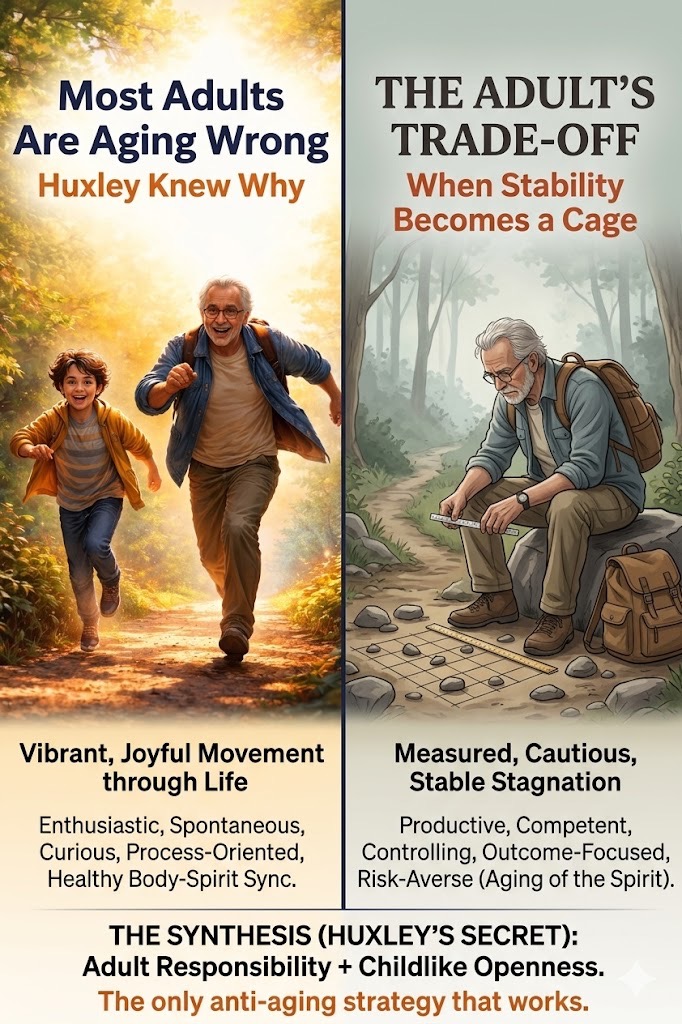
The Adult’s Trade-Off: Choosing between vibrant, joyful movement and measured, cautious stagnation. The secret to aging well lies in the synthesis of adult responsibility and childlike openness. / Author created image using AI
The transition from youthful vibrancy to the “gray fog” of adulthood isn’t an inevitable biological decline. Often, it is a psychological surrender.
Aldous Huxley, the visionary author of Brave New World, identified a phenomenon that many of us fall prey to long before we notice our first wrinkle. He described the tragic shift that occurs when we trade our curiosity for the comfort of the known:
“The secret of genius is to carry the spirit of the child into old age, which means never losing your enthusiasm.” — Aldous Huxley
Most adults spend their thirties and beyond building walls of certainty and routine, thinking they are cultivating maturity. In reality, they are often just automating their lives and losing that essential enthusiasm Huxley championed.
The Trap of the “Grown-Up” Mindset
By the time we hit thirty, society rewards us for being predictable, disciplined, and specialized. We trade our innate curiosity for efficiency. We stop asking “why” and start focusing on “how much” or “how fast.” This shift is what causes the spirit to atrophy.
We often think the secret to staying sharp into our seventies and eighties is found in “the grind” or the latest longevity bio-hacks. While physical health is vital, the engine behind a long, meaningful life is a specific psychological trait: Openness to Experience.
When we abandon this trait, we stop growing. We begin to age “wrong” because we treat life as a problem to be solved or a sentence to be served, rather than an ongoing experiment.
Reclaiming the Huxleyan Ideal
Huxley suggested that the secret to a vital life is to be “childlike” rather than “childish.” It is the ability to look at the world with fresh eyes, even when you’ve seen it a thousand times.
To reverse this psychological aging, we have to practice a form of “intentional novelty.” Instead of just looking for ways to improve efficiency, we must look for ways to re-inject wonder into our daily lives. This might mean:
- Learning something where you are a total beginner: Nothing humbles and refreshes the mind like the clumsiness of a new skill.
- Questioning your “settled” opinions: Active disagreement with your own status quo keeps the neural pathways flexible.
- Embracing Yutori: Leaving enough room in your schedule for the unexpected to happen, rather than over-optimizing every hour.
Designing the Architecture of Your Second Act
Aging correctly means designing a “Second Act” that isn’t a retreat, but a redesign. It requires the courage to dismantle the identity you spent decades building to make room for the person you are becoming.
Discipline and health are the foundation, but curiosity is the spark. If you want to stay sharp for decades, stop trying to be more disciplined and start trying to be more interested. As Huxley implied, the moment we lose our enthusiasm is the moment we truly begin to age.
Go Deeper: To dive deeper into the psychological mechanics of why we age the way we do, read the full original article on Medium:
Most Adults Are Aging Wrong. Huxley Knew Why.
About the Author
Gary L. Fretwell is the Editor of Illumination: Retirement, Aging and Legacy, a publication dedicated to helping high-performers navigate the transition from “Success to Significance.” Drawing on 43 years of leadership in higher education, Gary architects intentional second acts by blending the ancient wisdom of Stoic philosophy with the modern precision of neuroscience.
As the #1 international bestselling author of The Magic of a Moment, Embracing Retirement, and the recently released Intentional Retirement, Gary provides the cognitive blueprints that help high-achievers decouple their identity from their titles. Whether serving as a Board President or mentoring MBA thinkers, his mission is to help others step into the “Second Mile.”
- Explore the Second Mile: garyfretwell.com
- Weekly Deep Dives: Subscribe to The Wise Effort on Substack.
- Latest Articles: Follow on Medium.


Leave a Reply