

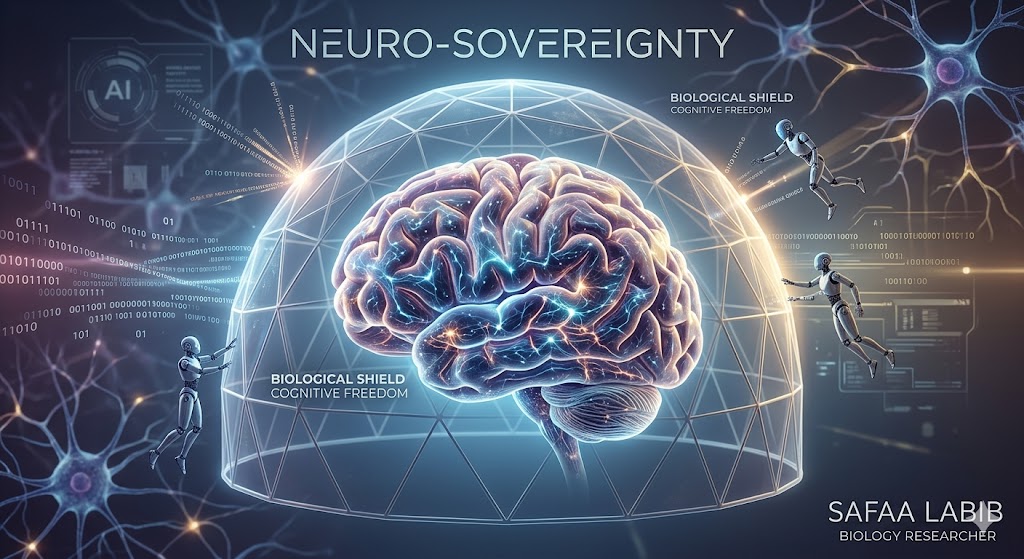
The Battle for the Synapse
As we transition from simple search engines to autonomous AI agents, the boundary between human intent and algorithmic influence is blurring. In the second part of our deep dive into the Digital Hippocampus, we explore a critical question: Is our cognitive independence—our Neuro-Sovereignty—under threat?
As a biology researcher, I contend that our current technological trajectory isn’t just changing our habits; it is challenging the biological bedrock of our decision-making. We are witnessing a shift where the “interior laboratories” of our minds are being bypassed by external cognitive agents.
The Paradox of Ease: Use It or Lose It
Biology operates on a strict principle: Neural pathways strengthen through resistance. When we delegate critical thinking and memory consolidation to AI, we risk functional atrophy. If the brain is a muscle, the “Map of Ease” offered by seamless technology is the equivalent of a sedentary lifestyle. True cognitive restoration comes from engagement, yet we are being nudged toward passive consumption.
The Epigenetic Script: A Legacy of Dependency?
Beyond immediate synaptic pruning, we must consider the epigenetic implications. Epigenetics teaches us that while our DNA remains constant, gene expression is highly sensitive to our environment. When we operate in a state of constant “algorithmic prompting,” we may be influencing the methylation patterns of genes associated with BDNF (Brain-Derived Neurotrophic Factor)—the protein essential for neuronal growth. We might be leaving a biological signature of cognitive dependency for future generations.
The Metabolic Cost: Why Thinking is “Expensive”
The human brain represents only 2% of body weight but consumes 20% of our metabolic energy. Evolution has programmed us to be “cognitive misers” to save energy. AI exploits this loophole by offering “pre-digested” information. However, the metabolic savings gained by outsourcing thought come at a high price: the loss of Neural Resilience. When we refuse to spend the ATP required for deep analysis, we induce a state of metabolic dormancy in the areas that define human creativity.
Building the Biological Shield
How do we reclaim our agency? The answer lies in Hormetic Stress—the beneficial tension that triggers growth. We must build a “Biological Shield” through:
- Synaptic Resistance: Engaging in deep work without AI assistance.
- Micro-Boredom: Allowing the brain to enter the Default Mode Network (DMN) for neural housekeeping.
- Cognitive Defusion: Separating biological instincts from digital “nudges.”
“Dive deeper into the science of Neuro-Sovereignty. Read the full featured article on ILLUMINATION Scholar here: [https://medium.com/illumination-scholar/the-digital-hippocampus-part-ii-neuro-sovereignty-and-the-biological-shield-in-the-ai-age-c7c9dbbd7d64]”
Here is some information about my background: Connect with Safaa Labib
I offer summaries of stories in my guest blogs: Safaa Labib on Digitalmehmet


Leave a Reply