

Why “Trying Harder” is Biologically Flawed
We have been conditioned to believe that productivity is a moral struggle. When we fail to start a task, we label ourselves as “lazy” or “undisciplined.” However, as a Biology Researcher, I’ve observed that what we call procrastination is often a sophisticated neurological defense mechanism. It is not a character flaw; it is a metabolic and chemical misalignment within the Autonomic Nervous System.
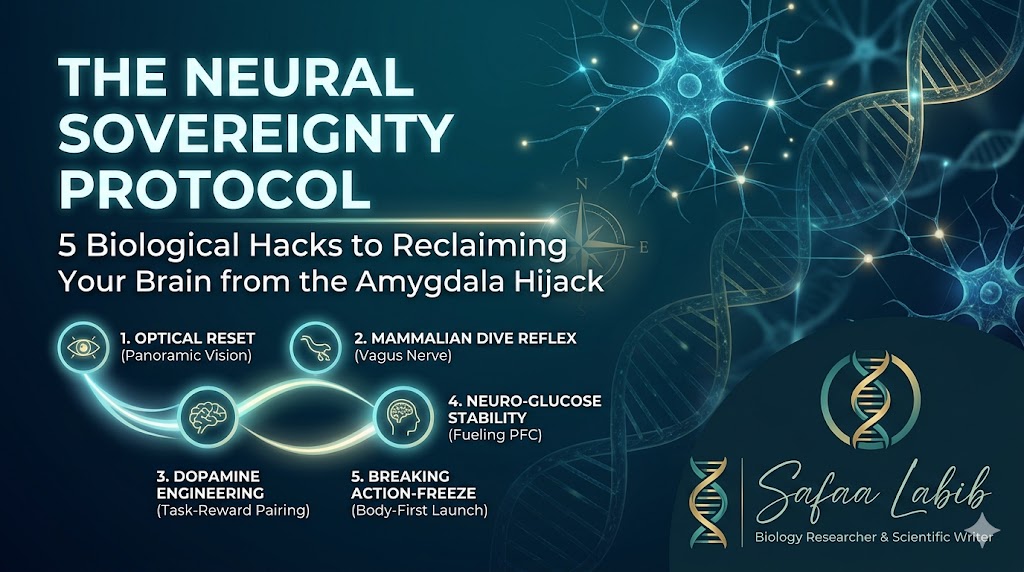
In my latest research series, I delve into the concept of Neural Sovereignty—the ability to consciously regulate your brain’s physiological state to align with your executive goals. If you missed Part I: The Amygdala Hijack (published on ILLUMINATION), you understand that the brain can perceive a “to-do list” as a predatory threat. But how do we move from this “Survival Mode” back into “Executive Mode”?
The Metabolic Cost of Focus
The Prefrontal Cortex (PFC) is the seat of your focus and decision-making. Despite its importance, it is the most energy-expensive part of the human brain. It consumes approximately 20% of your body’s total glucose. When your blood sugar fluctuates or your cellular energy (ATP) is low, the PFC effectively “hibernates,” handing control to the impulsive Limbic System.
This is why your willpower fails you in the evening or when you are stressed. You aren’t lacking discipline; you are lacking Neuro-Glucose stability.
The Neural Sovereignty Protocol: What’s Inside?
In the second installment of this series, now available on Substack, I break down five biological protocols that act as “manual overrides” for your nervous system. These aren’t productivity “tips”—they are physiological interventions.
In the full deep-dive, we explore:
- The Optical Reset: How manipulating your visual field can deactivate the brainstem’s arousal centers in under 30 seconds.
- The Mammalian Dive Reflex: Using thermal stimulation of the Vagus Nerve to snap out of a “functional freeze.”
- Dopamine Mirroring: A scientific approach to re-engineering your reward pathways to make difficult tasks feel chemically rewarding.
- Breaking Action-Freeze: Understanding why the “start” of a task requires the highest burst of ATP and how to trigger it mechanically.
Reclaiming Your Biological Identity
The goal of this research is to transform you from a victim of your neurochemistry into the architect of your brain. When you understand the “Why” behind your resistance, the “How” becomes a matter of clinical precision rather than a daily battle.
[Read the Full Scientific Protocol on Substack]
(Click the button above to access the detailed breakdown and biological exercises)
About the Author: Safaa Labib is a Biology Researcher and Scientific Writer specializing in the intersection of neurobiology, behavioral wellness, and metabolic health. Follow the journey across Medium, Substack, and LinkedIn for more evidence-based insights.
Here is some information about my background: Connect with Safaa Labib
I offer summaries of stories in my guest blogs: Safaa Labib on Digitalmehmet


Leave a Reply