

A Master Framework for Modern Professionals
Integrating self-leadership, capability development, and authentic leadership in complex environments
Written by Keith Williams
Melbourne, Australia
April 2026
Curator’s Note: This scholarly white paper outlines the Growthenticity Ecosystem™, a framework designed to address the fragmented nature of professional development in today’s complex environments. It integrates three key pillars: THRIVE (self-leadership), IMPACT (capability building), and CLARITY (leading others). The framework emphasizes that sustainable growth starts with self-awareness, is cultivated through practical learning, and culminates in authentic leadership. This approach argues that effective professional development cannot occur in isolation and highlights the importance of psychological safety and intrinsic motivation. Ultimately, it promotes an iterative process of continuous learning, adaptability, and personal authenticity in the pursuit of professional excellence.
TABLE OF CONTENTS
Executive Summary
Modern professionals are expected to perform, adapt, and lead in conditions shaped by uncertainty, complexity, and continuous change. Yet professional development is still commonly designed in fragments: leadership is separated from learning, learning from wellbeing, and personal growth from organizational contribution.
This white paper presents the Growthenticity Ecosystem™, an integrated developmental architecture designed to reconnect those fragmented domains. At its centre is a simple proposition: sustainable professional development begins with self-leadership, is strengthened through capability-building, and matures through the authentic leadership of others.
The ecosystem consists of three interdependent pillars: THRIVE for leading yourself, IMPACT for building capability, and CLARITY for leading others. Together, they describe a coherent pathway for helping professionals become more grounded, more capable, and more effective in influencing others and responding to complexity.
This version has been revised to align more explicitly with the companion Medium Scholar article. It more clearly shows how the framework emerged by connecting the work of recognised thinkers in mindset, motivation, experimentation, workplace learning, psychological safety, and adaptive leadership.
Introduction
In many organisations, professional development is still delivered as a set of disconnected interventions. Employees attend leadership programs, complete technical training, and participate in wellbeing initiatives, but these efforts are rarely designed as part of a coherent developmental system.
The consequence is predictable. A professional may be technically strong but emotionally reactive. Another may be highly self-aware but unable to translate growth into capability or influence. A team may be extensively trained yet still lack the psychological conditions needed for learning, candor, and experimentation to take hold.
The Growthenticity Ecosystem™ was developed in response to that fragmentation. Rather than treating leadership, learning, and personal growth as separate disciplines, it brings them together into an integrated model, assuming that durable leadership capacity develops from the inside out and is reinforced through practice, reflection, and adaptation.
How the Ecosystem Emerged
The Growthenticity Ecosystem™ did not emerge from a desire to add another framework to an already crowded field. It emerged from seeing how several influential thinkers had each illuminated an important part of the same professional challenge, yet those ideas were often applied in isolation rather than in relation to one another.
- Carol Dweck gave the field the language of the growth mindset, helping explain why development begins with a willingness to learn, stretch, and revise one’s assumptions.
- Adam Grant highlighted the value of confident humility, showing that mature professionals must balance conviction with the willingness to rethink.
- Eric Ries demonstrated the discipline of experimentation, reminding practitioners that progress often comes through testing and iteration rather than waiting for certainty.
- Amy Edmondson defined the importance of psychological safety, making clear that learning, contribution, and innovation depend on environments where people can speak up, question, and improve without fear.
- Ryan and Deci added the critical insight that sustainable development depends heavily on intrinsic motivation, autonomy, and purpose.
- Josh Bersin reinforced that much meaningful learning happens in the flow of work, not only in formal programmes.
- Heifetz, Linsky, and Grashow showed that leadership in uncertainty is adaptive work, not simply the application of authority or technique.
The central insight of Growthenticity is that these are not separate conversations. They are interrelated dimensions of a single developmental reality. Mindset without motivation is fragile. Experimentation without psychological safety is inhibited. Learning without application remains abstract. Leadership without self-leadership becomes performative. The Growthenticity Ecosystem™ was created to bring these strands together into one coherent architecture.
Defining Growthenticity
‘Growthenticity is the continuous, integrated process of becoming more oneself — authentic — through leading with questions, learning through action, and growing by embracing uncertainty and imperfection, all fuelled by curiosity.’
This definition deliberately joins two ideas that are often treated as separate. Growth is commonly framed as progress, advancement, and capability acquisition. Authenticity is usually associated with alignment, integrity, purpose, and self-awareness. The Growthenticity perspective argues that modern professionals need both, because growth without authenticity can become performative or extractive, while authenticity without growth can become static and insufficiently engaged with real-world demands.
The framework is organised around four recurring practices:
- Leading with questions instead of certainty.
- Learning through action instead of waiting for perfect knowledge.
- Growing by embracing uncertainty and imperfection instead of avoiding them.
- Sustaining curiosity as a discipline rather than treating it as a personality trait.
These practices provide the philosophical foundation of the ecosystem and are expressed in different ways through THRIVE, IMPACT, and CLARITY.
The Ecosystem Structure
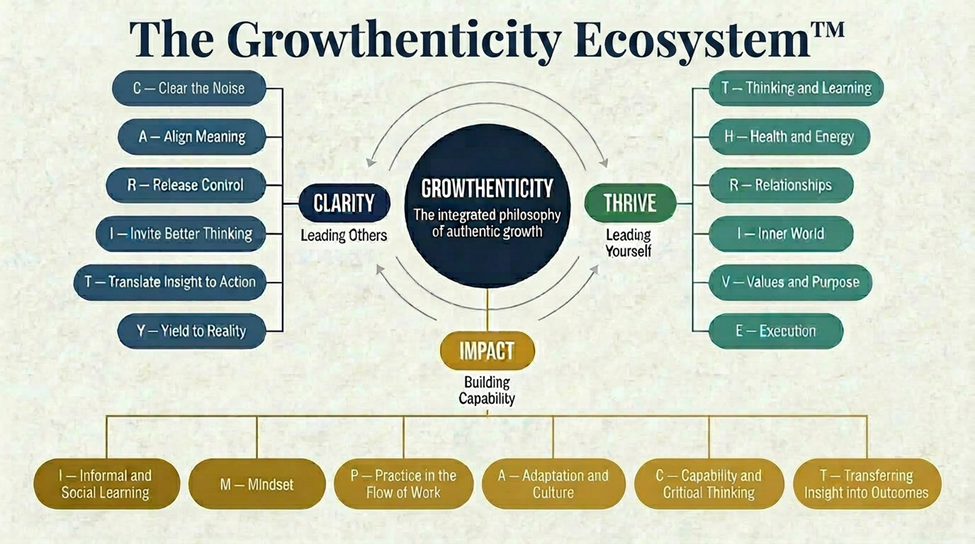
The Growthenticity Ecosystem™ is built on three interdependent pillars:
- THRIVE — Leading Yourself
- IMPACT — Building Capability
- CLARITY — Leading Others
These are not standalone models grouped under a common label. They function as an ecosystem because each one depends on the others for depth, sustainability, and practical effect. THRIVE provides the internal foundation. IMPACT converts readiness into capability. CLARITY translates personal growth and capability into influence, trust, and leadership in context.growthenticity-ecosystem-white-paper.docx+1
THRIVE: Leading Yourself
THRIVE is the foundational layer of the ecosystem. It addresses the internal conditions that make sustainable growth possible. Before individuals can learn effectively or lead others well, they must develop the steadiness, energy, self-awareness, and alignment required to function well under pressure.
THRIVE consists of six dimensions:
- Thinking and Learning — reflective thinking, intellectual curiosity, and the willingness to keep learning. This dimension aligns closely with Dweck’s work on a growth mindset, because development begins with the belief that one can keep growing rather than merely defending a fixed identity.
- Health and Energy — recognition that physical and psychological energy underpin sustainable performance and learning.
- Relationships — the cultivation of reciprocal, growth-oriented relationships that provide support, challenge, and perspective.
- Inner World — self-awareness, emotional regulation, and psychological maturity, all of which shape how a person interprets pressure, feedback, and change.
- Values and Purpose — alignment of behaviour with deeper principles, identity, and meaning. This dimension is strengthened by Ryan and Deci’s work, which shows how intrinsic motivation, autonomy, and internal commitment are central to sustained development.
- Execution — the disciplined translation of intention into action, without which insight remains abstract.
THRIVE matters because capability cannot be sustained on a weak internal foundation. Individuals who are depleted, misaligned, or disconnected from their own patterns may still achieve short-term performance, but they are less likely to sustain growth or exercise mature leadership over time.
Why THRIVE comes first
THRIVE comes first because the quality of capability development depends on the quality of the internal foundation beneath it. Professionals who lack energy, self-awareness, or values alignment are less likely to engage deeply in experimentation, learning in the flow of work, or adaptive behaviour. In that sense, THRIVE is not a wellbeing add-on; it is the developmental base layer of the ecosystem.growthenticity-ecosystem-white-paper.docx+1
IMPACT: Building Capability
IMPACT is the capability-building layer of the ecosystem. It focuses on how individuals and teams convert personal readiness into practical competence and meaningful performance. Rather than treating learning as an isolated event, IMPACT positions development as a continuous, socially embedded, and work-based process.growthenticity-ecosystem-white-paper.docx+1
IMPACT consists of six dimensions:
- Informal and Social Learning — recognising that much valuable learning occurs through dialogue, mentoring, collaboration, and shared practice.growthenticity-ecosystem-white-paper.docx+1
- Mindset — cultivating the psychological orientation required for growth, including openness, humility, motivation, and willingness to improve. Here Dweck, Ryan and Deci, and Edmondson all matter, because mindset is shaped not only by belief in growth but also by motivation and the social conditions that support honest learning.growthenticity-ecosystem-white-paper.docx+1
- Practice in the Flow of Work — embedding development into real work through action, reflection, feedback, and adjustment rather than separating learning from performance. This dimension aligns strongly with Bersin’s work on learning in the flow of work and with Ries’s view that learning happens through testing and iteration.
- Adaptation and Culture — building the ability to read context, respond to change, and operate within or help reshape organisational culture.
- Capability and Critical Thinking — strengthening judgement, decision-making, problem-solving, and the capacity to think clearly in complexity.
- Translating Insight into Outcomes — ensuring that what is learned produces visible improvement in behaviour, performance, and contribution. This is where Ries’s discipline of experimentation becomes especially useful, because learning must eventually be expressed in outcomes rather than good intentions.
IMPACT draws together the practical logic of workplace development. People learn through action, reflection, feedback, social exchange, and the disciplined testing of what works. Capability is not built by information transfer alone.
Why IMPACT comes second
IMPACT comes second because leadership without capability is hollow. Before professionals can guide others clearly, they need the practical ability to make sense of complexity, adapt intelligently, and turn insight into results. IMPACT is the engine that transforms personal potential into demonstrated competence.
CLARITY: Leading Others
CLARITY is the ecosystem’s outward-facing leadership layer. It concerns how professionals influence, guide, and develop others in environments where certainty is limited, and complexity is high. It rests on the view that authentic leadership is not simply a matter of authority or communication style, but the disciplined practice of creating trust, meaning, and direction while staying adaptive to reality.growthenticity-ecosystem-white-paper.docx+1
CLARITY consists of seven dimensions:
- Clear the Noise — reducing internal and external distraction to see situations more clearly.
- Lead Yourself First — grounding leadership in self-management, self-awareness, and discipline.
- Align Meaning — connecting work to purpose so that people understand why their efforts matter.
- Release Control — creating space for trust, agency, and shared ownership rather than over-control.
- Invite Better Thinking — fostering dialogue, challenge, reflection, and psychological safety so better thinking can emerge. This is where Grant’s emphasis on rethinking and Edmondson’s emphasis on psychological safety become especially relevant.
- Translate Insight to Action — turning understanding into direction, decisions, and implementation.
- Yield to Reality — adapting intelligently when assumptions fail, conditions shift, or plans no longer fit the situation. This dimension aligns closely with Heifetz, Linsky, and Grashow’s work on adaptive leadership, which reframes leadership as the capacity to help people face reality and respond wisely rather than cling to certainty.growthenticity-ecosystem-white-paper.docx+1
CLARITY is both internal and external. Although it culminates in leading others, its early dimensions are rooted in self-leadership and personal discipline. In this sense, CLARITY does not stand apart from THRIVE; it builds on it. Nor does it stand apart from IMPACT; it depends on the capability developed there.
Why CLARITY comes third and loops back
CLARITY comes third because it depends on both THRIVE and IMPACT. A leader who lacks inner steadiness is likely to become reactive. A leader who lacks capability is unlikely to guide others wisely. At the same time, CLARITY feeds back into the other two pillars: leaders who practice it well model THRIVE behaviors and create the cultural conditions for IMPACT to flourish across teams and organizations.
Why an Ecosystem Approach Is Needed
The value of the Growthenticity Ecosystem™ lies in its integration. Many development models address one part of the challenge effectively: some focus on wellbeing, some on workplace learning, and others on leadership behaviour. Each can be useful, but none is sufficient on its own for sustainable, whole-person professional development.
An ecosystem approach matters because:
- Self-leadership without capability may produce insight without influence.
- Capability without self-leadership may produce performance without sustainability.
- Leadership without both may produce authority without maturity.
The companion Medium Scholar article presents this argument in a more public-facing narrative form. This white paper complements that article by making the synthesis more explicit and showing more clearly why the framework is best understood as a coherent integration of ideas rather than a standalone, branded model.
The Growthenticity Loop
The ecosystem is best understood not as a sequence to be completed once, but as a developmental loop. Professionals revisit each pillar over time, often at deeper and more complex levels.
An individual may begin by strengthening their THRIVE foundation. As they become more grounded and self-aware, they are better positioned to engage with IMPACT and build meaningful capability. As that capability deepens, they are increasingly called to exercise leadership through CLARITY. That act of leadership then exposes new developmental edges, sending them back into deeper work on THRIVE and new learning through IMPACT.
This looping quality reflects the lived reality of professional growth. Development is iterative rather than neat, relational rather than isolated, and shaped by changing demands rather than fixed stages.
Implications for Professionals and Organisations
For individual professionals, the Growthenticity Ecosystem™ offers a way to make sense of development as an integrated practice. It suggests that sustainable growth is rooted in self-awareness, strengthened through learning in action, and expressed through meaningful contribution to others.
For organisations, the framework offers a more coherent way to think about leadership development, learning strategy, and culture. Rather than investing in disconnected interventions, organisations can design development ecosystems that support the whole person while also improving capability and leadership effectiveness.growthenticity-ecosystem-white-paper.docx+1
For learning and development practitioners, the framework creates a useful bridge between personal growth, workplace learning, and leadership maturity. It supports a shift away from event-based development toward a more systemic view of how people grow in real work.
Conclusions
The Growthenticity Ecosystem™ offers a coherent response to one of the central challenges of modern professional life: how to grow, learn, and lead without becoming fragmented in the process.
By integrating THRIVE, IMPACT, and CLARITY, the framework positions professional development as an inside-out practice. It begins with leading yourself, extends to building real capability, and matures through the authentic leadership of others.
This is not a call for perfection. It is a call for integration. In complex environments, the future belongs not simply to those who know the most, but to those who can remain grounded, keep learning, and lead with clarity under pressure.
That is the work of Growthenticity.
Key Takeaways
- Professional growth breaks down when growth, learning, and leadership are treated as separate pursuits.
- The Growthenticity Ecosystem™ brings them back together through three connected pillars: THRIVE, IMPACT, and CLARITY.
- Sustainable development is built on self-leadership, intrinsic motivation, learning in action, and the courage to lead through uncertainty.
- Real growth is not linear or finished; it is a loop of becoming more capable, more adaptive, and more authentically yourself.
References & Further Reading
- To support the core ideas discussed above, the following sources provide conceptual, psychological, leadership, and workplace-learning foundations for growth, adaptability, motivation, experimentation, and learning in practice.
- On Mindset, Growth, and Belief Systems:
- Dweck, C. S. (2006). Mindset: The new psychology of success. Random House.
(Foundational work on fixed and growth mindsets, especially useful for understanding how beliefs shape learning, resilience, and development.) - Grant, A. (2021). Think again: The power of knowing what you don’t know. Viking.
(Explores rethinking, intellectual humility, and the value of questioning assumptions — particularly relevant to confident humility and adaptive learning.) - On Psychological Safety and Learning Cultures:
- Edmondson, A. C. (2018). The fearless organization: Creating psychological safety in the workplace for learning, innovation, and growth. John Wiley & Sons.
(A key source on psychological safety as a condition for learning, experimentation, speaking up, and innovation in teams and organisations.) - On Adaptive Leadership and Change:
- Heifetz, R. A., Linsky, M., & Grashow, A. (2009). The practice of adaptive leadership: Tools and tactics for changing your organization and the world. Harvard Business Press.
(Provides a practical framework for leading through complexity, uncertainty, and change when technical solutions are insufficient.) - On Experimentation, Iteration, and Learning by Testing:
- Ries, E. (2011). The lean startup: How today’s entrepreneurs use continuous innovation to create radically successful businesses. Crown Business.
(Introduces the logic of rapid experimentation, validated learning, and the minimum viable product as a way to test ideas in practice.)
On Motivation, Autonomy, and Well-Being:- Ryan, R. M., & Deci, E. L. (2000). Self-determination theory and the facilitation of intrinsic motivation, social development, and well-being. American Psychologist, 55(1), 68–78.
(A foundational article on intrinsic motivation, showing how autonomy, competence, and relatedness support engagement, development, and well-being.)
On Workplace Learning and Learning in the Flow of Work:- Bersin, J. (2018, July 7). A new paradigm for corporate training: Learning in the flow of work. Josh Bersin. https://joshbersin.com/2018/06/a-new-paradigm-for-corporate-training-learning-in-the-flow-of-work/
(Explains how learning can be embedded into everyday work rather than separated from it, making development more timely, relevant, and applied.)
About the Author
Keith Williams is a learning designer and leadership specialist based in Melbourne, Australia. He is the creator of the Growthenticity Ecosystem™ — comprising the THRIVE Leading Yourself Pillar™, the IMPACT Building Capability Pillar™, and the CLARITY Leading Others Pillar™.
Keith publishes through his blog at Nomad Learning, on Medium, and his Substack, Lead, Learn, Grow. He is currently writing a book titled The Growthenticity Path.


Leave a Reply