

A New Blueprint for Adaptive Materials Emerging from Japan and the UK
Curator’s Note: A recent international study from researchers in Japan and the UK has introduced a chlorophyll-based supramolecular polymer that evolves dynamically, transforming its structure from non-helical fibers to tightly coiled helices over days. This process mimics natural adaptability and emphasizes the significance of helicity, spiral structures crucial for biological functions. The polymer’s structural evolution occurs in a stepwise manner, influenced by environmental cues, and showcases cooperative behavior across the material. This breakthrough suggests a shift in materials design, focusing on adaptive qualities over static forms, which could lead to innovative applications in smart materials and molecular electronics. This science essay was written by Dr Michael Broadly, a retired scientist and public health professional.
Time-Evolving Helicity in a Polymer
Science occasionally reminds us that nature is still the best engineer we have because it is dynamic. It doesn’t lock itself into rigid structures too early. It adapts, evolves, and refines its form over time.
Today, my collaborators from Japan published an international study. They are researchers from Chiba University, Shizuoka University, Ritsumeikan University, Kanazawa University, and Keele University, and they offer a fascinating example of how far materials science is moving in this direction.
The team has developed a chlorophyll-based supramolecular polymer that does something rather unusual in synthetic chemistry: it does not “decide” its final structure immediately. Instead, it evolves.
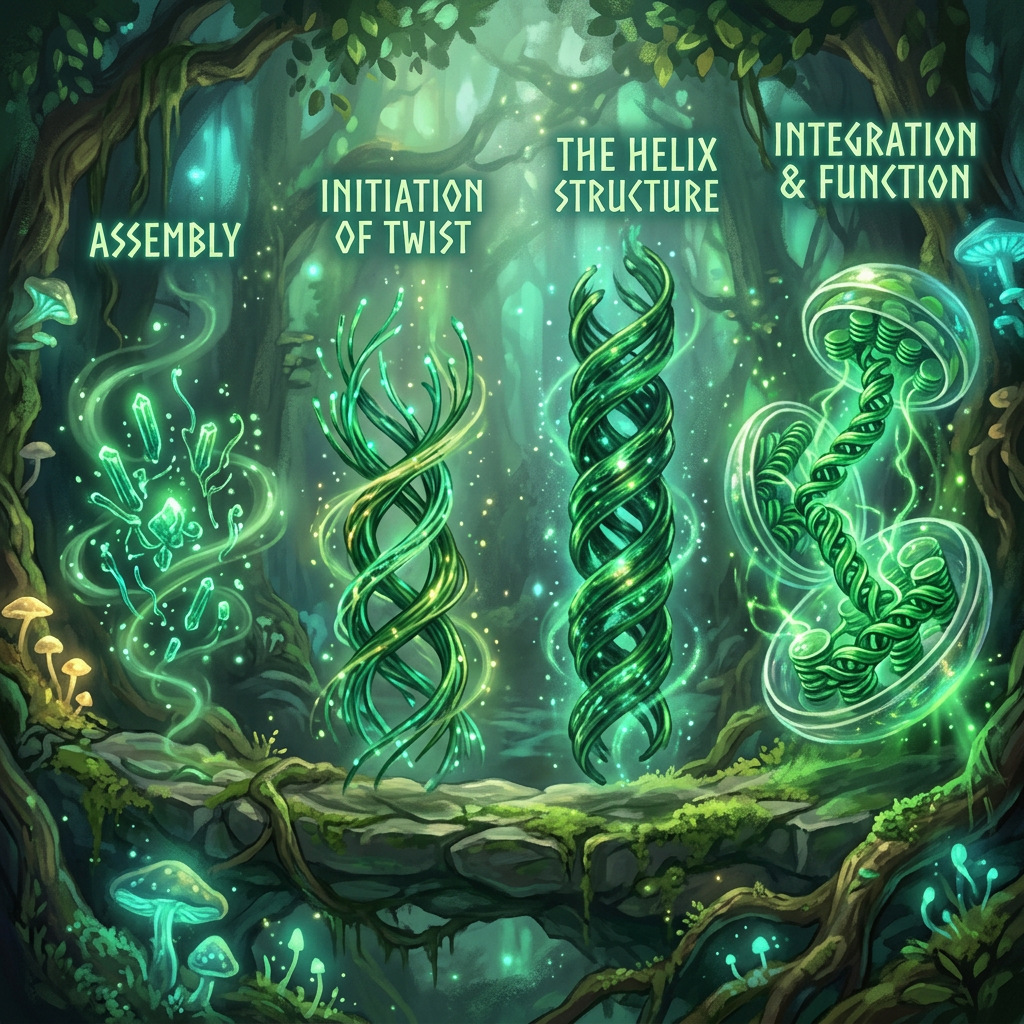
It begins as a simple, non-helical fiber with almost flat organization, but over time, through a sequence of intermediate stages, it gradually transforms into tightly wound helical structures.
In other words, it behaves less like a static material and more like a system learning how to organize itself.
What Is Helicity, and Why Does It Matter More Than It Looks
Some readers unfamiliar with helicity wonder what it is. I will explain it briefly and clearly so that this study and story make sense to you.
At first glance, helicity can sound like a highly specialized structural detail reserved for chemists and physicists. In reality, it is one of nature’s most fundamental design principles.
Helicity refers to a twisting, spiral-like arrangement of molecules or structures. But this seemingly simple geometry carries enormous functional significance in biological systems.
One of the most familiar examples is DNA, which forms a double helix. This shape is not decorative. It is essential for how genetic information is stored, copied, and accessed. Similarly, proteins often fold into helical segments that determine how they interact, move, and perform biological functions.
What makes helical structures particularly powerful is their responsiveness. Unlike rigid forms, helices are not fixed in a single configuration. They can tighten, loosen, or subtly shift their twist in response to environmental conditions such as temperature, chemical conditions, or mechanical stress.
The key nuance is that in biological terms, this flexibility is not incidental. It is what allows living systems to remain adaptable. A small change in helical structure can influence how a protein behaves, how a molecule binds, or how efficiently a biological process occurs.
To me, helicity is not just a geometric curiosity. It is a functional mechanism for dynamic adaptation at the molecular scale.For scientists working in materials chemistry, this presents both an inspiration and a challenge.
It is not enough to create molecules that form helical shapes under controlled conditions. The real goal is to design systems that can develop helicity over time, responding to internal and external cues in a controlled, stepwise manner.
And this is exactly where the present study becomes particularly interesting and worth telling a story about. It moves beyond static helices and begins to explore how helicity itself can emerge, evolve, and mature within a synthetic system.
A material that doesn’t form a shape, but it discovers one
The research team built a chlorophyll derivative functionalized with barbituric acid groups and long alkyl chains. These molecules self-assemble into ring-like structures via hydrogen bonding, forming rosettes.
Initially, these rosettes stack into long, one-dimensional fibers in low-polarity environments. But instead of immediately locking into a stable helical arrangement, the system behaves differently. It hesitates.
It first forms non-helical fibers, then transitions into loosely twisted helices, and finally matures into tightly coiled structures over several days.
This progression is not random. It follows a clear sequence of structural refinement:
- Non-helical fibers (NF)
- Early helical forms (HF1, HF2)
- Fully developed tight helices (HF3)
Interestingly, all helices formed are right-handed, but each stage has a different pitch—gradually tightening from roughly 26 nm down to 8 nm. It is, in effect, a molecular “learning process” expressed through structure.
Watching molecules evolve in real time
Using high-resolution imaging techniques such as atomic force microscopy, the researchers were able to track this transformation step by step.
Within just 30 minutes, most non-helical fibers disappeared, replaced by early helical forms. Over the next few hours, intermediate structures continued to reorganize. But the final transition into the most tightly wound helices took days.
That slow maturation is scientifically important. It suggests that the system does not simply “flip” into a final shape. Instead, it moves across a rugged energy landscape, passing through intermediate stable states before settling into its most energetically favorable configuration.
As Prof. Shiki Yagai from Chiba University explains, such dynamic emergence of helicity from initially non-helical structures is rare in synthetic supramolecular systems.
The surprising role of cooperation at the molecular level
Perhaps the most intriguing aspect of this work is not just the structural evolution, but how it spreads.
Once a small region of a fiber adopts a more stable helical form, that change encourages neighboring regions to follow suit. In other words, structural change propagates cooperatively along the polymer.
This is not unlike a wave of reorganization moving through the material; once initiated, it sustains itself.
From a design perspective, this is significant. It suggests that future materials could be engineered not only to change shape but also to self-propagate transformation, much as biological systems do during growth or adaptation.
Why this matters beyond chemistry
At a broader level, this study points toward a different way of thinking about materials.
Most synthetic materials are designed to reach a final form as quickly and efficiently as possible. But biological systems often do the opposite: they prioritize developmental pathways over final states.
This research brings synthetic chemistry a step closer to that logic.
By designing molecules that can occupy multiple stable configurations and transition between them gradually, scientists may be able to create materials that:
- adjust optical properties over time
- respond to environmental change
- or reorganize their electronic behavior dynamically
That opens doors in fields ranging from smart coatings to adaptive photonic systems and molecular electronics.
The bigger scientific question that remains and A shift in how we design matters
One key question remains unresolved: does this structural evolution occur randomly along the fiber, or does it propagate directionally from specific initiation points? Answering that could shift this from a fascinating observation into a fully controllable design principle. And in materials science, controllability is very important.
A broader lesson in this story is that we may need to stop thinking of materials as static objects. Instead, we may begin to design them as processes, systems that evolve, adapt, and refine themselves over time.
In that sense, this chlorophyll-based polymer looks more than a chemical curiosity to me. I see it as a small but meaningful step toward materials that behave less like engineered objects and more like living systems.
And that, possibly, is where the future of material science is heading, from my understanding.
Reference: Sequential, Multistep, and Cooperative Helicity Evolution in Supramolecular Polymers of Chlorophyll Rosettes published on Journal of the American Chemical Society authored by Balaraman Vedhanarayanan, Ryoma Tsuchida, Ryo Kudo, Hiroki Hanayama, Sougata Datta, K. C. Seetha Lakshmi, Hitoshi Tamiaki, Nobuyuki Hara, Yuta Hori, Sarah E. Rogers, Takatoshi Fujita, Martin J. Hollamby, Shinnosuke Kawai, and Shiki Yagai. DOI: 10.1021/jacs.6c03125
Here is the press release authored by Professor Shiki YAGAI.
About Me
I’m a retired healthcare scientist in my late-70s. I have several grandkids who keep me going and inspire me to write on this platform. I am also the chief editor of the Health and Science publication on Medium.com. As a giveback activity, I volunteered as an editor and content curator for Illumination publications, supporting many new writers. I will be happy to read, publish, and promote your stories. You may connect with me on LinkedIn, Twitter, and Facebook, where I share stories I read. You may subscribe to my account to get my stories in your inbox when I post. You can also find my distilled content on Substack: Health Science Research by Dr Mike Broadly.
Editorial Announcements
Apart from my own pub Health and Science, I also introduced another new publication established by Gary L. Fretwell and Aiden (Owner of Illumination Gaming). Check out the relevant stories below:
Introduction to ILLUMINATION: Retirement, Aging, and Legacy
Initial Submission Guidelines and Reflections from a Retired Healthcare Professionalmedium.com
Welcome to ILLUMINATION Local News and Documentary Publication
Benefits of this new publication for readers and writers, and some guidance for contributorsmedium.com
You can find the submission guidelines for the ILLUMINATION Integrated Publications from the following links:
ILLUMINATION, Curated Newsletters, SYNERGY (Newsletter Booster), Technology Hits, Health and Science,ILLUMINATION Book Chapters, Readers Hope, ILLUMINATION Gaming,Videos/Podcasts, Magnetic Newsletter Pro, Substack Mastery Boost, ILLUMINATION Scholar (NEW), ILLUMINATION Local News and Documentaries (NEW), ILLUMINATION Retirement, Aging, and Legacy (NEW)
Thank you for reading my stories and joining our publications.


Leave a Reply