

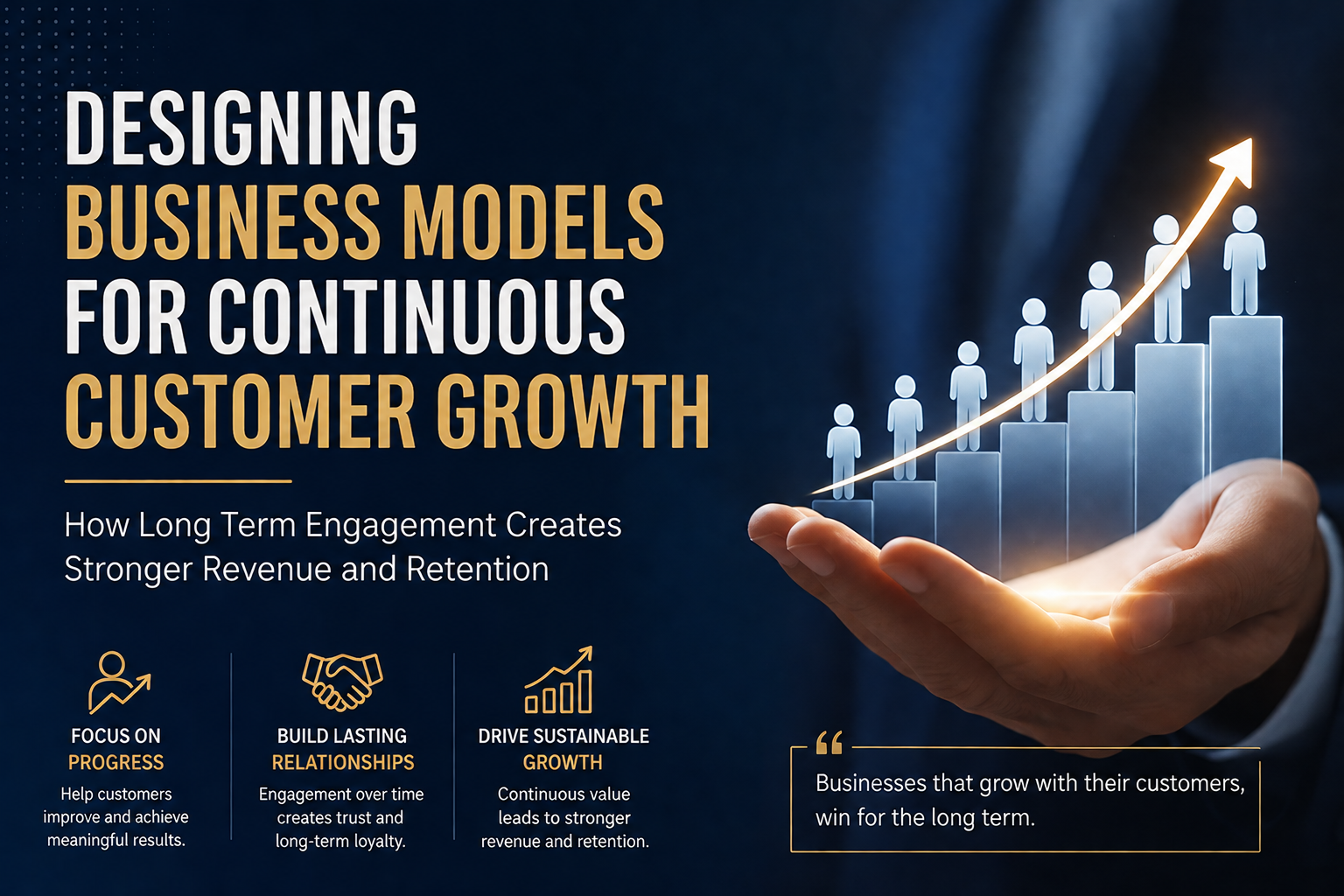
Building Business Models That Scale Through Customer Progress
This article is built on a pattern that becomes clear when you look at how value has evolved over time. There was a time when companies created advantages through better products. Then came a phase where services made the difference. After that, businesses started focusing on customer experience to stand out. Each step increased value, but also increased competition as more players learned to deliver the same thing.
Now the next stage is becoming visible. Customers are not just buying products or services, and they are not even satisfied with good experiences alone. They are trying to achieve outcomes that improve their lives and capabilities.
Understanding What Customers Actually Want to Become
When the intent behind a purchase is deep and personal, the customer is not looking for a product; they are aiming for a change in who they are. This kind of aspiration reflects a deeper change in identity, not just an improvement in skill.
A person does not join a program to access features; they are trying to move toward a more capable and defined version of themselves. Real change does not come from access alone; it comes from consistent effort, reflection, and a willingness to evolve from within. The transaction opens the door, but the real expectation is transformation over time.
A recent example can be seen in Duolingo, which has moved beyond simple lessons into a system built around habit and discipline. Its model encourages daily consistency, gradual improvement, and personal accountability.
Over time, users are not just completing lessons; they begin to see themselves differently, as someone who is committed and capable. This is where value deepens, when the offering supports a journey that reshapes behavior and mindset rather than just delivering content.
Mapping Customer Change: From Small Improvements to Identity Transformation
Customer change operates across clear levels, not as a single uniform outcome. Some customers pursue small improvements in existing behavior, while others aim for broader capability expansion or even a redefinition of who they are. When these levels are treated the same, the result is weak positioning and limited retention. Strong businesses recognize that progress unfolds gradually, and meaningful change requires consistency, discipline, and internal alignment from the individual.
Business thinking has identified that customer value evolves across stages, from basic offerings to higher levels of engagement and transformation. This progression is explained in the widely referenced work on the experience economy, where value moves from goods to services to experiences, and eventually toward transformation.
Companies that align their offerings with these evolving stages remain relevant across the full customer lifecycle instead of competing only at the entry point.
Designing Offerings That Drive Continuous Customer Progress
When a business understands that customers are trying to improve themselves, the design of the offering has to change as well. Value can no longer be limited to a single interaction. Real progress takes shape over time, through repeated effort, reflection, and steady discipline.
What truly grows is not what is handed over once, but what is nurtured within the person again and again. A model that ends at the point of sale may give access, but it cannot carry someone forward.
This is why stronger businesses move toward continuity. You can see this across leading platforms today. Google builds AI systems like Google Gemini that become part of how people search, write, and analyze daily. OpenAI with ChatGPT follows a similar pattern, where repeated use improves how users think and work.
Netflix keeps users engaged through personalized recommendations that evolve with behavior, while Figma enables teams to continuously refine how they collaborate and build products. In each case, the value is not delivered once. It develops through ongoing interaction. Users return, adjust, and improve, and the system evolves with them.
Building Systems That Sustain Customer Progress
Understanding customer progress is one step. Sustaining that progress is where real business strength is built. Most people begin with intention, but without structure, that intention fades. What lasts is what is reinforced over time. Growth stays when it is supported through consistency, clear direction, and systems that bring the user back again and again.
A strong example can be seen in Anthropic and its product Claude. It does not deliver value in a single interaction. It becomes part of how developers and teams work on a daily basis. As users rely on it for coding, analysis, and decision support, their output improves with continued use.
This is reflected in its scale, with Claude reaching 18.9 million monthly users and around $14 billion in annualized revenue in 2026. More importantly, over 1,000 enterprise customers spend more than $1 million annually, showing that usage deepens as reliance grows. What begins as usage turns into a working system, and that is what sustains progress over time.
Capturing Value: Why Transformation Drives Premium Pricing
When value shifts from delivery to development, pricing becomes a result, not the starting point. People are willing to pay when they can feel their own progress. Not in theory, but in their daily work and outcomes. What grows slowly through effort starts to matter more, and what matters more is not easily replaced. That is where price stops being the main question.
You can see this clearly in Shopify. It does not just give merchants tools; it stays with them as they build and grow their business. As their effort compounds, the platform becomes part of how they operate. In 2024, Shopify generated around $8.8 billion in revenue, not from one-time use, but from continuous participation in that growth. A similar pattern exists in HubSpot, where companies start small and expand over time. What begins as usage turns into dependence, because real value is what stays with you after repeated effort.
What Will Define the Next Generation of High-Value Businesses
The next phase of business will be shaped by how well companies understand human progress. Products will keep improving, and services will keep getting faster, but that alone will not build a lasting advantage. Real value comes when a business helps a customer move forward in a meaningful way. That kind of progress is not instant. It builds with intention, patience, and consistent effort, and it stays only when it is rooted in the customer’s own commitment to improve.
Businesses that recognize this do not rush to complete transactions. They stay present across the journey. They design systems that support steady growth and make it easier for customers to remain consistent over time. This creates a different kind of relationship. It is not based on convenience alone; it is based on trust and continuity. Over time, what is temporary fades, but what is built through steady effort remains. That is where real business strength comes from.
My connection details:
hmdlabee@gmail.com
https://www.linkedin.com/in/technicalwriterus/
https://medium.com/@hmdlabee


Leave a Reply