

The Modern Myth of Constant Productivity
In an era of endless scrolling and 24/7 digital stimulation, we have been conditioned to view “boredom” as a failure. We fill every micro-moment—waiting for coffee, commuting, or even during work breaks—with sensory input. But as a Biology Researcher, I’ve observed a dangerous biological mismatch: our brains were never designed for this level of chronic stimulation. While we think we are being productive, we are actually suppressing one of the most powerful evolutionary mechanisms for human genius.
Unlocking the Default Mode Network (DMN)
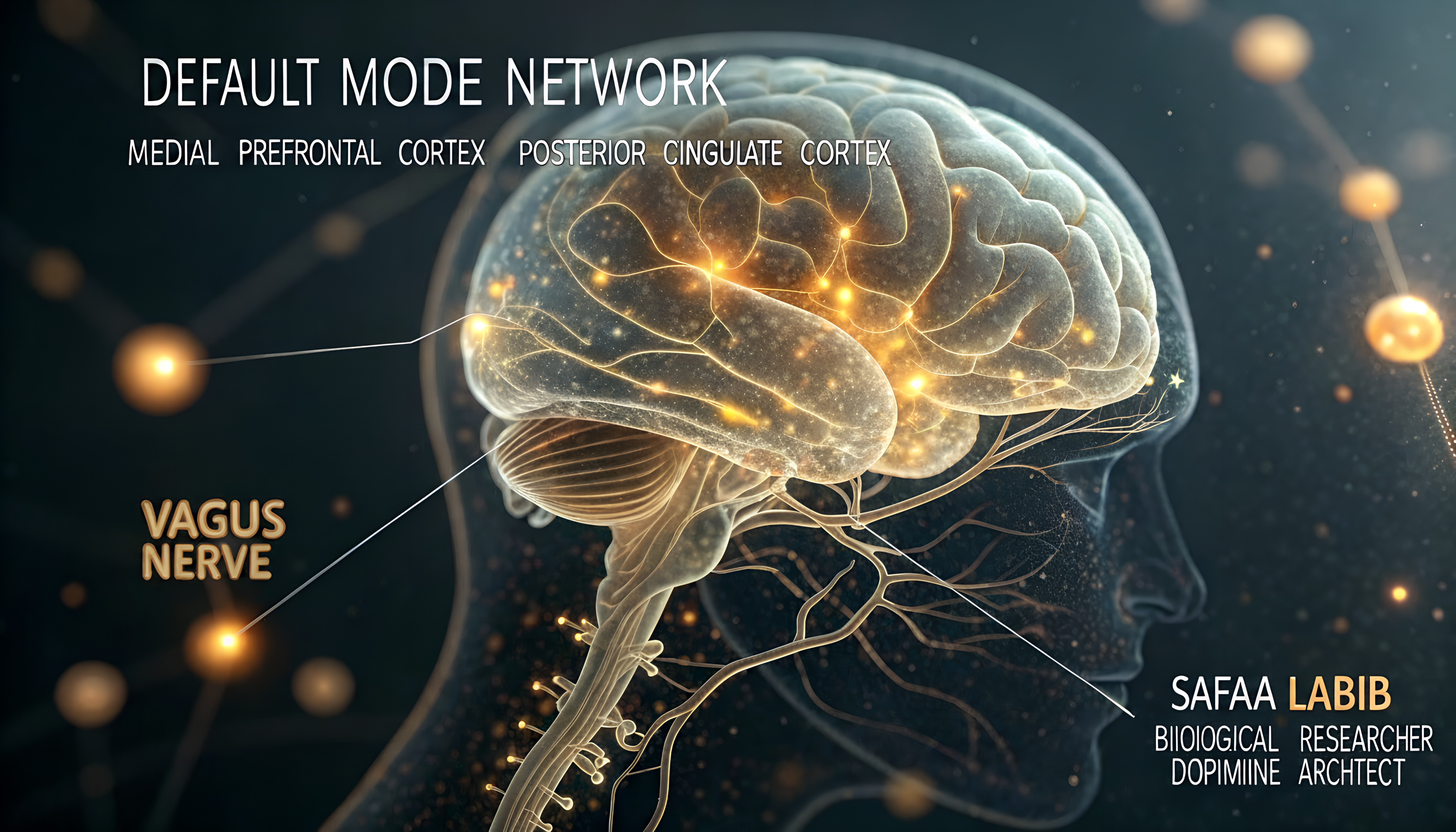
When you stop focusing on external tasks, your brain doesn’t just “turn off.” Instead, it ignites a complex hub known as the Default Mode Network (DMN). This system, involving the Medial Prefrontal Cortex, is the biological “incubation chamber” where creative synthesis happens. While you are staring at a wall or walking without your phone, your brain is busy performing Neural Incubation—integrating memories, processing social cognition, and testing future scenarios in a safe, offline environment.
The Metabolic Cost of Always Being ‘On’
The human brain is an energy-intensive organ, consuming nearly 20% of your metabolic resources. Constant “plugging in” forces the brain into permanent Task-Positive Network (TPN) activation. This creates a massive Neuro-Metabolic Cost, leading to decision fatigue and neural inefficiency. By embracing boredom, you aren’t just resting; you are allowing for Metabolic Recovery and performing a Neurochemical Reset of your dopamine receptors.
Synaptic Pruning: The Librarian of the Mind
Think of your brain as a library. If data is thrown on the floor 24/7, the librarian has no time to organize it. Boredom is the librarian’s shift. During these silent intervals, the brain undergoes Synaptic Pruning—the biological process of removing irrelevant neural connections to strengthen important ones. This “biological housekeeping” is what transforms a chaotic day of learning into structured wisdom.
Mastering Bio-Strategic Boredom
To achieve high-level innovation, we must re-calibrate our relationship with silence. In my latest feature for ILLUMINATION Scholar, I break down the science of Cognitive Flexibility and how intentionally practicing boredom can build a faster “neural highway” for creative problem-solving.
Is your constant hustle locking the door to your own genius? It’s time to allow your biology the silence it requires to speak.
[Read the Full Scientific Deep-Dive on ILLUMINATION Scholar]
Here is some information about my background: Connect with Safaa Labib
I offer summaries of stories in my guest blogs: Safaa Labib on Digitalmehmet
Mastering Bio-Harmony: The Science of Your Internal Ecosystem
The Hidden Cost of Biological Friction
In an era dominated by relentless productivity and “hustle culture,” we often treat our bodies like high-performance machines that can be pushed indefinitely. We rely on willpower to override exhaustion, caffeine to mask sleep deprivation, and digital stimulants to fuel our focus. But as we strive for peak performance, we often overlook a critical biological reality: Your body is not a machine; it is a complex, fluid ecosystem.
When our external demands exceed our internal metabolic capacity, we enter a state of Biological Friction. This isn’t just stress—it’s a systemic misalignment that affects every cell, from your mitochondria to your prefrontal cortex. To achieve sustainable success in 2026, we must move beyond “bio-hacking” and embrace Bio-Harmony.
The Pillars of Neuro-Metabolic Alignment
Living in harmony with your biology is a science-backed strategy for long-term health and cognitive clarity. It requires a deep understanding of the internal rhythms that dictate our energy and mood.
1. Circadian Sovereignty: Your internal clock, the Suprachiasmatic Nucleus (SCN), orchestrates your metabolic health. Ignoring your light-dark cycles leads to circadian desynchrony, preventing your brain from clearing toxic waste.
2. The Vagal Bridge: The Vagus Nerve acts as the highway between your brain and your immune system. By mastering “Vagal Tone,” you can switch your biology from a state of survival (defense) to a state of executive function (growth).
3. Mitochondrial Diplomacy: Every thought is funded by ATP. When we ignore our “Ultradian Rhythms”—the 90-minute cycles of focus and rest—we force our mitochondria into a state of oxidative stress, leading to what we commonly call “burnout.”
Why You Should Read the Full Analysis
In my latest deep-dive article, “The Biology of Inner Resonance,” I explore the specific neuro-metabolic architecture required for physiological alignment. We won’t just talk about “wellness”; we will analyze the cellular mechanics of intuition, the energy budgeting of the brain, and the protocol for reclaiming your biological stewardship.
Stop fighting your biology and start partnering with it. It’s time to transition from being an architect of stress to a gardener of growth.
[Read the Full Article on Substack: The Biology of Inner Resonance]
Here is some information about my background: Connect with Safaa Labib
I offer summaries of stories in my guest blogs: Safaa Labib on Digitalmehmet
Support My Research & Stay Connected
If you found this biological deep dive valuable, I invite you to join my community of science-driven readers. Your support empowers me to continue exploring the fascinating intersection of neurobiology and wellbeing.
- Subscribe to My Substack: Join the “World of Health and Self” newsletter for exclusive insights, research updates, and detailed biological protocols delivered to your inbox. 👉 Join the Community on Substack
- Support My Work on Patreon: If you’d like to support my independent research and help me create more high-quality, evidence-based content, consider becoming a patron. 👉 Support My Research on Patreon
Thank you for being part of this journey toward Biological Sovereignty.


Leave a Reply