

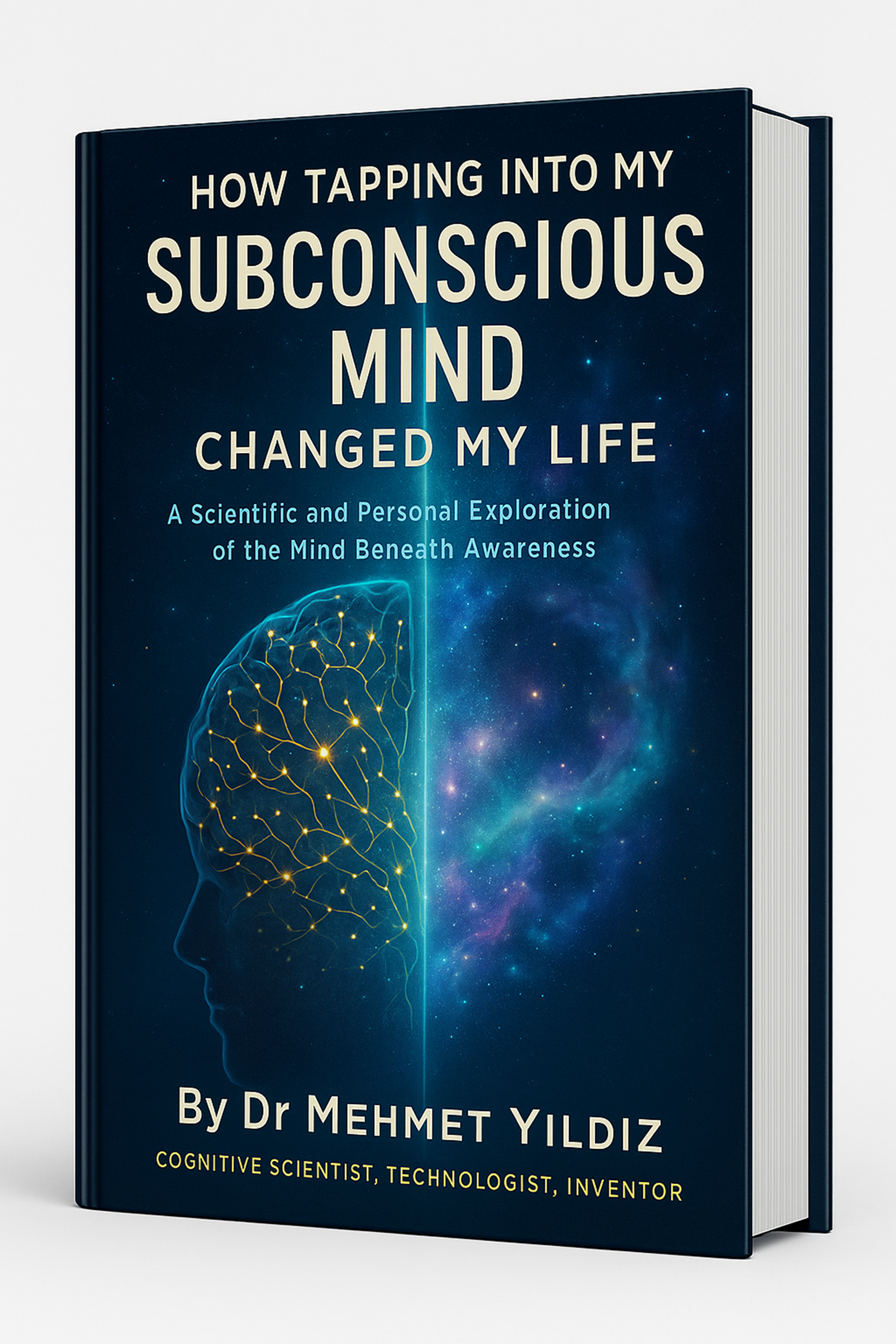
This book, Written by Dr. Mehmet Yildiz, a Cognitive Scientist Reviewed by Dr. Bronce Rice, Psychologist & Psychoanalyst
Curator’s Note: Dr. Mehmet Yildiz’s book, “How Tapping Into My Subconscious Mind Changed My Life,” explores the profound impact of the subconscious on human behavior and mental well-being. Combining scientific insights and personal reflection, Yildiz emphasizes the importance of understanding the subconscious as an active system influencing our responses and emotions. The book illustrates how emotions serve as a primary language of the subconscious, shaping reactions and perceptions. It further discusses the challenges in altering longstanding patterns and the role of new experiences in facilitating change. Overall, the work invites readers to engage thoughtfully with their subconscious to nurture personal healing and deeper relational connections. This review was written by Dr. Bronce Rice, Psychologist & Psychoanalyst
Dr. Mehmet Yildiz’s book, How Tapping Into My Subconscious Mind Changed My Life, is a wide-ranging and personally reflective exploration of how much of human life is shaped before we become consciously aware of it. The book brings science and lived experience together in a way that helps us think more clearly about the mind beneath awareness.
As a psychoanalyst and psychologist focused on mental health and wellbeing, I found this book especially meaningful because it takes up a subject that sits at the center of my own clinical work. Much of therapy involves helping people bring attention to parts of their inner life that have been influencing them before they can fully recognize what those influences are.
Many people come to therapy because something in their lives feels off, or because something within them does not feel right. They may not yet understand the psychological patterns shaping their lives, even when they can feel the effects of those patterns. What they often do not understand is why these patterns keep repeating, or why they can affect them so deeply.
The book gives us a grounded way to think about the subconscious without reducing it to a vague, hidden force we can never understand. Dr. Yildiz shows how the mind beneath awareness participates in ordinary life, especially in moments when our reactions or relationships do not make immediate sense to us.
Understanding the Subconscious Mind
One of the strengths of Dr. Yildiz’s approach is that he treats the subconscious as a dynamic system we can learn to observe. Rather than presenting the subconscious as a sealed-off part of the mind, he shows how it learns from experience and begins shaping our responses before we have fully thought them through. This gives the book a practical foundation: the subconscious becomes less of an abstract concept and more of a way to understand the automatic nature of our responses.
As someone trained in psychoanalytic thought, I usually think in terms of the unconscious, especially in Freud’s more dynamic sense of the word. In that tradition, the unconscious is not simply material outside awareness. It is an active part of mental life, one that can influence a person’s behavior before the person understands why they are reacting in certain ways. Dr. Yildiz uses the term subconscious more broadly, drawing from contemporary science while writing for a broader audience.
This approach also helps us see why change often requires more than conscious effort. If the subconscious learns from repeated experience, then new understanding has to be reinforced through new experience over time. The book is strongest when it shows that awareness does not instantly change us, but helps us begin participating differently in the patterns shaping our daily lives.
Emotion as a Primary Language of the Subconscious
In the chapters on emotion, Dr. Yildiz describes our emotions as one of the primary languages of the subconscious. What he means by this is that our emotions are a central way our body and mind register experience before we have a chance to understand it or explain it to ourselves. Because our emotions can arise before conscious thought, we may feel anxious or hurt before we understand why we feel this way.
For many of us, disconcerting emotions feel confusing or upsetting before we are able to understand them as meaningful information about ourselves. Dr. Yildiz’s point is that our emotions help determine what our minds give their attention to. In this sense, a feeling may be the first indication that an experience has registered as important before we know why.
The body enters this discussion as another place where emotional experience can first become known to us. A feeling may appear in our body before we can connect it to a thought we can examine. This does not mean every bodily sensation is emotional. It means our body can sometimes give us the first sign that something has affected us emotionally. Listening to our body is one way we can begin listening to the subconscious.
The book also shows how closely our emotions and memories are connected. An experience that affects us emotionally does not simply pass through us and disappear. A painful moment may have passed, but its emotional meaning can continue to affect how we respond to similar situations later. This is one reason an emotional experience can have such a lasting influence. It not only tells us what we felt then, but it can also influence how we respond when a later situation feels familiar, even if it is not the same.
His treatment of emotional regulation is valuable because it keeps the focus on working with our emotions rather than merely trying to make them disappear before we understand them. If we move too quickly to shut down how we feel, we may lose the chance to understand why we are feeling a particular emotion in the first place. The deeper point is not that we should suppress our emotions or move beyond them, but that we can develop enough of a relationship with what we feel that our emotional responses become less automatic and more available for reflection.
Prediction, Repetition, and Why Change Can Be Difficult
Dr. Yildiz’s discussion of the predictive brain adds an important psychological layer to the book. He shows that we do not encounter the present moment without some aspect of our past already present in it. Our minds draw on earlier experience to anticipate what is likely to happen to us in the future, and over time, our expectations can begin to feel less like possibilities and more like reality itself. From my perspective, this helps explain why old patterns can be so difficult to change. We may believe we are responding only to our current situation, while some older experience or expectation has already prepared us, in some strange way, for a familiar kind of hurt.
In Dr. Yildiz’s account, these predictions can be revised, but the revision has to become more than an idea we understand intellectually. Our minds need new evidence, and that evidence often comes when a familiar situation is lived through in a new way. Over time, the old expectation begins to lose some of its hold on the present. Change can feel uncomfortable because the subconscious is being asked to learn that an old expectation no longer has to determine how we respond.
The book describes this revision of old expectations through prediction error: the moment when what happens does not fit what we expected. Psychologically, that is often where change begins. If we expect criticism and instead meet understanding, the old expectation is not simply contradicted as an idea; it is challenged by experience. The mind has to take in that the present is not repeating what the past had prepared us to expect.
Here is where prediction and repetition begin to meet. And what repeats is not only a behavior; often, it is the expectation that the past will be confirmed in the present. This helps explain why change can feel difficult even when we deeply want it. We may be trying to live differently while part of our mind is still preparing for an old, familiar outcome that has not yet happened. In this sense, repetition is not only something we do; it is something we come to expect. This is where inner conflict begins, or what psychoanalysis might understand as the mind in conflict: part of us wants a different life, while another part is still prepared for the old outcome.
Healing, Relationships, and the Work of Repair
Dr. Yildiz’s book becomes especially useful when he turns from understanding the subconscious to working with it. He offers practical ways of attending more carefully to our emotional lives, but he does not present these practices as shortcuts around deeper change. At their best, they are ways of giving our subconscious new experiences to learn from, especially when old patterns have been organized around fear, stress, or emotional pain.
This way of understanding change made me think of a clinical example I recently wrote about in my article Inward Knowing and What Becomes Ours. In that piece, I described Daniel, whose fear of intimacy was not simply a thought he could change once he understood it better. It lived in his body and in the way closeness began to feel dangerous before he could fully explain why. As he came to understand this more deeply, he could begin to pause when closeness frightened him and ask whether he was responding to the person in front of him or to an older fear of being taken over. In this sense, his struggle highlights one of the central ideas in Dr. Yildiz’s book: old patterns often need more than understanding alone. They often need new experiences that help their mind and body learn that the present does not have to repeat the past.
As Daniel’s case conveys, old patterns often become most visible in our relationships with the people we care about. When we feel conflicted, we may react before we fully understand what has happened between us. A tone of voice may be enough to stir an old expectation. At other times, the trigger may be something more fleeting, such as a sensory detail we had long forgotten. This is where Dr. Yildiz’s focus on repair becomes useful. When we set out to repair something, it frequently asks us to notice when something older has entered the present, whether in our relationship to ourselves or with another person. With that recognition, responding with more understanding becomes more possible than the old pattern alone may have allowed.
The later chapters widen the book’s frame by bringing Jung and Frankl into the conversation. Although my own clinical orientation is more Freudian, I appreciated their inclusion because it keeps the subconscious from being understood only as a system of reaction. Jung’s work gives the book a way to think about dreams, symbols, and the forms through which inner life can become more visible before it reaches conscious awareness. And Frankl raises the question of meaning: how we remain oriented toward life when suffering threatens to strip life of any sense of purpose or direction. In this way, the book moves beyond emotional regulation and repair toward a larger concern with how our inner life can become more purposeful and more deeply understood.
I am grateful to Dr. Yildiz for writing a book that invites readers to take the subconscious seriously without making it feel inaccessible. How Tapping Into My Subconscious Mind Changed My Life will be especially meaningful for those interested in healing, relationships, and the search for meaning in our lives. The book’s greatest value is that it makes the subconscious feel more understandable and less foreign, something we can begin to work with rather than fear.
This overlaps with how I understand the work of therapy: not as an effort to overcome or sidestep the unconscious, but as a way of coming into a more thoughtful relationship with the parts of ourselves that have been influencing us outside our awareness. By the end, the subconscious is no longer presented as a hidden force operating beyond our grasp, but as part of our inner life, we can come to know in a way that helps us understand ourselves more deeply and participate in life with more fullness and enjoyment.
Author’s Note
For readers interested in the relationship between repetition, healing, and the unconscious, this review also connects with my paid companion essay, The Sacred Act of Returning: Repetition, Healing and the Living Equation that is Our Wellbeing. Dr. Yildiz’s book approaches the subconscious through his own scientific and personal framework. My essay approaches a related question through psychoanalytic thinking and The Wellbeing Equation: how old patterns return, how the body can carry what the mind has not yet understood, and how healing often involves meeting repetition with greater awareness and compassion.
Additional Information About the Book
The book How Tapping Into My Subconscious Mind Changed My Life was published on 30 April 2026, exclusive to Amazon initially, allowing readers to benefit from the KDP subscription program. The paperback and hardcover were also published and ready for purchase. ISBNs: 979–8258148292, 979–8258149633.
This book is part of his upcoming bundle, The Cognitive Health and Longevity Bundle, including 5 relevant health and well-being books. The author introduced in a recent story:
You may also check out this interesting review published by Dr. Michael Broadly, who was one of the editors and early access readers of the book: Subconscious Mind: Similarities and Differences Between Dr. Joseph Murphy and Dr. Mehmet Yildiz: What Dr. Murphy and Dr. Yildiz Taught Me About the Power of the Subconscious Mind Across Six Decades
The author, Dr Mehmet Yildiz, shared multiple chapters of this book on Medium. I link some of them here to give you a quick taste of this unique book.
What Science Reveals About the Subconscious Mind and Why It Matters
Embedding Intentions into the Subconscious for Manifesting What We Truly Want
Using the Subconscious Smartly to Nurture What We Truly Need Based on Maslow’s Hierarchy
Carl Jung’s Lasting Legacy and the Living Language of the Subconscious Mind
The Noological Dimension: Using Logotherapy to Enrich the Subconscious Mind for Wellbeing
Neuroception: The Subconscious Mind With Embodied Intelligence

Stay Connected
👉 If you’d like to read more about me and my Wellbeing Equation journey, please visit my website: www.broncerice.com and my Substack About Page.
👉 New readers may also want to begin with my essay Your Wellbeing Equation Is as Unique as Your Fingerprint, which offers a clear introduction to what I mean by The Wellbeing Equation.
👉 And if you like what you’ve read, please sign up for my newsletter The Wellbeing Equation HERE and spread the word by hitting the restack button ♻️ to share with your community.
👉 I also offer Paid Subscribers access to additional resources and deeper content related to your wellbeing. You can sign up HERE.
Support This Work
If my writing has been useful to you, or to someone you love, and you’d like to support the time and care that goes into it, you can do so here.


Leave a Reply