

Insights and Inspiration from the Inscriptive Philosophy as a Theory of Embodied Mind
Curator’s Note: Epigraphosophy is a philosophical theory that explores the significance of durable inscriptions in relation to ethical responsibility and embodied thought. It expands on the study of epigraphy, arguing that philosophical concepts gain weight and meaning when inscribed, thereby enduring beyond their creators. The theory posits that meaningful reflection requires accountability through physical traces, affecting relationships with time and existence. By intertwining memory, identity, and ethical considerations, Epigraphosophy challenges thinkers to consider the lasting impact of their ideas and actions. Ultimately, it defines wisdom as the judicious choice of what traces to leave behind, emphasizing the moral implications of inscription. This cornerstone essay was written by Liauw Pauw Phing and edited by Dr Mehmet Yildiz and curated by Dr Michael Broadly.
Executive Summary
Epigraphosophy names a theory of philosophy as responsible inscription. It begins with epigraphy, the study of writing fixed on durable materials, then extends that material fact into a wider account of thought, embodiment, memory, and ethical consequence. The argument does not reduce philosophy to carved words, written systems, or archival survival. It claims instead that philosophical thought reaches a severe form when it accepts a body, enters time, and becomes open to judgment beyond the private intention of its author. The theory brings together epigraphic practice, phenomenology, semiotics, cultural memory, narrative identity, and the lived formation of character. Its distinctive claim is that meaning becomes philosophically serious when it receives a traceable ability to endure, be read, be contested, and answer for itself. It defines wisdom as the capacity to choose which traces deserve to be left behind.
I. When Thought Receives a Body
There comes a moment when an idea is no longer content to remain a voice. It seeks a body, a surface more lasting than breath, sensing that what it carries should not vanish with the hour that produced it.
At that threshold, Epigraphosophy begins.¹ The theory holds that philosophy reaches one of its most exact forms when thought enters durable form. Inscription here exceeds writing cut into stone, metal, pottery, or bone. That historical grounding remains essential, since epigraphy studies texts recorded on hard or lasting materials.² From that root, I move further. An inscriptive act is a metaphysical decision to give thought persistence, visibility, and exposure to time.
Speech can still evade its burden. It may be refined, withdrawn, contradicted, or softened by the next sentence. A carved word has no such privilege. It stands before seasons, foreign eyes, hostile readings, pious uses, neglect, and centuries of weather. What was once a breath moving through the world becomes something that stays.
I describe Epigraphosophy as inscriptive philosophy. Its concern is not the clever arrangement of propositions, nor the decorative use of difficult terminology. Its measure lies in the willingness of thought to leave a sign for which it can be held responsible. Ideas here are not private decorations of the mind. They become criteria by which a life, a culture, or a civilization may be tested.
Thought earns philosophical gravity when it fulfills three conditions: it carries weight; it assumes a form that can be examined; and it alters a person’s relation to existence and time. Its subject is philosophy, its medium inscription, its measure significance, its horizon the world. So construed, reflection does not remain inward possession. It takes form, leaves shelter, and accepts consequence.
II. Inscription as a Metaphysical Decision
To inscribe is to decide what deserves duration.
The decision is never neutral. Few utterances are cut into stone. Not every law, prayer, oath, lament, or teaching receives a durable body. When someone writes on a lasting surface, they make a judgment about value, death, inheritance, and the authority of memory. The act says that the matter at stake must not sink with the heartbeat that first carried it.
Ancient epigraphic practice gives this decision many forms: laws, dedications, epitaphs, vows, public decrees, religious formulae, curses, civic honors, and moral teachings. Each form contains an answer to a silent question. What should stand before those not yet born? A stone record submits words to temporal trial. Words set in stone were words someone believed the world had no right to forget.
Diogenes of Oinoanda offers a decisive example. He commissioned the engraving of Epicurean philosophy across a large wall at Oinoanda, most likely attached to a public stoa or portico. The surviving fragments show philosophy made public through material display, as if a teaching intended to heal fear, desire, and false belief should not remain confined to a private circle. In that gesture, instruction becomes a civic event. Thought no longer dwells solely in the mind of a teacher. It becomes a wall that passers-by can read.³
Here lies the first foundation of Epigraphosophy. Philosophy is reflection granted a form through which it can take hold. Once a thought is carved, printed, enacted, vowed, or otherwise fixed in a durable sign, it has passed beyond the wish to impress. It now stands under the demand of accountability.
The inscribed sign becomes a witness. A witness does not ask whether it still pleases its first speaker. It remains available to rereading, refutation, reverence, misuse, and defacement. Before such a sign, the writer ceases to be the sole governor of meaning. The world acquires the right to interrogate what has been released into it.
III. Presence, Trace, and Accountability
The difference between utterance and inscription is medial, temporal, and ontological. Utterance lives in flowing time. It unfolds with the voice and recedes with silence. Inscription lives in sedimented time. Its stillness resists the changes around it. Speech tends to require the speaker’s presence. The durable mark continues after the speaker has gone.
Jacques Derrida unsettled the inherited priority of speech over writing. He showed that writing cannot be treated as the mere shadow of the voice, since the sign carries trace, distance, repeatability, and the possibility of being read beyond its first situation. Within that frame, writing is not an addition placed after meaning. It discloses the way meaning operates through marks that exceed immediate presence.⁴
Epigraphosophy accepts that structural insight, then shifts the question. Derrida reveals writing as a structural condition of the sign. My argument asks what follows when a thinker accepts responsibility for the traces that thought inevitably leaves. That movement from structure to responsibility is where Epigraphosophy departs from Derrida.
Merleau-Ponty’s phenomenology sharpens this point. The body is not an external instrument used by consciousness. It is the mode through which consciousness is present in the world. Perception, touch, movement, gesture, and effort are not lower layers beneath reason. They are the field in which intelligibility arises. For this reason, the hand that carves is no servant to a finished idea. It participates in thinking. The resistant surface also participates, since pressure, hardness, depth, and the material’s grain compel thought to accept a measure it did not impose on itself.⁵
Carving is never passive submission to a plan. An idea floating in abstraction can seem noble because it has not yet met matter. A marked argument must negotiate surface, space, tool, body, and time. Metaphysics encounters physics at precisely that resistance. The point is not that stone possesses virtue. It possesses indifference. It holds what was cut into it, and that indifference makes it a severe witness.
IV. The Semiotics of the Durable Sign
Every sign has a body.
Saussure distinguishes signifier and signified within linguistic signs and presents language as a system of differences rather than a simple list of names attached to things. Meaning arises through relations within a system. It does not descend from the object alone.⁶
Epigraphosophy builds on that semiotic foundation while adding a material requirement. Once a sign becomes a durable mark, it no longer functions solely as a relation among signs. It enters the world of material things. It occupies space, reflects light, breaks, erodes, survives burial, invites copying, and gathers later interpretation. Its body matters because the way a sentence persists alters the way it speaks.
The same sentence carries a different force when traced in sand, written on paper, displayed on a screen, carved into a lintel, or placed on a tomb. The difference is not cosmetic. Sand suggests disappearance. Paper invites handling and circulation. A screen gives recurrence without bodily weight. Stone brings public gravity, effort, and mortality into the sign itself. The medium shapes the conditions under which sense appears.
For this reason, the theory understands the sign as a double event: a structure of intelligibility and a body of endurance. The sign speaks through what it says and through the way it remains. A carved surface speaks before its words are read. It tells the reader that someone once judged this matter worthy of labor, exposure, and the hazard of time.
V. Cultural Memory and Responsible Endurance
No society lives without traces. Communities preserve themselves through names, stories, rites, graves, monuments, songs, legal formulae, and records of loss. Epitaphs show one clear form of this commemorative labor, since names and funerary language preserve the dead within public and familial memory. More broadly, these practices belong to social and cultural memory. Connerton shows how societies remember through bodily and ritual practices, while Assmann distinguishes between communicative and cultural memory and examines the role of external storage, including writing, across generations.⁷ ⁸
Epigraphosophy understands cultural memory as collective inscription. A society carries its past forward by choosing durable forms. That choice always involves power. What is engraved, archived, named, and repeated is more readily treated as legitimate. What receives no durable form risks being gradually lost from the record.
Caution is necessary here. Inscription is not sacred by itself. A mark can serve rulers, conquest, exclusion, propaganda, and the freezing of distorted history. Stone may preserve wisdom. It may also preserve wounds. There are records that honor the dead and monuments that dress violence as glory. The theory cannot praise endurance in itself. It must judge each act by the responsibility it accepts towards those affected by the mark.
This is the ethical turn of Epigraphosophy. The central question concerns survival, authority, and inheritance: who receives the right to endure, who is forced into silence, and which forms of memory are carried forward. The theory does not pretend to settle every contest over history. It insists on one criterion: the ethical weight of an inscription depends on the accountability borne by those who leave it and by those who preserve it.
VI. Consciousness as the First Tablet
The earliest tablet was not made of stone. It is consciousness.
Every experience presses something into the self. The mark may remain invisible and unnamed, yet it alters how a person sees, chooses, fears, and hopes. A child who has been humiliated may hear laughter differently. Someone who has been saved may recognize goodness with a changed sense of light. Body and soul become a living archive.
Husserl places time-consciousness at the center of experience. The present is not an empty point. It retains what has just passed and opens towards what is approaching. In phenomenological terms, experience contains retention and protention. Consciousness carries residues of the past and tension towards the future.⁹
If inscription means the pressing of significance into something capable of duration, consciousness may be understood as a living field that receives the cuts of experience. The self is not a finished object. It is a surface formed by impressions, interpretations, habits, wounds, and acts of attention. Experience works like carving. One cut affects the angle of the next. Old harm can teach suspicion. An act of love can restore trust. Repeated conduct deepens into grooves. Grooves harden into character. Character, if left unexamined, can begin to resemble fate.
We are being marked, and we are marking. Every choice draws a fine line within us. Betrayal, courage, tenderness, cowardice, restraint, and hidden mercy each leave a trace. Human beings are not mere rememberers. We become inscribed lives.
VII. Dasein and Existence Marked by the World
Heidegger names the human being Dasein, the being whose existence is always already in the world. We do not first appear as empty subjects facing external objects. We find ourselves amid language, others, tools, moods, histories, and possibilities we did not choose. Existence is shaped through thrownness and through practical relations that make action intelligible.¹⁰
The argument accepts the insight and gives it an inscriptive emphasis. To be in the world is to receive impressions from it. No one touches existence without being touched in return. We are nourished, wounded, addressed, tempted, and summoned by the world into which we have been thrown. A philosophical life does not escape traces. It learns to recognize them.
The question concerns what is true and what marks arise from the truth one chooses to bear. Truth that leaves no impression remains weak. A mark that does not arise from truth becomes a burden for those who inherit it.
The theory asks for coherence between word and life. A person who keeps engraving the word justice while practicing injustice corrodes the word. The same is true of love joined to contempt, freedom secured through another’s bondage, or wisdom displayed without tenderness. In the end, the durable sign asks whether the sentence and the life that produced it still recognize each other.
VIII. Narrative Identity as Self-Inscription
Ricoeur understands identity through narrative. A person comes to know themselves through stories composed, received, revised, and contested. Identity forms within plots, promises, wounds, memories, and interpretations. It is neither a rigid block nor a pure invention.¹¹
Epigraphosophy deepens Ricoeur’s insight through self-inscription. A life narrative exceeds the story one tells about oneself. It is also written into patterns of choice. A person who repeatedly chooses courage has made courage a habit. One who repeatedly chooses falsehood has written it into tone, glance, timing, and avoidance.
Each self is an unfinished script, although never a blank one. Some pages are already written. Some are burnt. Some sentences have been forced in by outside hands, without the person’s consent. Other spaces still belong to the person who must live through them. Identity moves neither as pure freedom nor as fixed destiny. It resembles a text that receives new marks without wholly erasing what has already been cut.
Epigraphosophy does not claim that persons can erase every imprint. Some impressions remain. Some names continue to sound. Some events cannot be missed. Even so, the self may take a new attitude towards its residues. Wounds can harden into hatred or become instruments of clarity. Loss can hollow a person into emptiness or deepen them beyond what comfort alone could have taught.
Here, philosophy no longer hovers above life. It enters rooms where no one is watching, letters never sent, promises kept without witness, and the sentence a person whispers when everyone else has gone.
IX. Epigraphic Modality and Philosophical Seriousness
Ramsay MacMullen introduced the term epigraphic habit to describe the spread of inscriptional practices in the Roman world, showing how choices about what to record, where to record it, and in what form disclose civic values and social self-understanding.¹²
Epigraphosophy draws from that historical account and turns it towards philosophical judgment. I call this shift epigraphic modality. It names a way of thinking that does not stop at the skillful arrangement of positions. It asks whether an idea has entered life deeply enough to become accountable conduct.
Some positions remain possibilities. Others settle into posture, habit, courage, shame, love, discipline, and the way a person faces death. Philosophical seriousness is measured by the depth of what is at stake. An idea that has not altered the one who holds it remains near the margin of life. An idea that governs action has reached existential density.
I call this the law of inner carving. A body of thought that never changes the conduct of its holder remains untested. What remains untested answers to no one. Reflection that a thinker cannot bear within their own life has not yet reached epigraphic dignity.
This law is severe. It is also necessary. Philosophy often becomes a stage for intelligence rather than a discipline of transformation. The word wisdom may be pronounced without any increase in justice. Freedom may be admired while truth is feared. Humanity may be praised while tenderness towards the nearest person is lost. The theory refuses that gap. A noble claim must leave an impression in action. The requirement is fidelity of direction, not flawless purity.
X. Establishing Epigraphosophy as a Theory
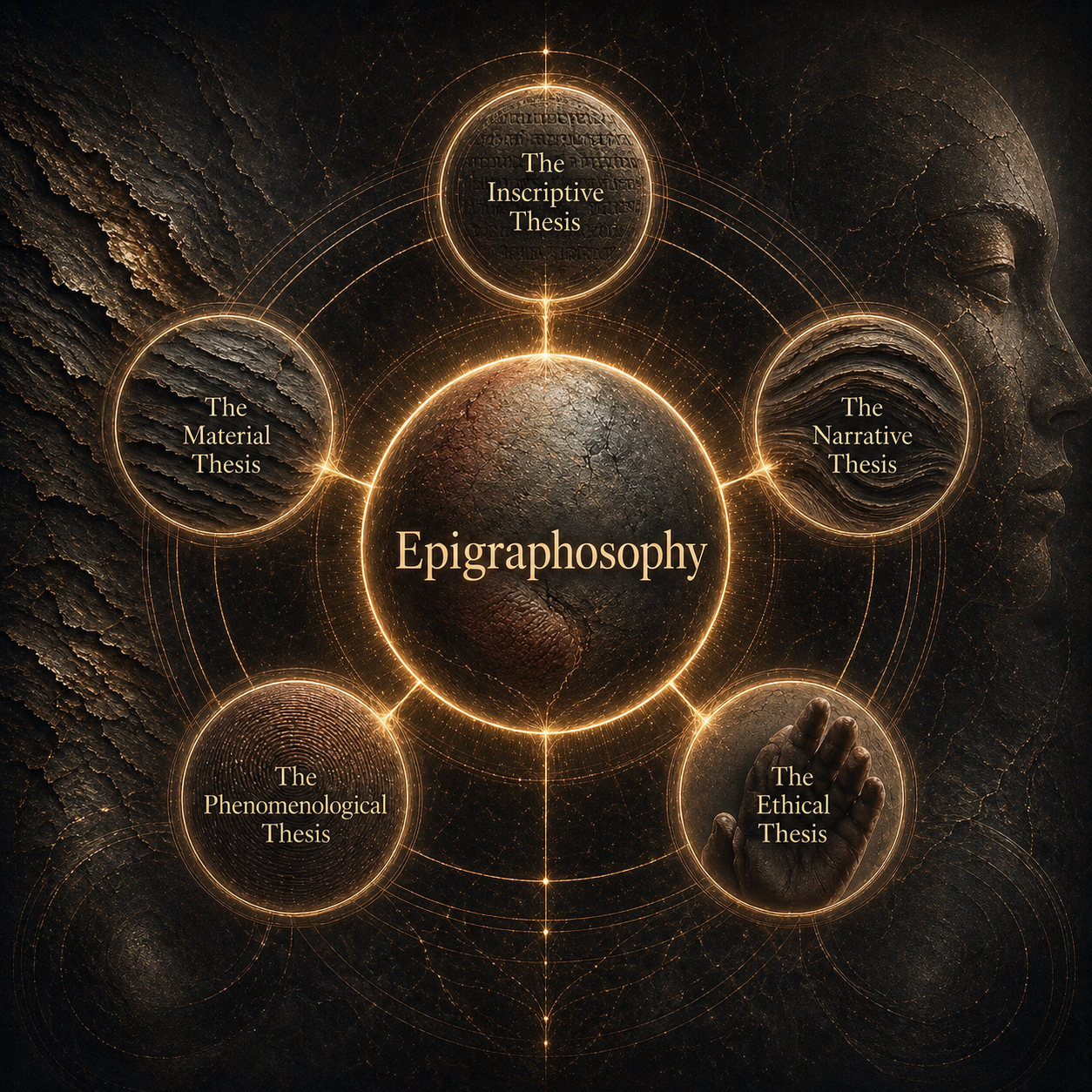
Epigraphosophy may be established through five theses.
1. The inscriptive thesis
Philosophy is the responsible inscription of significance. Reflection earns philosophical standing when it takes a form that can endure, be examined, and be interpreted beyond the instant of its birth.
2. The material thesis
Form is not an external container for thought. Surface, medium, resistance, and the conditions of durability participate in shaping the presence of what is thought.
3. The phenomenological thesis
Consciousness is the primordial field of inscription. Experience presses itself into the self, and those impressions become habits, orientations, fears, hopes, and capacities for action.
4. The narrative thesis
Identity is a lived inscription. The self is formed by stories told and by choices repeated until they become legible as character.
5. The ethical thesis
The seriousness of philosophy is measured by the courage to leave responsible traces. Reflection that one cannot bear in life has not yet reached full philosophical dignity.
The contribution of Epigraphosophy lies in the conjunction of these theses. It is not identical with grammatology, since its focus is not the general structure of writing but the responsibility borne by the trace. It is not identical with semiotics, since it treats material endurance as part of the sign’s force. It is not reducible to cultural memory, since it moves from collective records to the formation of consciousness and character. It differs from a theory of embodiment, since the body is read as a site where significance receives consequence. It exceeds narrative identity, since the self is understood as a script written through action rather than interpretation alone.
Epigraphosophy is a theory of the relation between significance, materiality, time, and accountability. It returns philosophy to surfaces, bodies, institutions, memories, habits, and words that leave a mark even when retracted.
The theory also offers a definition of wisdom: wisdom is the capacity to choose which traces deserve to be left behind. The wise person does not seek to mark the world for vanity. Such a person recognizes that every act leaves some inheritance, and asks whether that inheritance will nourish or poison those who receive it.
XI. Objections and Limits
A theory of inscription must answer its own danger. It could appear to devalue speech, interior contemplation, oral teaching, or the fragile forms of wisdom that never enter archives. Epigraphosophy does not make that error. Oral thought may be fully philosophical when it forms conduct, memory, ritual, relation, and disciplined attention. The issue is not whether thought becomes literal writing. The issue is whether it receives a trace that can answer beyond private impulse.
A second danger lies in revering survival. Endurance has no moral innocence. The palace record, the prison wall, the colonial monument, and the epitaph of the beloved may all last. Their duration alone does not make them worthy. Duration alone can establish persistence; it cannot confer dignity. A trace deserves respect only when it can bear ethical examination.
A third danger is moral severity. If philosophy must mark life, does every failure nullify thought? No. The demand is not perfection. Human beings are fractured and unfinished. The demand is fidelity, the willingness to let an idea judge the life that claims it. A philosophy that never troubles its holder has not yet become serious. A philosophy that tears into its holder and draws something true from the wound may already have begun to carve.
These limits matter because they prevent the theory from becoming a romance of stone, a worship of archives, or a punishment of human weakness. Epigraphosophy asks for accountable endurance, not the claim to authority through mere persistence.
XII. The Revelatory Force of Inscription
A sentence can pass through a reader without leaving a trace. Another sentence can cut into them or open what had long been closed. Inscription has revelatory force because it discloses the relation between finitude and the desire to confer significance. Before an old stone, a grave text, a public vow, or a sentence preserved beyond its speaker, we sense a paradox. The one who wrote has gone, yet the will to speak persists. The body has submitted to time, yet the trace has not surrendered at the same speed.
The mortal being seeks to outlast their own disappearance without denying death. We know the voice will fade, the body will collapse, the name may blur, and even stone will wear away. Still, we write, plant trees, keep letters, make vows, raise memorials, and shape children through words they will carry after us. These acts address time: I was here, and what I carried was worth more than the silence that follows.
Philosophy arises from that tremor. It is not a collection of cold answers. It is the way mortals look into the abyss of disappearance and refuse to hand meaning over to darkness. When reflection becomes inscription, the thinker does not defeat time. The thinker meets time not with surrender but with the weight of what has been genuinely lived and thought.
XIII. Closing Traces Worthy of Inheritance
Epigraphosophy is a philosophy of responsible traces. The argument begins with stone, then moves through body and memory, habit and history, selfhood and ethical consequence. It shows that mortals live within a field of marks. We receive impressions from the world and leave impressions upon it. No life is without writing. Even someone who never publishes a book still writes through the manner in which they love, harm, forgive, endure, and depart.
The question is not whether a sentence has been carved on stone or placed on paper. What matters is whether it has been carved into existence. If an idea does not alter life, it remains imagination. If it has entered conduct, courage, tenderness, and responsibility, it has become inscription.
I name this theory Epigraphosophy because mortals require a philosophy able to outlast eloquence and endure as witness. Mature philosophy is not a voice seeking victory. It is a trace that dares to remain after the voice has fallen silent. Against the slow erosion of time, only traces born from truthful living retain a rightful claim to endure.
This essay is part of my recent book The Cartography of Unbecoming
Seven Inscriptions in the Archaeology of Identitymedium.com
With deep gratitude, I wish to thank Dr Mehmet Yildiz for his generous editorial guidance, his discerning eye, and the intellectual care he has given this work.
Here is the editorial review of the book by Dr Yildiz:

The Cartography of Unbecoming
Why I Edited a Philosophical, Metaphysical, and Spiritual Book medium.com
I am equally indebted to Dr Michael Broadly, DHSc, for the generosity with which he wrote the foreword. I linked his foreword too:
Foreword to “The Cartography of Unbecoming” by Liauw Pauw Phing
Why a Retired Scientist Has an Interest in a Philosophical and Metaphysical Bookmedium.com
Their trust, encouragement, and contributions have shaped this book far beyond anything I could have achieved alone.
I am pleased that the book has been published and is available in several book stores. Here is the official page.
This book is now available for preorders and will be released on 30 April 2026. The early access digital and audio formats are available via Google Books and Google Play. Here is the landing page, which will include digital, paperback, hardcover, and audio links.

ILLUMINATION Philosophy and Metaphysics
ILLUMINATION Philosophy and Metaphysics
A publication devoted to philosophy, metaphysics, ethics, consciousness, cognition, psychology, mindfulness…medium.com
Introduction
ILLUMINATION Philosophy and Metaphysics: An Introduction by the Owner
This publication is devoted to philosophy, metaphysics, spirituality, mindfulness, psychology, ethics, consciousness…medium.com
Submission Guidelines by Dr Michael Broadly, DHSc
ILLUMINATION Philosophy and Metaphysics: Initial Submission Guidelines
Welcome to a new publication within the ILLUMINATION Integrated Publications ecosystemmedium.com
Here is some information about my background and editorial profile.
Keywords:
Epigraphosophy, inscription, epigraphy, philosophy, phenomenology, semiotics, consciousness, cultural memory, materiality, narrative identity, trace
Author Notes
¹ The argument here is a theoretical proposal, not a claim that ancient inscriptions were already a named philosophical school. The point is that inscription can be analyzed as a philosophical act.
² John Bodel, “Epigraphy and the Ancient Historian,” in Epigraphic Evidence: Ancient History from Inscriptions, ed. John Bodel (London: Routledge, 2001), especially 1–6.
³ Martin Ferguson Smith, ed., Diogenes of Oinoanda: The Epicurean Inscription(Naples: Bibliopolis, 1993), 3–14.
⁴ Jacques Derrida, Of Grammatology, trans. Gayatri Chakravorty Spivak (Baltimore: Johns Hopkins University Press, 1976), 6–26.
⁵ Maurice Merleau-Ponty, Phenomenology of Perception, trans. Colin Smith (London: Routledge & Kegan Paul, 1962), 138–147. The extension of this argument to carving and material resistance is the present author’s own.
⁶ Ferdinand de Saussure, Course in General Linguistics, trans. Wade Baskin (New York: Philosophical Library, 1959), 67–69.
⁷ For epitaphic memorial language, see Richmond Lattimore, Themes in Greek and Latin Epitaphs (Urbana: University of Illinois Press, 1942), 84–117. For social memory as embodied and ritual practice, see Paul Connerton, How Societies Remember (Cambridge: Cambridge University Press, 1989), 1–40.
⁸ Jan Assmann, Cultural Memory and Early Civilization: Writing, Remembrance, and Political Imagination, trans. David Henry Wilson (Cambridge: Cambridge University Press, 2011), 17–40.
⁹ Edmund Husserl, On the Phenomenology of the Consciousness of Internal Time(1893–1917), trans. John Barnett Brough (Dordrecht: Kluwer Academic Publishers, 1991), 24–42.
¹⁰ Martin Heidegger, Being and Time, trans. John Macquarrie and Edward Robinson (New York: Harper & Row, 1962), 78–90; for thrownness specifically, see §29, 172–174.
¹¹ Paul Ricoeur, Oneself as Another, trans. Kathleen Blamey (Chicago: University of Chicago Press, 1992), 113–139.
¹² Ramsay MacMullen, “The Epigraphic Habit in the Roman Empire,” American Journal of Philology 103, no. 3 (1982): 233–246. As applied here, the concept is drawn into a normative philosophical register; that extension is the present author’s own.
Bibliography
Assmann, Jan. Cultural Memory and Early Civilization: Writing, Remembrance, and Political Imagination. Translated by David Henry Wilson. Cambridge: Cambridge University Press, 2011.
Bodel, John. “Epigraphy and the Ancient Historian.” In Epigraphic Evidence: Ancient History from Inscriptions, edited by John Bodel, 1–56. London: Routledge, 2001.
Connerton, Paul. How Societies Remember. Cambridge: Cambridge University Press, 1989.
Derrida, Jacques. Of Grammatology. Translated by Gayatri Chakravorty Spivak. Baltimore: Johns Hopkins University Press, 1976.
Heidegger, Martin. Being and Time. Translated by John Macquarrie and Edward Robinson. New York: Harper & Row, 1962.
Husserl, Edmund. On the Phenomenology of the Consciousness of Internal Time(1893–1917). Translated by John Barnett Brough. Dordrecht: Kluwer Academic Publishers, 1991.
Lattimore, Richmond. Themes in Greek and Latin Epitaphs. Urbana: University of Illinois Press, 1942.
MacMullen, Ramsay. “The Epigraphic Habit in the Roman Empire.” American Journal of Philology 103, no. 3 (1982): 233–246.
Merleau-Ponty, Maurice. Phenomenology of Perception. Translated by Colin Smith. London: Routledge & Kegan Paul, 1962.
Ricoeur, Paul. Oneself as Another. Translated by Kathleen Blamey. Chicago: University of Chicago Press, 1992.
Saussure, Ferdinand de. Course in General Linguistics. Translated by Wade Baskin. New York: Philosophical Library, 1959.
Smith, Martin Ferguson, ed. Diogenes of Oinoanda: The Epicurean Inscription. Naples: Bibliopolis, 1993.


Leave a Reply