

Most conversations about artificial intelligence today focus on tools.
Which tools to use.
Which prompts work best.
Which platforms are trending.
But beneath all of that noise, something more important is happening.
The real advantage in AI is quietly shifting away from usage… and toward capability.
The Pattern We’re Seeing in Organizations
Recent research from MIT Sloan highlights an interesting trend in how organizations are adopting generative AI.
Despite the hype, most successful companies are not rushing into large, sweeping transformations. They are not redesigning entire business units overnight or replacing workflows in one go.
Instead, they are progressing in smaller, structured steps.
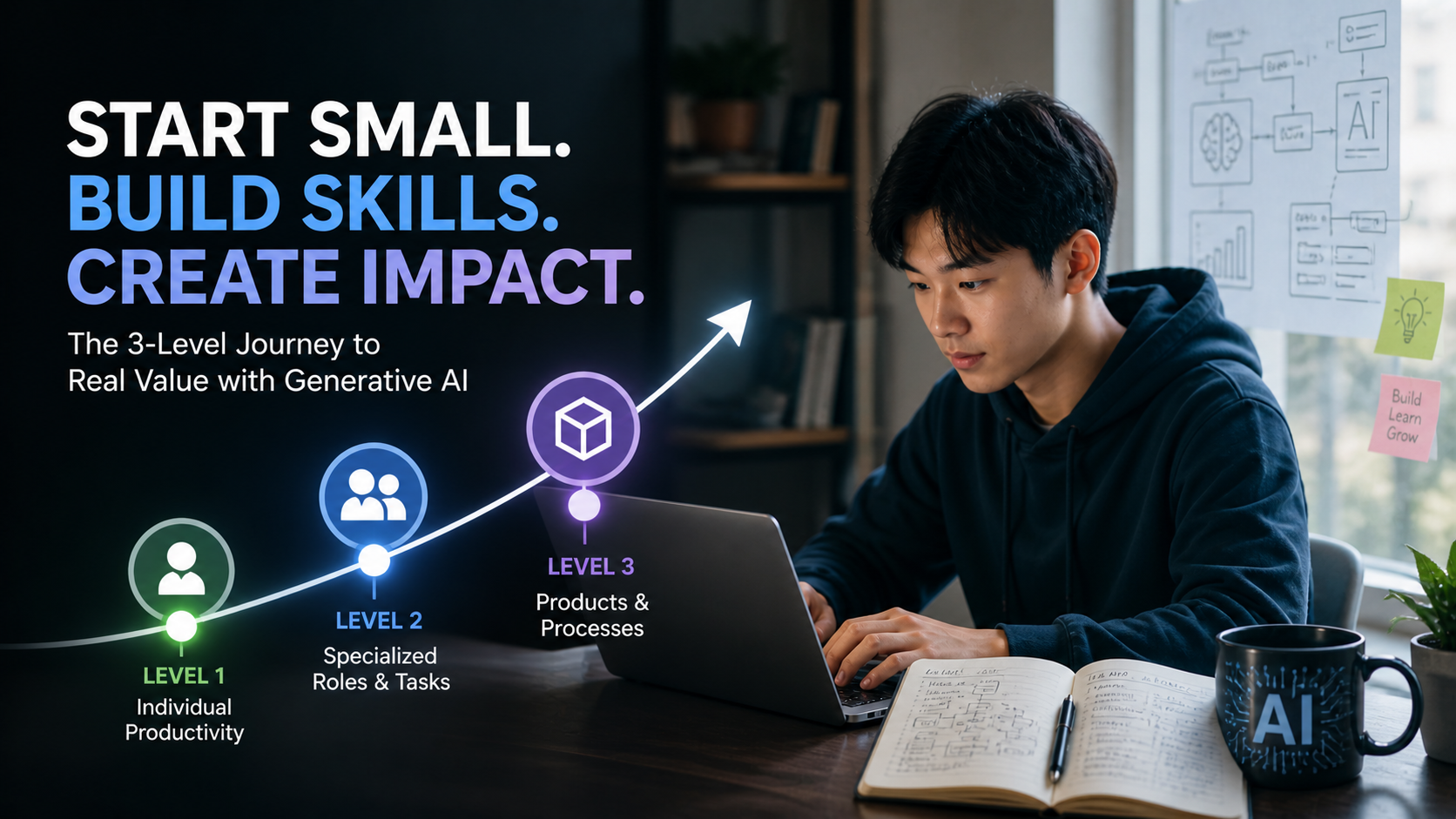
They start by using AI to improve individual productivity. Employees summarize information faster, draft communications more efficiently, and manage routine tasks with less effort.
Then they move into more specialized applications. AI begins to support specific roles, such as assisting with coding, analyzing data, or handling parts of customer interactions.
At this stage, humans and AI work together more closely, with clear boundaries and oversight.
Eventually, some organizations reach a point where AI becomes embedded in products and processes. It becomes part of how value is delivered, not just how tasks are completed.
This progression is often described as a “risk slope.” Each step introduces more complexity and greater potential impact, but also requires stronger capabilities and deeper understanding.
What stands out is not just the structure of this journey, but the approach behind it.
The companies that succeed are not trying to do everything at once. They are building competence gradually, learning at each stage, and using small wins to unlock bigger opportunities.
Why This Matters for Learning
This same pattern applies surprisingly well to how individuals learn.
Many people approach AI as something to understand conceptually. They read about it, watch tutorials, and experiment with tools at a surface level. While this builds awareness, it rarely translates into real capability.
Understanding what AI can do is not the same as knowing how to apply it.
The difference becomes clear when someone attempts to build something, even a simple application.
Suddenly, concepts that seemed abstract start to take shape. Questions become more concrete. Decisions matter. Structure becomes important.
Learning shifts from passive consumption to active creation.
And just like in organizations, progress tends to happen in stages.
At first, learners use AI tools to complete small tasks. Then they begin to apply AI within specific workflows.
Over time, they start connecting different components, designing systems, and producing something functional.
The key is not the size of the project. It is the act of building.
The Role of Small, Practical Projects
There is a tendency to associate meaningful learning with complexity. Bigger projects, more advanced concepts, and deeper technical detail often feel like the right direction.
In reality, small, well-designed projects often deliver more value.
They allow learners to:
- Understand how inputs and outputs connect
- See how decisions affect results
- Experience the full cycle from idea to outcome
Each project builds confidence and reinforces structured thinking. Over time, these experiences accumulate into a more intuitive understanding of how systems work.
This is the same principle organizations follow when they adopt AI incrementally. Each step is manageable, measurable, and grounded in real application.
Developing the Builder’s Mindset
One of the most important outcomes of this approach is not technical skill, but mindset.
When someone learns by building, they begin to see technology differently. It becomes something they can shape, rather than something they simply use.
They start asking different questions:
- How does this work behind the scenes?
- How can I improve this process?
- What can I create from this idea?
This shift is subtle, but powerful. It changes how problems are approached and how opportunities are identified.
In a world where AI tools are becoming increasingly accessible, this mindset is what separates those who adapt from those who lead.
Starting Earlier Than We Think
Traditionally, building this kind of capability has been associated with higher education or professional experience.
The assumption has been that students need years of foundational learning before they can begin applying complex tools.
That assumption is changing.
Today’s AI tools are more accessible, more visual, and more interactive than ever before.
With the right structure and guidance, even younger learners can begin exploring how systems are built.
They do not need to master everything at once. They need to start with clear, manageable steps that allow them to see progress and understand what they are doing.
This is where the idea of “small t” transformation becomes especially relevant.
It is not about pushing students into advanced concepts prematurely. It is about guiding them through a progression where each step builds on the last, developing both confidence and capability.
A Shift in How We Think About Education
As AI continues to reshape industries, the question is no longer whether students should be exposed to these technologies.
The more important question is how they should learn them.
If the focus remains on usage alone, students may become efficient users of tools, but their understanding will remain limited.
If the focus shifts toward building, even at a basic level, students begin to develop skills that extend beyond any single technology. They learn how to structure problems, design solutions, and think in systems.
These are skills that remain relevant regardless of how the tools evolve.
In Malaysia, there is growing interest in educational approaches that reflect this shift.
Some programs are beginning to emphasize hands-on learning, guiding students through the process of creating simple AI-powered applications rather than only introducing concepts.
One example is the AI App Developer Program for School Children by Badak AI, which focuses on helping students learn AI by building practical projects in a structured environment.
The emphasis is on progression — starting with manageable tasks and gradually moving toward more complete applications.
More details about the program can be found here:


Leave a Reply