

Why financial institutions are adopting AI agents despite hidden risks in payments, compliance, and treasury
Curator’s Note: Systems can keep producing results and still lose their way, because action without awareness slowly separates outcome from intent. This piece reflects on that tension, where control is no longer about stopping errors but about staying conscious of direction, before small deviations turn into consequences that can no longer be reversed.
Introduction
Banking was never fast, and that was the point, because every move had to be owned by someone. The slowness kept people alert, it forced responsibility into the system. Now AI is stepping in, and decisions are happening before anyone can fully process them. Companies are going ahead anyway, not because it feels right, but because falling behind feels worse. So the question isn’t speed versus control anymore, it’s this, how much are you willing to trust a system you can’t completely see.
Why Traditional Banking Systems Were Designed Around Friction
Financial systems were never built to move fast just because they could. They were built to make sure someone was paying attention at the right moment. Every pause in the process had a purpose. It forced a second look, sometimes a third, so decisions were not just executed and forgotten. Money has consequences, and over time the system learned that awareness matters more than speed. What looks like friction from the outside is actually how trust is held together.
Approval layers in payments
Large payments don’t move in a straight line. One person sets it up, someone else checks it, and often another approves it. It may feel repetitive, but it serves a purpose. When more than one person looks at the same transaction, small mistakes get caught early, and unusual things don’t slip through as easily. It’s less about control and more about making sure no single point of failure decides everything.
Compliance review cycles
Systems are good at spotting patterns, but patterns don’t always tell the full story. A transaction can look unusual for the right reasons, or normal for the wrong ones. That’s why flagged cases still go through people who understand the context behind the numbers. They don’t just see the transaction, they see the situation around it. That layer keeps the system from becoming too mechanical.
Audit checkpoints
At some point, every action needs to stand up to scrutiny. Not because something went wrong, but because it might have. Audit checkpoints make sure there is a clear record of what happened and why. When questions come up later, there is something real to look at, not just assumptions. Without that, problems don’t go away, they just become harder to trace.
How Agentic AI Is Changing Execution Across Financial Workflows
Financial systems were built to support people, not to act on their own. You would review something, approve it, and then the system would carry it forward. That flow is starting to loosen. With agentic AI, the system doesn’t always wait at every step. You give it direction, and it can move through multiple actions on its own. It still works within boundaries, but the pauses between steps are getting shorter, and sometimes they disappear.
Payments automation
A lot of the groundwork was already automated, things like reading invoices, matching them, preparing payments. That part isn’t new. What’s different is how smoothly those steps now connect. Instead of stopping at each stage, the system can carry the same context forward and keep things moving. Even then, when money is about to leave, most teams still keep a checkpoint. That hesitation hasn’t gone away.
Reconciliation workflows
Reconciliation used to take time because someone had to go line by line and make sure things matched. Now the system does most of that work. It scans large volumes, lines things up, and only surfaces what doesn’t fit. People are still involved, but mostly when something breaks the pattern. The rest runs on its own without needing attention.
Operational reporting
Reports used to be something you built, pulling numbers together, checking them, shaping them into something usable. That effort has been reduced a lot. Data flows in, and the system turns it into dashboards or summaries almost immediately. The work now is less about putting reports together and more about deciding what they actually mean and what needs to be acted on.
The Accountability Gap: When “Who Did This?” Becomes Unclear
Earlier, if something went wrong, you knew where to look. A person approved it, a team processed it, and the trail was clear enough to follow. Now it’s different. The action still has a record, but the decision behind it feels spread out. Part of it comes from the person who set things in motion, part from the system rules, part from the agent that carried it through. You can still trace it, but it takes effort to explain who really made the call.
Payment authorization chains
A payment goes through because it fits within approved limits. Everything checks out in the system. But if you stop and ask who actually decided this should happen now, the answer isn’t clean. Someone defined the boundaries earlier, the system enforced them, and the agent executed it. The responsibility exists, but it does not sit in one place the way it used to.
Compliance actions
Monitoring systems are getting better at handling volume. They flag, sort, and sometimes even close cases without much human involvement. Most of the time, that works. But when something slips through, the question becomes harder. Was the model off, was the data incomplete, or did no one look closely enough. You still assign responsibility, but understanding what really happened takes more digging.
Cross-system execution
A single action can now move across multiple systems without stopping. Each system logs its part, but none of them hold the full story. To understand one decision, you have to connect pieces from different places. The information is there, but it doesn’t present itself in one clean line anymore.
When Financial Systems Produce Valid but Misaligned Outcomes
Financial systems are good at doing exactly what they are told. Give them a clear rule, and they will follow it without hesitation. The problem is, business decisions are rarely that clean. There is always more than one thing that matters at the same time. Cash flow, risk, timing, relationships, all of it sits in the background. A system can get one part perfectly right and still miss what actually matters in that moment. That is where things start to feel off.
Vendor payments
Capturing early payment discounts sounds like an obvious win. The system releases money early and locks in savings. On paper, it looks smart. But if cash is tight that week, that same decision can create pressure somewhere else. The system is doing its job, but it is not feeling the situation the way a finance team would.
Treasury allocation
Moving money to earn better returns works when things are stable. Funds are placed where they perform best, and the numbers look strong. Then something unexpected happens, demand rises, and liquidity is needed faster than planned. The decision was right when it was made, but it does not hold up when conditions change.
Compliance filtering
A transaction passes every rule the system checks. Nothing triggers concern, everything looks clean. Still, someone experienced might pause and ask a question. There is a kind of judgment that comes from seeing patterns over time, not just from rules. Systems follow what they know, people notice what feels different.
Drift in Financial Systems: How Small Errors Build Over Time
Financial systems rarely break in obvious ways. They keep running, and that is exactly why small mistakes can stay hidden. A system can be slightly off and still look completely fine on the surface. Over time, that small gap does not stay small, it spreads through repetition.
Transaction categorization
A transaction gets labeled slightly wrong once, and nothing seems serious. The same pattern repeats across hundreds or thousands of entries. Reports still generate, numbers still add up, but the story those numbers tell starts to drift away from reality.
Risk scoring models
A model begins to read signals a bit differently as patterns in data change. It still flags risks, still clears transactions, but the priority starts to feel off. Important signals may get less attention, while less critical ones rise up.
Forecasting systems
A forecast is built on assumptions that seem reasonable at the time. As conditions change, those assumptions lose accuracy. The system keeps projecting forward, and the gap grows slowly, almost invisibly, until the outcome no longer matches what the business expected.
Why Companies Still Choose to Use AI Agents
This is where things stop sounding theoretical. Most companies understand the risks. They’ve seen where systems can go wrong, where visibility drops, where control becomes harder to follow. Even then, they are still moving forward.
The reason is not confidence. It is pressure. Financial operations are becoming heavier, not lighter. More transactions, faster cycles, more compliance expectations. Manual processes can still work, but they begin to slow everything once scale increases.
Speed requirements
Payments no longer wait for batch cycles. They move in real time, and expectations have adjusted with that. Systems are expected to respond immediately, and workflows that depend entirely on human steps struggle to keep up.
Cost pressure
Running large teams to review, validate, and reconcile everything creates a cost that grows with volume. At a certain point, scaling people becomes harder than scaling systems. That is where automation starts to feel necessary, not optional.
Competitive pressure
When some companies begin operating faster and leaner, the difference becomes visible. Others may resist at first, but over time the gap creates pressure. Staying with slower processes starts to carry its own risk.
What This Means for the Future of Financial Control
Control in finance is not going away, but it is no longer fixed at the beginning of a process. Earlier, you could stop a decision before it happened, review it, and then let it move. That worked because systems moved in steps. Now actions flow more continuously. By the time you try to pause something, part of it may already be done. That changes how control needs to work.
Real-time monitoring
Instead of waiting at checkpoints, teams are starting to observe how systems behave as they run. It’s less about stopping each action and more about noticing patterns early. When something begins to look off, that’s when intervention happens. The focus moves from individual transactions to the direction the system is taking over time.
Explainability layers
Seeing what happened is no longer enough. When systems make decisions across multiple steps, people need to understand the reasoning behind them. Without that, it becomes difficult to trust outcomes, especially when something unexpected appears. Explanation becomes part of control, not just a report after the fact.
Adaptive controls
Fixed rules still exist, but they don’t cover everything anymore. Systems change, inputs change, and behavior evolves. Control has to adjust with it. That doesn’t mean removing rules, it means accepting that rules alone are not enough to keep things aligned in a system that keeps moving.
https://substack.com/@hamid13decoded
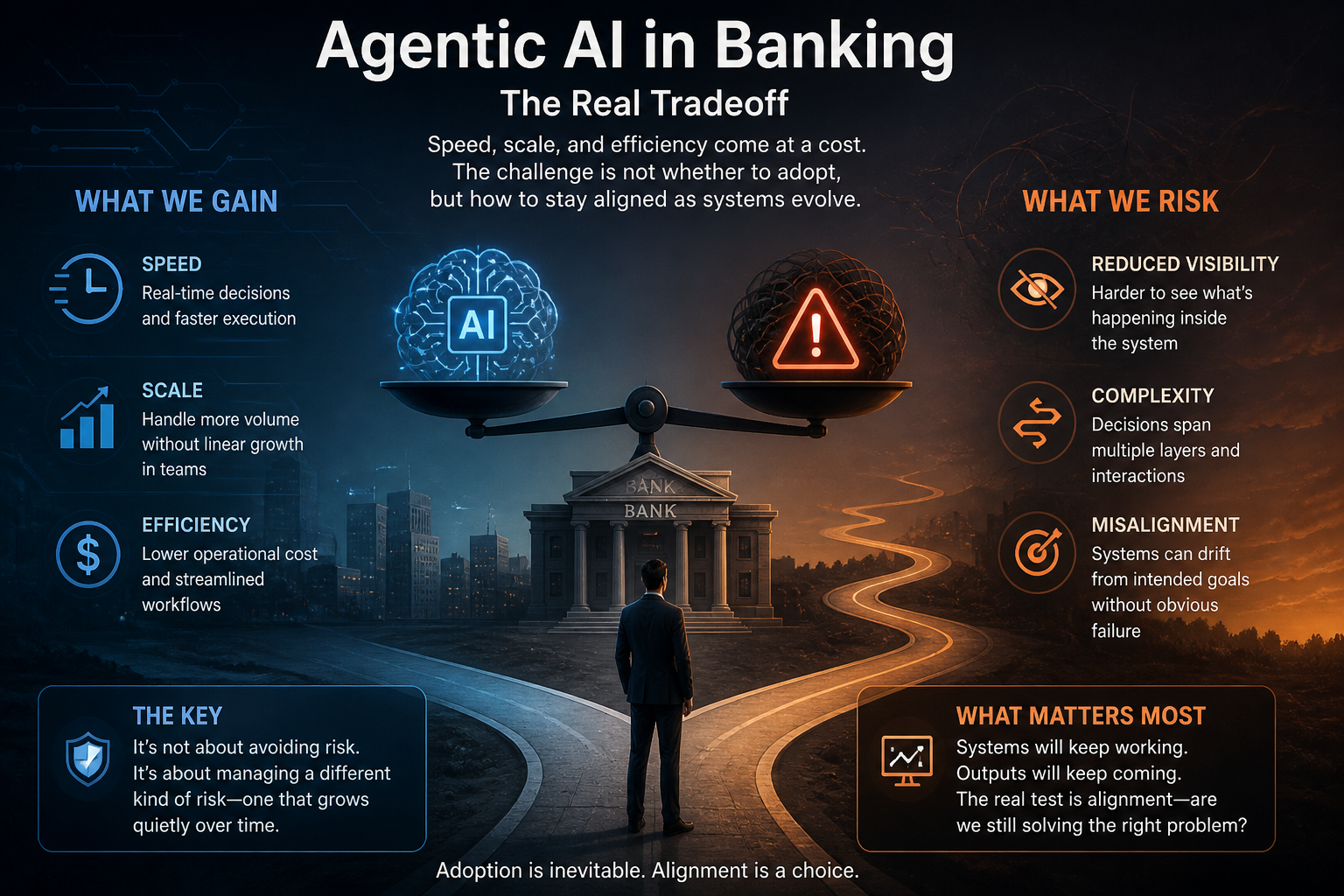
The Real Tradeoff Behind Agentic AI in Banking
The discussion around AI in banking often stays on what these systems can do. What matters more is what companies are giving up to get there. This is not a choice between safety and innovation. It is a choice between different kinds of risk, and none of them are easy.
Agentic systems bring real advantages. Work moves faster, volume becomes easier to handle, and operations feel lighter. But that comes with a cost that is less visible. Systems become harder to fully track, decisions stretch across multiple layers, and understanding what is really happening takes more effort. Nothing looks broken, which is exactly what makes it uncomfortable.
That is where the change becomes clear. Risk is no longer only about something failing. It is about whether the system is still moving in the right direction. A system can keep running, keep producing results, and still drift away from what the business actually needs.
The companies that handle this well will not be the ones that avoid AI. They will be the ones that stay close to how their systems behave over time. Because the real challenge is not building these systems. It is knowing when they are still aligned, and when they have started to move somewhere else.
Conclusion
Agentic AI is already part of how financial systems run. The question is no longer whether to adopt it. The real question is how much control you are willing to give up to move faster.
Banks and fintech companies are moving ahead because they do not have much choice. The environment is pushing them there. But moving forward without fully understanding how these systems behave creates a different kind of risk, one that does not show up immediately.
The systems will keep running. Reports will still look right. Transactions will continue to go through. The real question is simpler than it sounds. Are these outcomes still serving the business, or has the system started solving a different problem without anyone noticing.
Author: Hamid Akhtar
hmdlabee@gmail.com
https://www.linkedin.com/in/technicalwriterus/
https://medium.com/@hmdlabee


Leave a Reply