

Where the Voice First Bleeds into Language
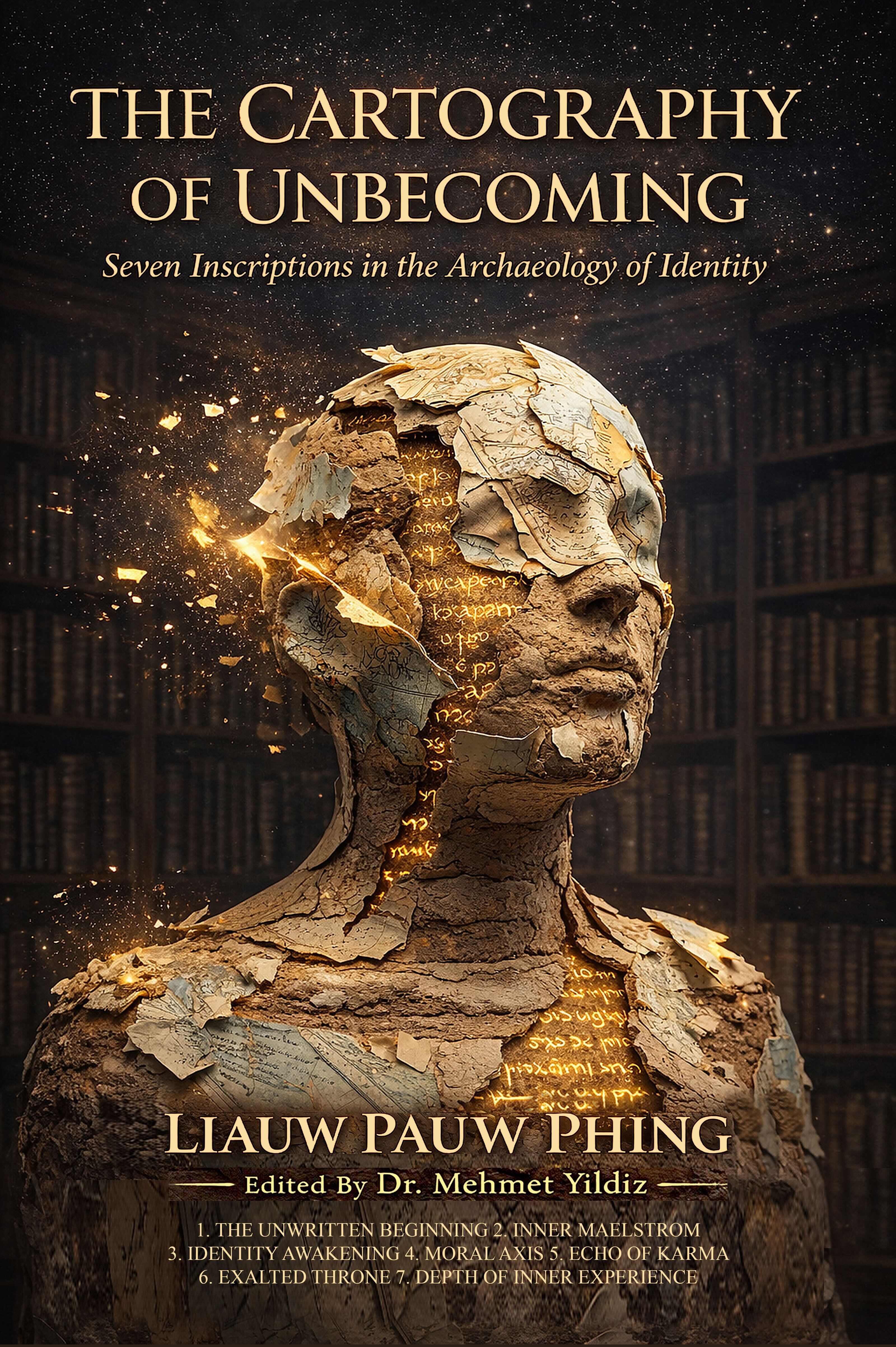
Curator’s Note: The text explores the complex relationship between silence, suffering, and the act of writing. It reflects on how personal grief often feels too insignificant for expression and discusses the transformative power of writing as a means of confronting one’s emotions and past. The author presents writing not as a path to comfort but as a way to understand and articulate pain authentically. This exploration emphasizes that while suffering doesn’t always lead to wisdom, acknowledging and naming it can help create distance and allow for survival. Ultimately, the voice that emerges from this process becomes a form of witness, resonating with others who share similar experiences. This essay was written by Liaw Pauw Phing, author of the philosophical book titled The Cartography of Unbecoming — ISBN: 9798233715303
There is a kind of silence that has nothing to do with peace. It settles inside a person over the years, gathering unannounced, until the soul begins to believe that its private grief is too small to deserve language.
What rises from that silence is not a neat arc of recovery. It is something rarer, and more difficult to face honestly: a human being who stands before the wreckage of a former self and does not flinch. I was not asking for pity. I was trying to tell the truth without making old damage appear more dignified than it was. What I finally admitted was something I had always known. Writing was never decoration. It was the one crack through which an overburdened life could still breathe.
This book began when I understood that speech, however uncertain, could become a way of remaining alive.
Bitterness as a Secret Instrument of Perception
I listened to suffering as a form of knowledge, never as material for display.
In my hands, bitterness became something closer to a faculty, sharpened by deprivation and sustained interior darkness. It taught me to notice what comfort almost always misses. It catches the tremor buried inside an ordinary sentence. It registers the weight a room carries after an argument has ended without resolution.
Pain may sharpen a person into wisdom. It may also harden a person into armor. When suffering is endured without self-deception, without the softening stories we tell ourselves in order to get through the week, it can open an intelligence that no comfortable life can cultivate. The person who has known genuine loneliness does not merely sympathize with it in others. They know its temperature. They understand, from within, how the world can continue moving while the inner life has stopped entirely.
I write from inside that experience.
The Courage to Write Into the Unknown
I have never confused writing with knowing.
For me, writing means entering the unknown and remaining there long enough for something true to surface. The sentence is a lantern carried into a dark room whose walls have not yet been found. I write in order to understand. That understanding begins only when the first honest word has been placed on the page and can no longer be withdrawn.
Meaning does not arrive ready-made. It emerges through the effort to speak at all, sometimes only barely. The page becomes a place where memory and language begin, slowly, to recognize one another. I never began from certainty. I followed the pressure of a sentence until something steadier than comfort started to appear.
Standing in the Weather
Writing does not erase the storm.
What it creates is quieter than I expected: a genuine distance between the self that suffers and the self that observes. The grief does not vanish. I am not pretending otherwise. What shifts is position. I am standing in the weather while also, from somewhere just behind myself, watching it move through me.
That distance is where survival begins to build itself. I return to it throughout this book. Suppressed emotion makes the inner world airless. It compresses the soul and folds everything inward. To name what has been wordless is to loosen that pressure, to give pain a shape one can finally stand beside without being owned by it.
Against the Consolation of Earned Suffering
So much writing about pain moves too quickly towards consolation. It wants suffering to justify itself, to become the kind of lesson that gives damage a retrospective purpose. Too many books demand that pain arrive neatly at peace before it is permitted to be spoken. This book refuses that demand.
Some grief does not become wisdom. I know this. Some damage simply remains what it was, and no arrangement of language changes that fact. But what writing did, over time, was alter the terms of that relationship. The damage did not disappear. It ceased to be the thing that decided everything else.
Healing was not the word I trusted. What mattered was the decision, reached slowly and in the absence of any clear sign, to refuse being governed by what had already happened.
The Small Voice That Refuses to Disappear
I do not close with triumph.
The voice I discovered through writing arrived almost trembling, carrying no answers, unmistakably alive. It is what remains once performance has fallen away, once imitation has exhausted itself, and silence has become the harder thing to live with.
That voice is difficult to forget, because a life spoken honestly becomes a form of witness. It is the kind that makes another person feel, perhaps for the first time in a long while, not entirely alone. I wrote this book because I needed someone to have written it.
Perhaps you do too.
This essay is part of my recent book The Cartography of Unbecoming
Seven Inscriptions in the Archaeology of Identitymedium.com
With deep gratitude, I wish to thank Dr Mehmet Yildiz for his generous editorial guidance, his discerning eye, and the intellectual care he has given this work.
Here is the editorial review of the book by Dr Yildiz:

The Cartography of Unbecoming
Why I Edited a Philosophical, Metaphysical, and Spiritual Book medium.com
I am equally indebted to Dr Michael Broadly, DHSc, for the generosity with which he wrote the foreword. I linked his foreword too:
Foreword to “The Cartography of Unbecoming” by Liauw Pauw Phing
Why a Retired Scientist Has an Interest in a Philosophical and Metaphysical Bookmedium.com
Their trust, encouragement, and contributions have shaped this book far beyond anything I could have achieved alone.
I am pleased that the book has been published and is available in several book stores. Here is the official page.
This book is now available for preorders and will be released on 30 April 2026. The early access digital and audio formats are available via Google Books and Google Play. Here is the landing page, which will include digital, paperback, hardcover, and audio links.

ILLUMINATION Philosophy and Metaphysics
ILLUMINATION Philosophy and Metaphysics
A publication devoted to philosophy, metaphysics, ethics, consciousness, cognition, psychology, mindfulness…medium.com
Introduction
ILLUMINATION Philosophy and Metaphysics: An Introduction by the Owner
This publication is devoted to philosophy, metaphysics, spirituality, mindfulness, psychology, ethics, consciousness…medium.com
Submission Guidelines by Dr Michael Broadly, DHSc
ILLUMINATION Philosophy and Metaphysics: Initial Submission Guidelines
Welcome to a new publication within the ILLUMINATION Integrated Publications ecosystemmedium.com
Here is some information about my background and editorial profile.


Leave a Reply