

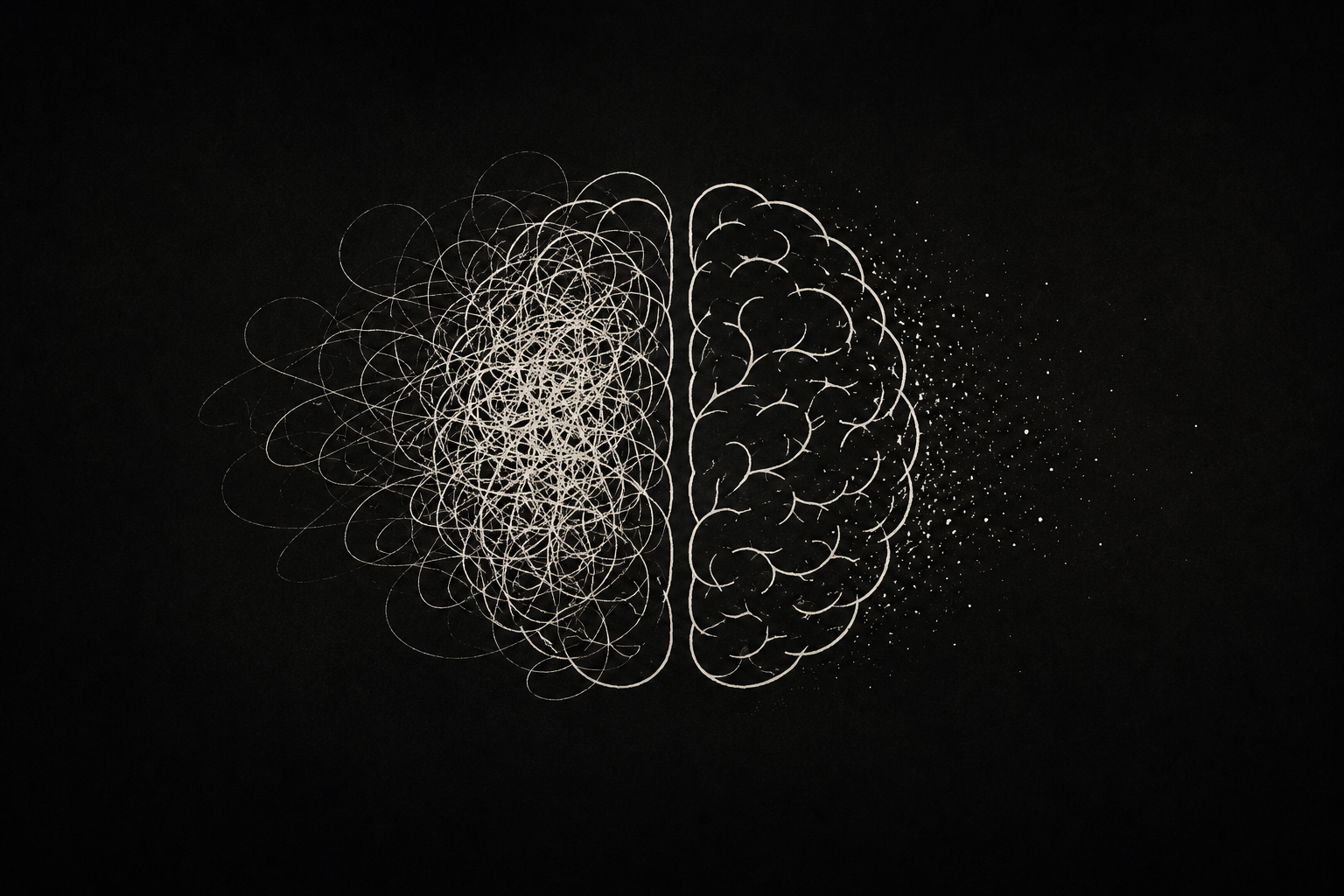
Refrain from constant distractions and endless small decisions, stay grounded, and choose with intention to achieve your goals and sustain your success
Curator’s Note: This cornerstone essay discusses the impact of constant distractions and decision fatigue on individuals’ mental well-being. It highlights how people often react rather than choose intentionally, which can lead to feelings of instability and a lack of control. It emphasizes that incessant notifications fragment attention, making it difficult to engage meaningfully with tasks and thoughts. This results in shallow information processing and diminished self-awareness. The piece argues for the importance of slowing down, maintaining focus, and minimizing unnecessary decisions to preserve mental strength. Ultimately, regaining control requires intentionality, reflection, and reducing distractions to build and nurture deeper engagement, empathy, understanding, and compassion. This essay was penned by Hamid Akhtar, who is a contributor to Digitalmehmet Content Ecosystem and ILLUMINATION publications on Medium and Substack.
Introduction
You start your day with something in mind, then your phone lights up, you check it, then something else comes, and before you even think about it, you’re already doing something completely different. You didn’t decide to change direction. It just happened. And the strange part is, it doesn’t feel like a problem in that moment.
That’s what’s changing. Earlier, there used to be a small second where you would think, “should I do this right now or not?” Now that the second is missing more often. The World Happiness Report 2026 is basically showing the outcome of this. People feel more unstable, not because life suddenly got harder, but because they are reacting more than they are choosing. When that small check disappears, you don’t notice it directly. You just slowly stop being the one deciding your actions.
When you stop asking yourself before you move
There is a study. It says one notification can hold your attention for about seven seconds. Your day is not one notification. It is many, one after another. And each one pulls you just enough to break your flow.
When a person stops asking themselves before acting, they do not notice the loss. A person should not follow what they do not truly understand, because every action carries weight. There is also a call to look at what one is sending forward, which brings attention back to self-check. And there is a recognition that within every person there is already a sense that can tell right from wrong. But it only works when a person returns to it before moving.
When your attention gets trained without you noticing
You don’t wake up one day and decide to become more reactive. It happens slowly through repetition. The more you respond instantly, the more your mind starts expecting that pattern. A notification comes and your attention moves before you even realise it. After a while, it’s not even about the notification anymore. Your mind starts looking for the next thing on its own.
Distraction is not just about how long you use your phone, but how often your attention gets broken. The more fragmented your habits are, the harder it becomes to hold a single line of thought. And when thought itself becomes unstable, decisions naturally follow that instability.
When you start reaching for your phone without a reason
You’re not bored, not busy, nothing urgent. Still, your hand goes to your phone. You open it, scroll a bit, close it. Then a few minutes later, you do it again. There’s no clear reason behind it. It just happens like a habit your body learned on its own.
When attention keeps getting pulled again and again, the mind starts expecting that pull. After some time, it doesn’t even wait for a notification. It begins to look for something on its own. That’s why you open your phone even when nothing is there.
There is a simple idea that a person is shaped by what they keep turning towards. There is also a pattern where following every urge slowly weakens control over it. And there is guidance that staying steady comes from holding yourself back before you move, even in small moments.
When your memory starts depending on what you can check
You ever notice how you don’t try to remember things the same way anymore. A number, a date, even a small idea. The first instinct is not to hold it, but to save it, search it, or come back to it later. Why use your mind when everything is stored outside anyway.
You stop sitting with ideas long enough to understand them. You move on quickly because you know you can always return. Over time, thinking becomes lighter, but also shallower. You collect more, but you process less.
It’s about losing depth in how you think and remember.
There is a reminder that a person is accountable for what they take in and what they hold onto. And here is guidance that real understanding comes when a person reflects, not just collects.
When you stay busy all day but still feel off
You go through the whole day doing things. Calls, messages, tasks, small wins here and there. By the end of it, you’re tired, so it feels like you’ve done enough. But if someone asks what actually mattered today, you pause for a second. You did a lot, but it’s hard to point to something that really moved things forward.
The tricky part is how convincing it feels. Being busy gives you a sense of progress. You’re active, you’re not wasting time, you’re keeping up. But activity and direction are not the same thing. One fills your day, the other shapes it. And when activity takes over, direction slowly fades in the background.
When your emotions start reacting faster than your understanding
You read a message and reply instantly. Sometimes it’s fine. Sometimes later you feel you could have said it differently. Same with comments, emails, even small conversations. The response comes out fast, almost automatic. Only after it’s done do you get a clearer sense of what you actually meant.
What’s changing here is not just speed, it’s sequence. Earlier, feeling and understanding used to move together. Now feeling comes first, action follows, and understanding arrives later. That gap may look small, but it changes outcomes. A quick reply can strain a relationship. A rushed reaction can create a problem that didn’t need to exist.
This isn’t about anger or impatience alone. It’s about how quickly something inside you gets triggered and how little space there is before you act on it. When everything around you is fast, your inner responses start matching that speed. And slowly, you stop waiting for clarity. You act on the first version of what you feel.
When you stop noticing what is actually influencing you
When something repeats in front of you enough times, it stops feeling external. It starts blending into your own thinking. You don’t question it anymore because it feels familiar. And that’s where it gets risky. Because now you’re not just reacting fast, you’re reacting from something you didn’t even choose.
Over time, a person can lose clarity about what is truly theirs and what came from outside. The line becomes blurred. You feel like you’re thinking independently, but a lot of that thinking is shaped by what you kept consuming. And because it happened gradually, there’s no moment where you feel it clearly. And here is guidance that clarity comes when a person becomes conscious of what they allow to influence them.
When something feels normal just because you’ve seen it too many times
You don’t wake up one day and decide what feels normal. It builds slowly. You see something once, then again, then again, and after a point you stop reacting to it. It doesn’t stand out anymore. It just blends into your day. And without noticing, you stop asking whether it should be there in the first place.
Repetition has its own power. Studies show the average worker faces around 15 interruptions per hour and gets distracted within the first hour of starting a task . That means most of what you see or do isn’t held long enough to be examined. It just passes through you, again and again, until it starts feeling familiar. And once something feels familiar, your mind stops treating it as something to question.
Now, here I am going to share something deep: familiarity is not the same as truth, even if something appears again and again. And there is guidance that awareness is not a one-time thing; it has to be renewed, especially when something starts feeling ordinary.
When too many decisions drain your ability to hold yourself
When people make many choices, their self-control drops afterward. They give up faster, they procrastinate more, and they don’t push through difficult tasks the same way. So it’s not just that decisions take time. They take strength. And that strength is limited.
Think about your day. What to reply, what to check, what to open, what to ignore. Dozens of small choices. Each one feels small, but together they drain you. By the time something important comes, you don’t have the same control left. You still know what’s right. You just don’t follow it.
Earlier in the day, you decide and act. Later in the day, you know but you don’t act. And the reason is not confusion. It’s that your inner strength has already been used up in small things.
A person loses control not because they don’t know, but because they get drained before it matters. Strength needs to be preserved, not just used.
How you take control back without fighting your whole life
By now, it’s clear the problem is not just distraction. It’s how your inner strength gets used up before it matters. The same energy you use to make decisions is the one you need for self-control later. When that energy is drained, you don’t fail because you don’t know what’s right. You fail because you don’t have enough left to follow it.
So the solution is not “be more disciplined.” That doesn’t work when the system itself is drained. The real solution is to reduce unnecessary decisions and protect your inner capacity early in the day. People in the study who didn’t keep choosing all the time were able to persist longer, resist distractions better, and perform with more control. Control is not built in the moment of temptation. It is built before that moment even arrives.
Start with something practical. Remove small decisions that don’t matter. Fixed routines help more than motivation ever will. When fewer choices are made, more strength is saved. That strength then shows up exactly where it matters, when something is hard, when you need to hold yourself, when you need to stay aligned. This is not about doing more. It is about spending less of yourself on things that don’t deserve it.
You don’t need to control everything around you. You need to notice when something is pulling you without reason. When you start returning to that moment again, your actions slowly start coming from you again.
A person is not expected to carry everything, but they are expected to manage what they take on. There is also a reminder that strength is something that can be preserved or wasted long before it is tested. And real control is not about reacting better, but about protecting yourself before reaction even becomes necessary.
Hamid
hmdlabee@gmail.com
https://www.linkedin.com/in/technicalwriterus/
https://medium.com/@hmdlabee


Leave a Reply