

Reviewed By Dr Mehmet Yildiz
Curator’s Note: The internet has reached a strange point where people can access more information than any generation before them, and still feel more mentally confused, emotionally manipulated, and uncertain about what to trust. AI did not create this problem, it exposed it. As content becomes easier to produce, human beings are becoming more sensitive to sincerity, honesty, restraint, and emotional truth behind words. This article explores why modern B2B trust is no longer built through endless information, but through clarity, reflection, lived experience, and the rare ability to understand human beings before trying to influence them.
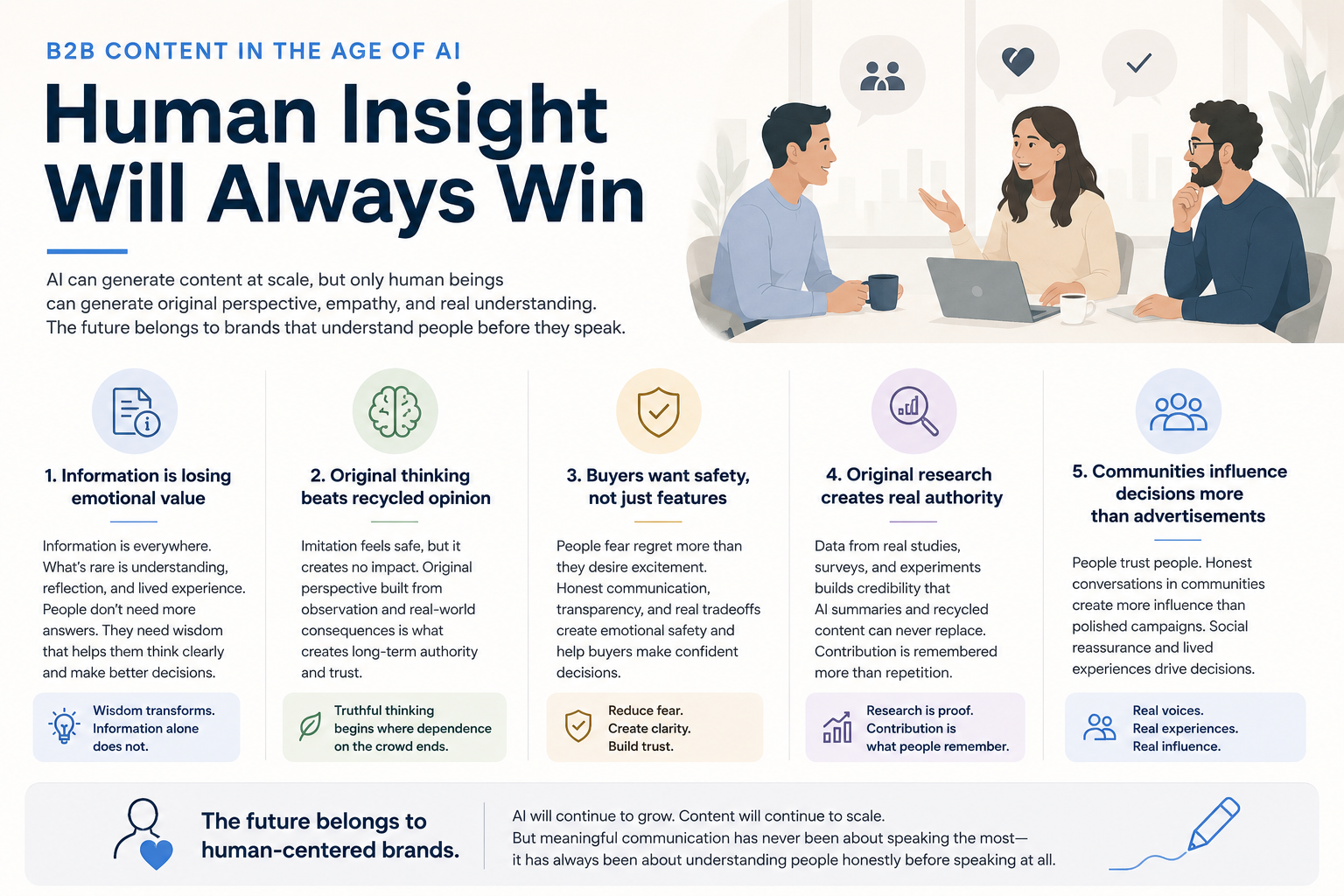
Informational content is losing emotional value
For years, B2B companies believed information alone could build authority. Publish enough tutorials, guides, and SEO blogs, and eventually attention would come. AI changed that rhythm completely. People now receive instant answers without opening ten browser tabs or reading long resource pages. That means information itself is no longer rare.
The strange thing is, human beings often become more emotionally lost when information becomes too easy to access. When answers arrive instantly, people slowly lose patience for reflection, struggle, and intellectual humility. They begin consuming knowledge the same way people consume fast food, quickly, emotionally, and without digestion. That creates a dangerous illusion of intelligence.
A person starts believing they understand something simply because they encountered information about it. Many brands followed the same pattern. They produced endless educational content, but most of it carried no sacrifice, no lived experience, and no transformation behind it. Real wisdom has always required something harder than access, it requires inner honesty strong enough to let knowledge change your character before you use it to influence others.
Original thinking became more valuable than volume
Most brands today are not truly thinking. They are reacting. One company copies another company’s tone, content structure, LinkedIn style, AI workflow, or positioning strategy because imitation feels commercially safe. But audiences eventually sense when a company has no intellectual center of its own. That is why original founders feel powerful today. They speak from observation instead of trend adoption.
A real example is Basecamp by Jason Fried and DHH. While the tech industry chased hypergrowth, endless meetings, and hustle culture, they openly rejected many dominant startup beliefs. Over time their clarity became their brand advantage. Their ideas carried weight because those ideas were tested through lived consequences, not assembled from whatever Silicon Valley was repeating that year.
Truthful thinking usually begins where emotional dependence on the crowd ends.
Buyers are searching for safety, not features
Most companies still market products as if buyers only compare feature lists. Real buying psychology works differently. People fear regret more than they desire excitement. Before purchasing software, buyers wonder whether the tool will create problems, waste time, or damage their reputation inside the company.
That is why comparison pages, honest reviews, and transparent case studies are becoming stronger than broad educational blogs.

The deeper reality is that buyers are not protecting money alone, they are protecting identity, credibility, and social trust. Research in decision psychology shows that anticipated regret strongly shapes human choices, especially when decisions carry reputation risk. A marketing manager recommending the wrong platform may lose internal trust long before the company loses budget.
That is why polished certainty often creates suspicion today. Human beings instinctively trust honesty because reality itself contains uncertainty, tradeoffs, and limitations. Studies around consumer trust also show that transparency reduces psychological resistance and increases emotional safety during decision-making.
The strongest brands are no longer acting perfect, they are helping people feel mentally safe enough to make a clear decision without fear of hidden consequences.
Original research creates real authority
One of the oldest patterns in human behavior is speaking confidently about things people never examined carefully for themselves. That is why original research feels powerful today, because it forces patience before opinion. Real observation demands discipline, intellectual honesty, and the willingness to face uncomfortable findings instead of shaping reality around ego or assumptions.
In B2B markets, buyers are increasingly exhausted by recycled expertise and AI-generated certainty.
They trust organizations that investigate reality directly before making claims publicly. Recent 2026 B2B research found that 93% of marketers using original research-based content reported stronger engagement and lead quality, because audiences associate evidence-backed insight with credibility and trust.
In many ways, real authority begins when a company values truth enough to study reality carefully before trying to influence how others think about it.
Communities now influence decisions more than advertisements
Modern buyers trust conversations more than campaigns. Many software decisions now begin inside Reddit discussions, private Slack groups, LinkedIn comments, and small online communities where people speak honestly without corporate filters. Human beings instinctively search for social reassurance before taking risks. A simple recommendation from someone with lived experience often feels stronger than expensive advertising.

People search for witnesses, shared experiences, and signs that others walked the same path safely before them. That is why communities became more powerful than advertisements. In environments filled with manipulation, polished messaging, and AI-generated persuasion, people instinctively move toward spaces where truth feels less controlled. The interesting part is that human beings do not only seek information from communities, they seek moral reassurance.
They want confirmation that their decision will not make them feel foolish, isolated, or regretful later. This psychological instinct explains why overly polished corporate branding often creates emotional distance today. Perfect messaging can feel suspicious because reality itself is imperfect. Communities feel believable because real people naturally speak with contradictions, uncertainty, emotion, and lived consequences inside their words.
The same pattern appears repeatedly across human history. People who searched honestly for truth were often described as individuals who listened carefully, verified information before spreading it, valued truthful witnesses, avoided blind following, and resisted becoming emotionally controlled by loud crowds. Wisdom was never presented as blind agreement with the majority.
Real discernment came from observation, reflection, verification, and intellectual honesty before judgment. That is why trust inside communities grows when conversations feel sincere instead of performative. Modern B2B buyers are behaving the same way. Research from 2026 shows that peer recommendations and community validation now influence buying decisions more strongly than direct vendor messaging, especially among digital-first buyers.
The future belongs to human-centered brands
One of the deepest mistakes people make is believing that influence comes from speaking more. Human beings are not transformed by volume, they are transformed by sincerity, timing, clarity, and emotional truth. That is why audiences rarely remember the loudest brands for long. They remember the voices that reduced confusion during moments of uncertainty.
Across human history, wisdom repeatedly pointed toward the same principle, truthful communication begins with understanding people before trying to control them. Many companies today are unconsciously addicted to visibility, but visibility without substance eventually creates emotional exhaustion around a brand. The more automated communication becomes, the more valuable human restraint, honesty, and thoughtful speech start to feel.
There is also a psychological reason human-centered brands will become stronger in the AI era. Human beings instinctively search for signs of genuine intention behind words. When communication feels manipulative, exaggerated, or emotionally disconnected from reality, trust weakens even if the messaging looks professionally perfect. That is why founders and brands openly sharing uncertainty, lessons, ethical tradeoffs, and lived experience are creating stronger emotional loyalty today.
Real wisdom was never about saying everything possible. It was about speaking with enough awareness that words create clarity instead of confusion. In many ways, the future of trust belongs to companies mature enough to value human understanding over endless attention extraction.


Leave a Reply