

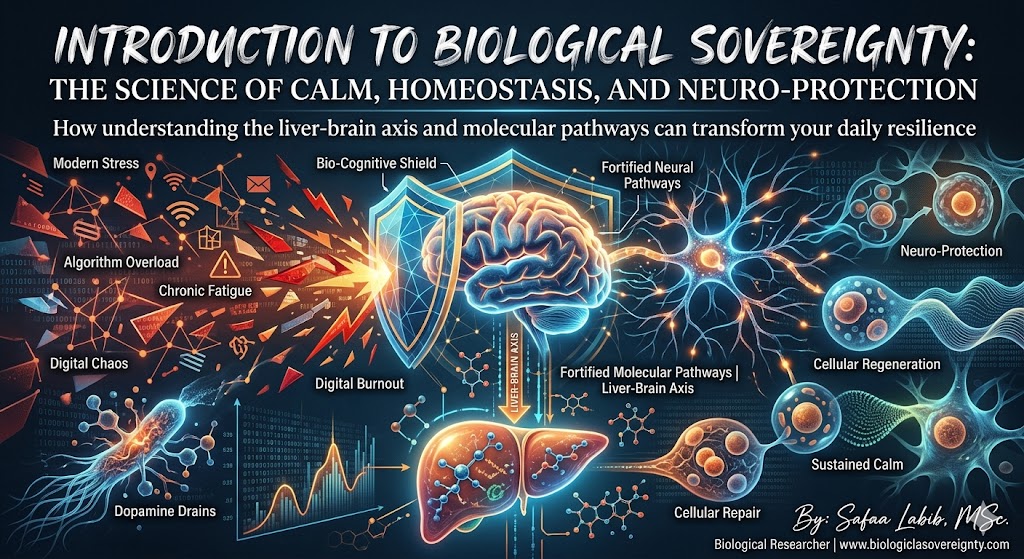
How understanding the liver-brain axis and molecular pathways can shield your nervous system from modern digital burnout and transform your daily resilience.
Every day, our nervous systems enter an unseen battle. We navigate crowded digital spaces, process vast amounts of complex data, and try to sustain peak cognitive performance. Consequently, when the dust settles, many of us are left with chronic brain fog, physical exhaustion, and a persistent sense of operating in “survival mode.”
As a biologist, I founded Biological Sovereignty because I wanted to answer a fundamental question: How do we protect our biological integrity and nervous system in the hyper-connected modern age?
This publication is a dedicated research and communication hub designed to bridge the gap between rigorous neurobiology and practical daily living. Therefore, we look directly at the hidden molecular pathways of stress, moving past generic self-help to explore the true cellular realities of human well-being.
Why Modern Stress is a Biological Mismatch
For years, society has conditioned us to believe that chronic fatigue and anxiety are simply “mental failures” or a lack of willpower. However, from a biological perspective, this is a complete misconception. Our bodies and brains are operating on ancient survival mechanisms, yet they face a constant bombardment from non-stop digital noise, toxic dopamine loops, and demanding algorithms.
Ultimately, when we don’t understand our biology, we become reactive. Conversely, when we master this knowledge, we achieve true sovereignty—which means absolute ownership of your health, your career, and your peace.
Did you know that brain fog isn’t just an isolated neurological event, but can be deeply linked to your liver’s metabolic health? Furthermore, did you know that your brain views the modern, relentless pursuit of perfectionism as a literal biological dead end?
Our Core Research Pillars
To help you reclaim your brain and body, this platform focuses on three interconnected branches of biological research:
1. The Gut-Brain & Liver-Brain Axis
We explore how peripheral organs dictate our mental clarity, metabolic flexibility, and mood stability. In addition, understanding the liver-brain axis is the first critical step to clearing low-grade neuro-inflammation and metabolic fatigue.
2. Neuro-Sovereignty & Digital Burnout
We investigate how high-cognition tasks and constant interaction with generative AI and algorithms secretly deplete the brain’s glucose reserves. As a result, here you will learn exactly how to reclaim your dopamine baselines and build a Bio-Cognitive Shield.
3. The Biology of Calm
We dive into the molecular insights of homeostasis. Specifically, you will receive science-backed, actionable Bio-Recovery Protocols to help your autonomic nervous system actively transition from chronic stress to deep cellular repair.
Join a Community of Deep Thinkers
This community is built for those who ask deep questions and refuse superficial answers. If you want to understand how your cells work, how your brain regulates vulnerability, and how to build a resilient life from the inside out, I invite you to join this scientific journey.
Let’s stop merely surviving. It’s time to reclaim our biological sovereignty.
🧬 Never Miss a Scientific Deep Dive:
Join our growing community of researchers and deep thinkers. [Click here to subscribe to my Substack newsletter] to receive exclusive bio-recovery protocols directly in your inbox.
About the Author
Safaa Labib is a Biology Researcher and specialist content writer. She bridges the gap between complex neurobiology and human productivity. Follow me on Medium for more in-depth research.
Connect & Support
Stay Connected with my Research:
- Read My Deep Dives on Medium — For comprehensive scientific articles and neuro-biological research.
- Support My Lab on Patreon — To access exclusive behind-the-scenes research, digital tools, and private community insights.
- Connect with Me on LinkedIn — For professional updates and networking in the field of behavioral science


Leave a Reply