

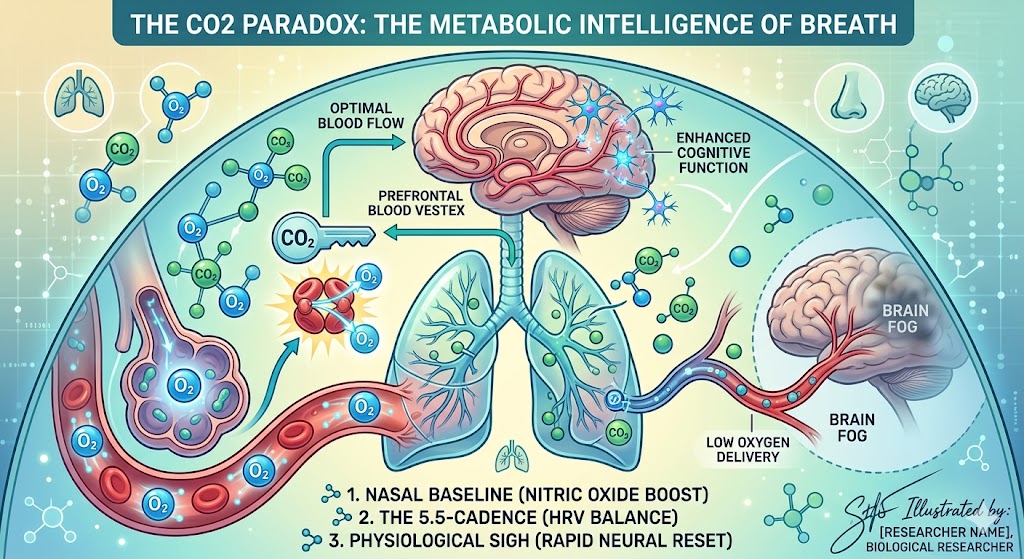
We have long been conditioned to believe that Oxygen (O₂) is the ultimate hero of our survival, while Carbon Dioxide (CO₂) is merely a “villainous” waste product that we must exhale as quickly as possible. Consequently, health advice often suggests we “take a deep breath” to get more oxygen. However, this often leads to rapid, shallow breathing. In fact, by obsessively trying to “oxygenate” your body this way, you might actually be suffocating your brain and tissues.
Welcome to the world of the CO₂ Paradox—a misunderstood physiological process that sits at the heart of your mental clarity, cognitive endurance, and stress regulation.
The Hidden Law of Gas Exchange: The Bohr Effect
Many people assume that faster breathing equals more oxygen. However, this is a dangerous half-truth. While rapid breathing may saturate your blood with oxygen, it fails to account for the actual delivery mechanism.
According to the Bohr Effect, hemoglobin—the protein in your blood responsible for carrying oxygen—is “sticky.” It refuses to release oxygen into your brain, muscles, and organs unless a specific amount of Carbon Dioxide is present. Therefore, if your CO₂ levels are chronically low—a state often caused by modern, stress-induced rapid breathing—your hemoglobin stubbornly holds onto the oxygen. You are, quite literally, starving your tissues of energy while your blood remains fully saturated.
The Biological Hijack: Why You’re Always Fatigued
When stress hits, your sympathetic nervous system triggers a “fight or flight” response, which leads to shallow chest breathing. When this pattern becomes chronic, you enter a damaging Stress-Breathing Loop:
- First, your CO₂ levels drop significantly.
- Subsequently, your blood vessels constrict, because CO₂ acts as a natural vasodilator.
- As a result, you experience cognitive fatigue and “brain fog.”
This is not just a passing mental state; it is a metabolic failure. To reclaim your performance, you don’t need “more air”—you need metabolic intelligence.
Reclaim Your Biological Sovereignty
In this deep dive into respiratory physiology, I break down the science behind how your breath functions as a remote control for your Autonomic Nervous System. Through this guide, you will learn:
- The 5.5-Cadence: The optimal rhythm to balance your heart rate variability (HRV).
- Nasal Respiration: Why nose breathing serves as your first line of defense against cognitive fatigue.
- The Physiological Sigh: A neuroscience-backed “reboot” button for your nervous system.
Ultimately, we are not machines designed for simple linear inputs and outputs; rather, we are complex, self-regulating biological systems. It is time to stop forcing your breath and start cooperating with your internal chemistry.
Ready to master your internal ecosystem and enhance your high-yield performance?
[Read the Full Research & Protocol Here]
Support My Research & Stay Connected
If you found this biological deep dive valuable, I invite you to join my growing community of science-driven readers. My work is dedicated to exploring the intersection of neurobiology, psychoanalysis, and physical health to help you reclaim your Biological Sovereignty.
Subscribe to My Substack: Join the “Biological Sovereignty” newsletter for exclusive research updates, in-depth biological protocols, and nuanced insights delivered directly to your inbox. 👉 Join the Community on Substack
Support My Work on Patreon: If you’d like to support my independent research and help me create more high-quality, evidence-based content, consider becoming a patron. You can choose the tier that fits your level of curiosity. 👉 Support My Research on Patreon
Explore More: You can find a collection of my published work and curated stories here: 👉 Safaa Labib on Digitalmehmet
Thank you for being part of this journey toward mastering your internal ecosystem.


Leave a Reply