

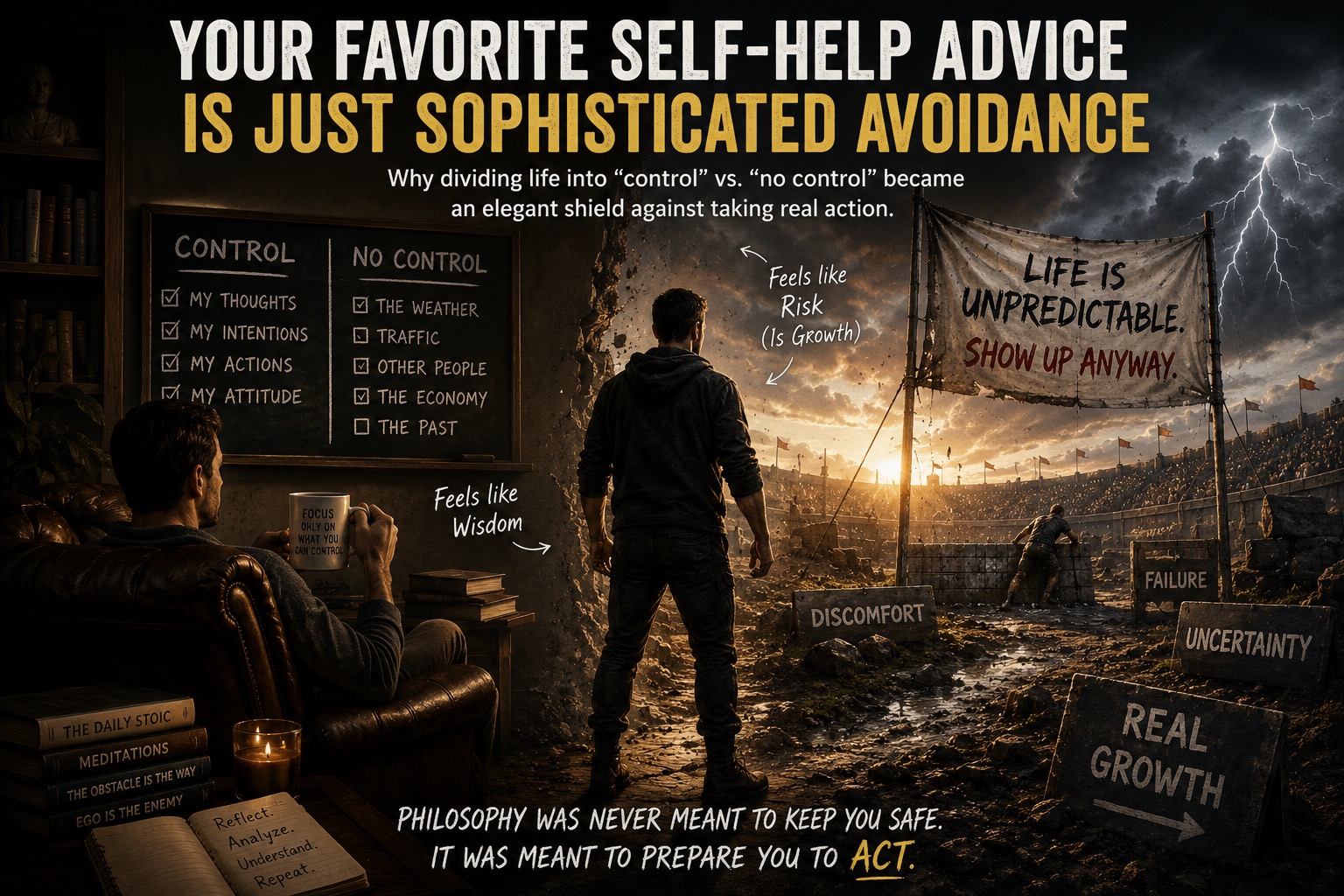
Sometimes the wisdom we trust most becomes the very thing keeping us safely stuck outside the arena of real life.
The author created the image using AI
Curator’s Note: In this story, the author, Gary L Fretwell, reflects on the limitations of relying too heavily on the dichotomy of control from Stoic philosophy, particularly as taught by Epictetus. While it initially offers a framework for mental clarity by categorizing control, the author realizes that this mindset can lead to intellectual avoidance and paralysis. Instead of prompting action, it may become a shield against reality’s uncertainties, leading to stagnation. The article emphasizes that true growth occurs when we engage with the unpredictable aspects of life rather than retreating into comfort zones. Authentic application of philosophy should inspire proactive engagement with life’s challenges, fostering resilience and genuine progress.
For years, I carried a specific piece of ancient wisdom around like an intellectual security blanket. It’s a concept millions of us lean on, a foundational pillar of modern self-help, and the bedrock of Stoic philosophy: Epictetus’s famous dichotomy of control.
The premise is elegant in its simplicity. You divide the world into two distinct columns. In the first column, you place the things completely within your power: your thoughts, your intentions, and your direct actions. In the second column, you place everything else: the weather, traffic, macroeconomic shifts, and the unpredictable behavior of other people. The promise is clear: focus exclusively on the first column, ignore the second, and you will achieve an unshakeable peace of mind.
It sounds perfect on paper. But over time, I noticed a troubling paradox. The more I relied on this idea to protect my peace, the more I felt strangely paralyzed. What I trusted most to push me forward was quietly keeping me stuck.
The Shield of Intellectual Avoidance
I had fallen into a common psychological trap: using philosophy not as a catalyst for action, but as an elegant shield against the discomfort of reality. By obsessively sorting every daily event into neat categories of “control” versus “no control,” I was inadvertently conditioning myself to step away from the messy, unpredictable friction of life.
If an outcome wasn’t guaranteed, or if a situation felt chaotic, it became all too easy to shrug, classify it as outside my power, and retreat into passive detachment. “Not my circus, not my monkeys,” became less about healthy boundaries and more about avoiding the risk of failure.
This wasn’t true serenity; it was an intellectualized form of avoidance. In my desire to avoid frustration and protect my inner calm, I was systematically avoiding the very experiences required to build genuine resilience. True peace isn’t found by hiding in a sterile, controlled environment; it is forged by learning how to stay centered while standing in the middle of a storm.
The Forgotten Half of the Equation
We tend to quote the first part of Epictetus’s wisdom while entirely forgetting the half that sets us free. The Stoics never intended for the dichotomy of control to be a justification for passive contemplation, safe isolation, or intellectual paralysis. It was never meant to be an exit ramp from reality. Instead, it was designed to be a tool for radical focus so that we could step into the arena with absolute clarity.
When Epictetus told us to understand what is not in our control, he wasn’t telling us to ignore the world. He was instructing us to stop wasting precious mental energy on anxiety, regret, and external validation so that 100% of our capacity could be directed toward our next meaningful action. The separation of control is meant to eliminate the friction inside your mind, not to help you avoid the friction of the real world.
Stepping Back into the Arena
True growth doesn’t happen in a vacuum of perfect control. It happens in the exact space where our internal intentions meet the external, unpredictable friction of the world. When we stop using philosophy as a defense mechanism to avoid failure, we unlock a deeper kind of freedom—the freedom to act boldly, accept the chaotic nature of reality, and keep moving forward regardless of the terrain.
Think about it: every creative endeavor, every professional pivot, and every deep relationship require us to interact with things we cannot completely control. If we refuse to engage unless we can guarantee the outcome, we stay small. We substitute reading about life for living it.
If you have ever felt like your personal growth routine has stalled into a comfortable, repetitive cycle of reading, reflecting, and analyzing without producing real-world progress, it might be time to look closer at the ideas you trust the most. We must ensure our mental frameworks pushing us into action rather than giving us a sophisticated excuse to stay exactly where we are. True philosophy is meant to be applied under pressure, not just contemplated in comfort.
I dive much deeper into this paradigm shift, exploring how we accidentally weaponize good advice against our own progress, and how to reclaim the active, courageous side of practical philosophy in my full article.
You can read the complete piece here: https://medium.com/illumination-curated/the-self-help-idea-i-trusted-most-was-keeping-me-stuck-9bab30e35c1d?sk=ecb18214d2068033dff239cab4b803e6
About the Author
Gary L. Fretwell is a #1 international best-selling author and a student of “Intentional Living.” By blending the rigors of neuroscience with the timeless wisdom of Stoic philosophy, Gary helps creators and leaders build a cognitive architecture of true significance.
As the author of the #1 International Best Seller: The Magic of a Moment, and best-sellers Intentional Retirement and Embracing Retirement, Gary provides definitive field guides for those ready to move from “Output” to “Influence.” His research-driven approach extends into personal wellness in Rewiring the Ring, available for pre-order now. This book explores the intersection of personal experience and cognitive science to understand and overcome Tinnitus. Rewiring the Ring will be available in all forms on June 1
Whether he is serving as Board President for Prescott Meals on Wheels or mentoring the next generation of MBA thinkers at Western Governors University, Gary’s mission is to help others navigate the “Identity Ghost” and design a life of purpose.
Explore the Second Mile:garyfretwell.com
Weekly Deep Dives: Subscribe to The Wise Effort on Substack.
Latest Articles: Follow on Medium.


Leave a Reply