

Curator’s Note
Vitamin B12 is the secret to feeling like your best self. This guide takes the mystery out of how your body stays energized. By understanding this one nutrient, you can stop feeling drained, get your focus back, and build a healthier future, starting today.
The Silent Epidemic
We often think of health in terms of what we can see. We look for a cough when we are sick, a rash when our skin is irritated, or a fever when we feel warm. But what happens when the problem is invisible? What happens when the very thing that keeps your brain clear and your heart beating with energy starts to slip away, almost unnoticed?
This is the reality of Vitamin B12 deficiency. It is not always a dramatic event. It often starts as a whisper. It begins with that extra snooze button hit in the morning, a slightly foggier head while working on a project, or a little more irritability than usual. We blame the weather, we blame our job, we blame the aging process. But often, the culprit is much smaller—a microscopic nutrient that our bodies cannot make, yet cannot live without.
Why We Cannot Survive Without It
Vitamin B12 is a marvel of biology. It is a complex, cobalt-containing compound that our body uses to perform miracles every second. Think of your body as a massive city. For that city to run, you need electricity to power the lights, fuel to run the transportation, and a master set of blueprints to repair the buildings. B12 is the electrician, the fuel, and the architect all in one.
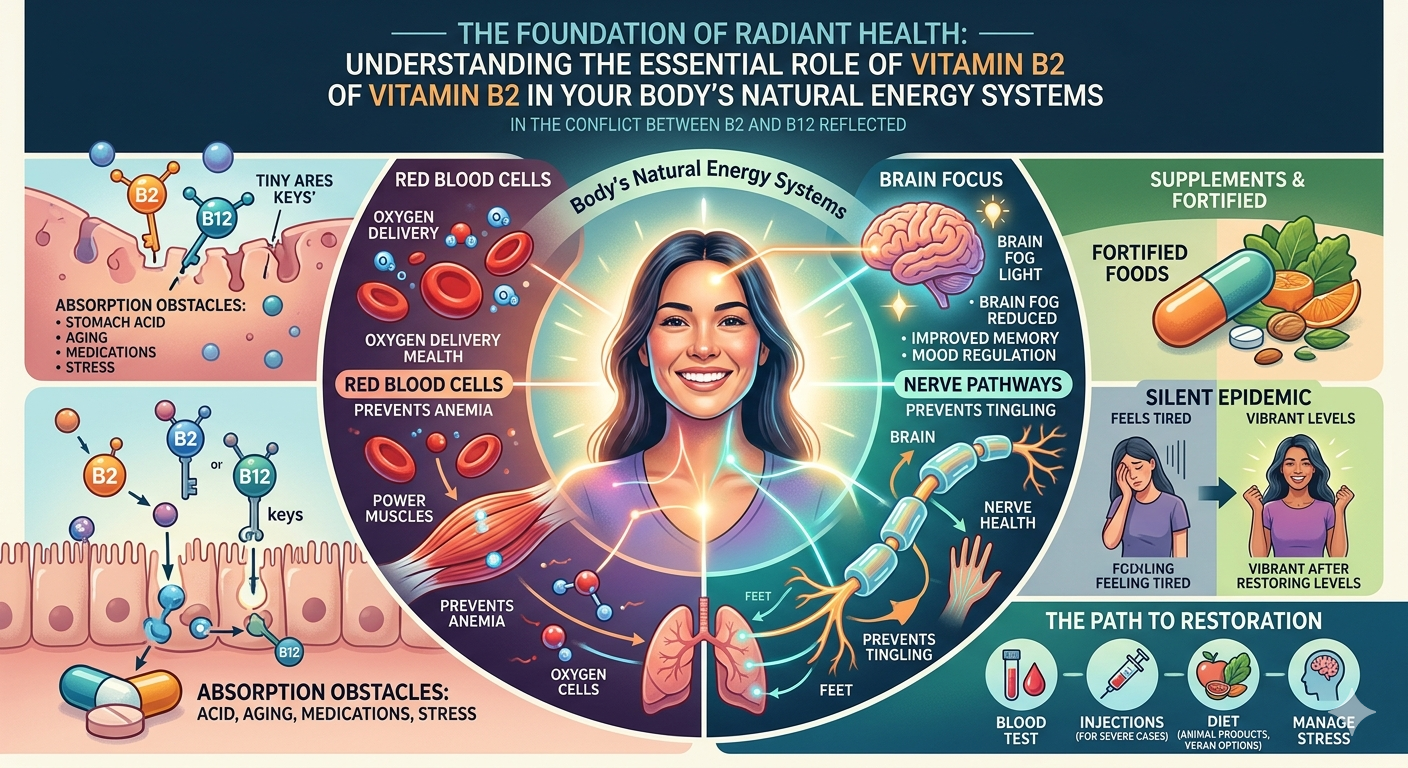
Without it, the “blueprint” of our cells—our DNA—cannot be properly repaired or copied. Our nerves, which are the power lines of our entire body, lose their protective coating. And our red blood cells, which act as the delivery trucks carrying oxygen to every inch of your system, fail to form correctly. When the delivery trucks stop running, your muscles feel heavy, your brain struggles to send signals, and the entire city begins to slow down.
The Global Issue
Why are we hearing about this more now? It is being called a “silent epidemic” for a reason. In many parts of the world, especially in countries with high vegetarian populations or rapidly aging demographics, the numbers are rising at an alarming rate.
We are living in an era where we have more food than ever, but less nutrition. Our modern diet is filled with processed goods that often lack the natural, animal-based sources of B12. Furthermore, as we live longer, we are discovering that our digestive systems—the very gates that should let B12 into our bodies—are not as efficient at 60 as they were at 20.
It is Not Just “Being Tired”
When people hear about B12, they immediately think of energy. But the consequences of a severe, long-term deficiency are much darker. The medical literature is filled with accounts of individuals who suffered for years with depression, paranoia, and memory loss, only to find out that their B12 levels were dangerously low. Some have even faced permanent neurological damage, such as the conditions that mimic dementia or nerve degeneration, which, if caught early, could have been completely reversed.
This is why this topic is so important. It is not just about having a little more pep in your step; it is about protecting the integrity of your nervous system and the clarity of your mind for the decades to come.
The Hidden Signs
When a nutrient is this important, its absence doesn’t just show up as a single symptom. It shows up as a collapse of systems. Because B12 is involved in so many different parts of your body, the signs of a deficiency can be incredibly broad and, frankly, confusing. This is why so many people go for years without ever realizing that their health struggles are linked to one missing piece of the puzzle.
The Sneaky Nature of Symptoms
The most frustrating part about B12 deficiency is that it rarely announces itself with a bang. It is a slow, gradual fade. You might start feeling tired, but you assume it is just the stress of a busy week. You might notice your memory is a bit shaky, but you tell yourself you are just distracted. Because these signs are so common and vague, doctors often overlook them or label them as “just a part of getting older.”
But beneath that “just feeling tired” label, your nerves and cells are actually struggling.
The Physical Heavyweight: Fatigue
The most common sign is a bone-deep, relentless fatigue. This is not the kind of tiredness that goes away after a good night’s sleep. It is a heavy, sluggish feeling that stays with you. Even after you wake up, you feel like you haven’t truly rested. This happens because your body isn’t producing enough healthy red blood cells. Without those cells, your blood cannot carry enough oxygen to your muscles, heart, and brain. You are essentially trying to run a marathon while breathing through a straw.
The Mental Fog: When Your Mind Won’t Clear
Perhaps more frightening than the physical exhaustion is the impact on your mind. Because B12 is essential for the nervous system, a lack of it often shows up in your thinking. This is often called “brain fog.” You might find yourself searching for words you usually know, forgetting why you walked into a room, or feeling like your thoughts are moving through thick syrup.
In more severe cases, this doesn’t stop at just being forgetful. The literature shows that long-term deficiency can lead to mood shifts that are severe—deep depression, irritability, and even feelings of paranoia. It is a heartbreaking reality: people struggling with their mental health for years, never realizing that a simple supplement or dietary change could have been the key to their recovery.
The Warning Shots: Nerves and Sensations
Then there are the “nerve signals.” If you have ever felt a strange tingling, a “pins and needles” sensation in your hands or feet, or even a weird numbness in your limbs, your body is sending you a very specific message. That tingling is often a sign that your nerves are losing their protective coating, which is called myelin. Think of myelin like the rubber insulation around a power cord. If that insulation wears away, the signals in your body start to “short circuit.” This can also lead to balance issues, muscle cramps, or a feeling of weakness in your legs that makes walking feel like a chore.
A Full-Body Struggle
Because the symptoms are so wide-ranging, it is easy to see why B12 deficiency is called a master of disguise. You might have an inflamed tongue that feels sore for no reason. You might notice your skin looking slightly pale or even a touch yellow. In some cases, people even report vision disturbances or muscle twitching.
The danger here is that we often treat the symptoms rather than the cause. We take something for the fatigue. We try something else for the memory issues. We see a different doctor for the nerve tingling. But if we don’t look at the B12 level, we are just putting a bandage on a wound that needs a totally different kind of care.
Learning to spot these clues isn’t about becoming a hypochondriac. It is about becoming an expert on your own body. If you feel like your “battery” is never fully charged, or your “connection” to the world feels a little staticky, it is worth asking the question: is my body getting the fuel it actually needs to run?
The Modern Obstacles
Even if you are eating a diet that you think is healthy, you might still be running low on Vitamin B12. This is the part that confuses most people. They say, “But I eat a balanced diet, why am I still tired?” The truth is that there is a massive difference between eating a nutrient and actually absorbing it. In our modern world, there are several “invisible walls” that stop our bodies from taking in the B12 we need.
The Stomach Acid Problem
To get B12 out of your food, your stomach needs to be a very acidic environment. It uses that acid like a key to unlock the vitamin from the proteins in your meat, fish, or eggs.
However, as we age, our stomachs naturally start producing less of this acid. It is a slow, quiet process. By the time many people hit their 50s or 60s, their “unlocked” B12 levels are much lower than they were in their 20s. But it isn’t just aging. Many of us, even in our 30s or 40s, spend years taking pills for heartburn, acid reflux, or general digestive discomfort. While these medicines help with the burning sensation, they often do it by lowering your stomach acid. If you lower the acid, you lose the “key” to the B12, and the vitamin just passes right through your system without being used.
The Stress and Gut Connection
We don’t often think about how stress affects our nutrition, but it is a major factor. When you are constantly stressed, your body shifts into “survival mode.” It stops focusing on the slow, careful process of breaking down food and absorbing minerals. Over time, this can lead to what some call a “leaky gut” or general inflammation in the digestive tract. When your gut lining is inflamed, it simply cannot do its job of pulling nutrients into your bloodstream. You could be eating the most expensive, organic food on the planet, but if your gut is inflamed, you are missing out on the fuel.
The Dietary Gap
We also have to be honest about our modern food landscape. B12 is unique because it is not found in plants. It is produced by bacteria, and we get it by eating animal products like red meat, poultry, dairy, and eggs.
In the last few decades, many people have shifted toward plant-based diets for excellent ethical and health reasons. However, a common mistake is moving to a plant-based diet without realizing that you are cutting off your only natural source of B12. If you don’t replace that source with fortified foods or the right supplements, your “battery” will inevitably run down. It might take years to notice, as the body keeps a reserve in the liver, but eventually, that reserve hits empty.
Medication Interference
Beyond just acid reducers, other modern medications play a role. Take metformin, for example. It is a lifesaver for millions of people managing diabetes, but one of its common side effects is that it can interfere with how your intestines absorb B12. If you are on long-term medication, your B12 levels should be part of your regular checkup conversation with your doctor. Most of the time, this isn’t even on the radar of a routine physical, which is why you have to be the one to ask.
The “Hurry Up” Lifestyle
Finally, there is the sheer pace of modern eating. We eat while driving, we eat while staring at our phones, and we eat in front of screens. We rarely take the time to chew properly or allow our bodies to enter a relaxed state for digestion. When we are always rushing, our digestion is rarely optimal. We are essentially “fueling up” a car while the engine is overheating, which makes the whole process much less efficient.
Understanding these obstacles is not about blaming yourself. It is about realizing that your body is working against some tough odds. Once you recognize that your stomach acid, your stress, your medications, or your diet might be creating a “blockage,” you can stop blaming yourself for being tired and start fixing the real issue.
The Path to Restoration
By now, you understand what Vitamin B12 does, why you might be running low, and how your daily habits could be blocking your body from absorbing it. But knowing the problem is only half the battle. The good news is that B12 deficiency is one of the most treatable issues in all of health. Once you take the right steps, the turnaround can be genuinely life-changing.
Getting the Right Answers
If you are tired of guessing, there is only one way to know for sure: a blood test. This is where you need to be a bit of an advocate for yourself. Many routine yearly physicals do not include a B12 check unless you specifically ask for it. Do not wait for your doctor to bring it up; mention your energy levels, any tingling, or your desire to be proactive.
When you get the results, remember that “normal” has a range. What is “normal” for a lab might not be “optimal” for how you want to feel. If your levels are on the lower end, even if they aren’t technically a “deficiency,” you might still benefit from a boost.
The Quickest Route: Injections
For people who are severely low, or for those whose digestion is significantly blocked, oral pills might not be enough. In these cases, doctors often suggest B12 injections. Because these go directly into the muscle and bypass the stomach entirely, they are incredibly effective. Many people describe feeling a massive shift in their mood and energy within just a few weeks of starting these injections. It is like turning the lights on in a dark room.
The Daily Support: Supplements and Diet
If your levels aren’t dangerously low, you have more options. If you eat animal products, adding things like beef liver, eggs, or wild-caught fish a few times a week can be a game-changer. For those who prefer a plant-based diet, sublingual tablets—the kind you dissolve under your tongue—are a great, easy way to bypass digestive issues and get the nutrient directly into your system.
When choosing a supplement, look for “methylcobalamin.” It is a form of B12 that your body can use right away without having to do much extra work to process it.
Building a Sustainable Future
Healing isn’t about one giant fix; it is about building a routine that supports your body every single day. Think of your health as a bank account. You cannot just make one big deposit and expect to live off it forever. You need consistent, small deposits.
- Be Patient with the Process: Your body has been running on low fuel for a while. It will take some time to rebuild your red blood cells and repair your nerve endings. Give yourself a few months of consistency before you expect to feel 100% back to normal.
- Manage Your Stress: Since stress impacts how your stomach handles food, finding ways to stay calm at mealtimes is actually a health strategy. Even just taking three deep breaths before you eat can help your body get ready to absorb what you are about to provide.
- Listen to Your Own Feedback: You are the best judge of your progress. Keep track of your energy levels, your sleep quality, and your focus. If you feel that afternoon crash starting to disappear, you know you are on the right path.
Final Thoughts
It is easy to feel frustrated when you don’t have the energy to do the things you love. It is easy to feel like something is wrong with you. But B12 deficiency reminds us that our health is often about the tiny, invisible details. We are complex systems, and sometimes, all we need is the right key to unlock our full potential.
You have the power to take control. Whether it starts with a simple blood test, a conversation with a professional, or a change in your grocery list, you are taking the steps toward a version of yourself that is clearer, stronger, and more vibrant. You don’t have to live in a fog. The “hidden battery” is there, waiting to be recharged. And now, you know exactly how to do it.


Leave a Reply