

Why Over-Polishing Desensitizes Our Creative Voice and Strips the Humanity from Our Craft
Curator’s Note: The post discusses the dangers of over-polishing creative work, emphasizing that while striving for perfection may seem admirable, it often strips away authenticity and individuality. Writers and creators may fall into the belief that technical perfection equates to quality, but this relentless refinement can diminish the unique voice that resonates with readers. Instead of creating relatable content, over-polished work becomes predictable and lifeless. The piece urges creators to embrace their imperfections and maintain the raw essence of their original ideas, as true connection arises from honest expression rather than flawless execution. It calls for a balance between discipline and preserving the creative spirit.
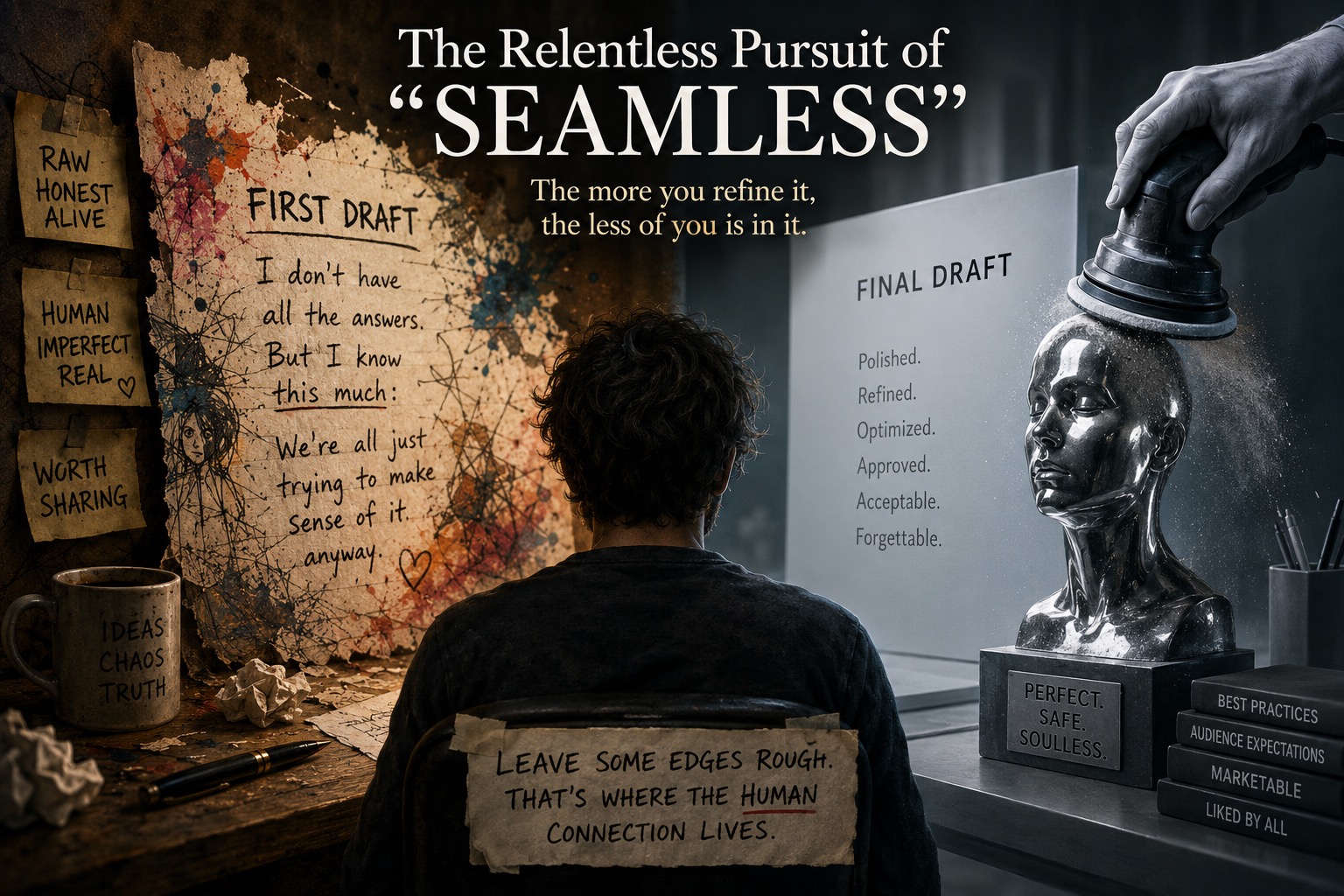
Perfection may impress, but authenticity is what readers remember. / Author created image using AI
There is a quiet, insidious trap waiting for every writer, creator, and leader at the end of a first draft or the initial launch of a project. It wears the mask of relentless dedication. It calls itself craftsmanship, professionalism, attention to detail, or simply “good editing.” It is the constant, obsessive pursuit of the seamless.
We have been conditioned by modern modern standards to believe that the ultimate goal of creative and intellectual work is absolute frictionlessness. From algorithms that reward predictable patterns to software that automates the human element out of style, we are constantly taught to sand down the jagged edges of our original thoughts. We smooth over the abrupt transitions, balance the formatting perfectly, and polish the surface until it reflects a flawless, mirror like gleam. We convince ourselves that if we just spend one more hour refining, tweaking, and reshaping, the work will finally be ready for the world.
But a profound danger hides within this obsession: the more you refine it, the less of you remains in it.
When we over refine a piece of work, we do not just eliminate technical flaws or typographical errors. If we are not careful, we shave away the vital, microscopic idiosyncrasies that made the idea worth sharing in the first place. We replace the raw urgency of our original thought with a sterile, homogenized perfection that reads like it was generated by an committee or a machine.
The prose becomes entirely safe. The insights become predictable and comfortable. The voice, once distinct, vibrant, and uniquely human, becomes completely muffled beneath layers of compromise, caution, and overthinking.
True resonance requires friction. Texture requires variance. Think about the books, essays, or presentations that have genuinely shifted your perspective or stayed with you for years. When a reader connects deeply with a piece of work, they are rarely responding to a display of flawless grammar, a perfectly balanced corporate framework, or a calculated sentence structure. They are responding to a human being speaking honestly across space and time. They are connecting with the slight asymmetry of an authentic perspective, the unexpected pivot of a personal narrative, and the rough, unpolished truths that a heavy handed, fearful edit would have easily erased.
This is not a defense of laziness, nor is it an endorsement of sloppy, unthinking craftsmanship. Precision matters deeply. Discipline remains the absolute cornerstone of any serious creative or professional practice. The real challenge, the true mark of mastery, lies in recognizing the exact moment when the act of refinement transitions from polishing a gem to grinding it into dust. It requires an immense amount of self awareness and restraint to know how to honor the necessary constraints of form while fiercely protecting the unique soul and energy of the work.
To counter this over polished aesthetic, we must cultivate the courage to leave some edges intentionally rough. We must learn to tolerate the minor vulnerabilities, the structural quirks, and the distinct stylistic turns that reveal the actual human hands behind the creation. It is those very imperfections that provide an intellectual foothold for a reader’s empathy and intelligence. Without them, the work becomes a slippery, completely frictionless slope that slides out of the mind the very moment the final page is turned or the tab is closed.
The next time you find yourself trapped in an endless loop of revision, caught in the grip of over analysis, pause and look closely at what you are changing. Ask yourself honestly: Am I genuinely clarifying the core message for my audience, or am I simply hiding from the vulnerability of being truly seen?
Do not let the sterile pursuit of an artificial ideal rob your work of its spirit, its texture, and its life. Trust the initial, raw spark that compelled you to create in the first place, and leave enough of yourself on the page for the world to actually find.
Discover the full exploration of this creative paradox here: https://medium.com/illumination/the-more-you-refine-it-the-less-of-you-is-in-it-60ccdb46594c?sk=ccacc4e10a424cf54238fb0df1021b59
About the Author
Gary L. Fretwell is a #1 international best-selling author and a student of “Intentional Living.” By blending the rigors of neuroscience with the timeless wisdom of Stoic philosophy, Gary helps creators and leaders build a cognitive architecture of true significance.
As the author of the #1 International Best Seller, The Magic of a Moment, and best-sellers Intentional Retirement and Embracing Retirement, Gary provides definitive field guides for those ready to move from “Output” to “Influence.” His research-driven approach extends into personal wellness in Rewiring the Ring, which explores the intersection of personal experience and cognitive science to understand and overcome tinnitus. His latest work, The Identity Ghost: Ancient Wisdom, Modern Neuroscience, and the Architecture of an Intentional Life, brings these threads together into a blueprint for designing a life of lasting purpose.
Gary is also the founder and editor of two Medium publications: Illumination: Retirement, Aging & Legacy and Illumination Beyond Identity. He serves as an editor for several other publications in the ILLUMINATION network, including ILLUMINATION Book Chapters, ILLUMINATION for India, ILLUMINATION Philosophy and Metaphysics, Health and Science, and ILLUMINATION Scholar.
Whether he is serving as Board President for Prescott Meals on Wheels or mentoring the next generation of MBA thinkers at Western Governors University, Gary’s mission is to help others navigate the “Identity Ghost” and design a life of purpose.
Explore the Second Mile: garyfretwell.com
Weekly Deep Dives: Subscribe to The Wise Effort on Substack.
Latest Articles: Follow on Medium.


Leave a Reply