

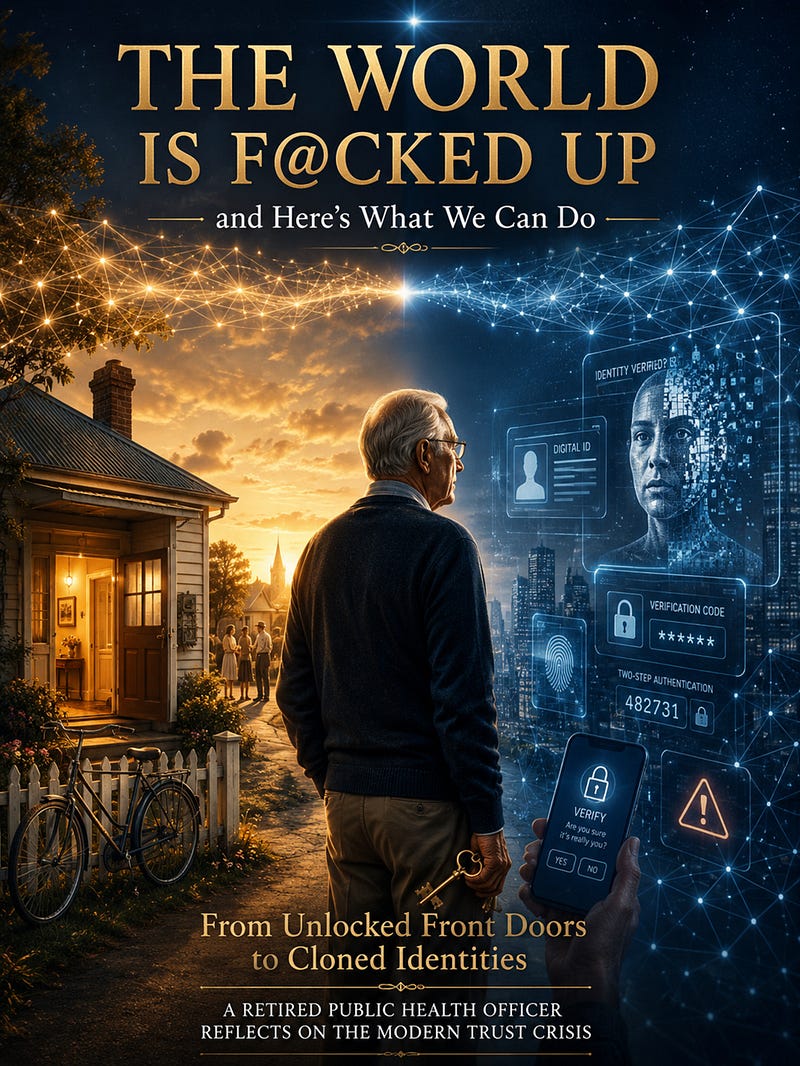
Here is why I think the World Is F@cked Up and What We Can Do About It from a Retired Public Health Professional Who Also Serves as an Editor and Curator on Medium and Substack Supporting ILLUMINATION Publications
I explain the Situation of How an Unlocked Front Door, a Cloned Identity, and a Spammed Platform Reveal What We Are Losing in the Digital Age
Curator’s Note: The author, Dr Michael Broadly, a retired public health professional, reflects on the erosion of trust in the digital age, contrasting it with a simpler past, where community relations thrived without the need for constant verification. The rise of the internet and artificial intelligence has transformed deception into a scalable threat, where fraudsters can impersonate identities without significant effort. This shift affects not just financial security but mental health and social cohesion as well. The author advocates for awareness, education, and a proactive approach to building digital resilience, emphasizing that while technology evolves, the core human qualities of trust and community remain essential for a safer digital environment.
Insights into Modern Trust Crisis
When I was growing up in Australia during the 1950s, our family home did not even have a lock on the front door. Many of our neighbors lived much the same way. During warm summer evenings, people moved freely between homes, conversations drifted across fences, and community relationships developed through familiarity rather than verification.
Looking back, I am careful not to romanticize those years. Human beings were no more virtuous then than they are now, and every generation has experienced dishonesty, crime, and selfishness. Yet there was a noticeable difference in the assumptions people carried about one another.
Trust generally arrived before suspicion. Most interactions began on a positive note and required caution only occasionally. As children, our greatest concerns involved scraped knees, unfinished homework, and arriving home before dark.
The possibility of having our identity stolen by a criminal operating from another continent would have sounded less like a realistic threat and more like the plot of an unusually imaginative science-fiction novel, like Isaac Asimov’s work, which I used to read with great interest before starting the science school at the University of Melbourne.
Over the decades, I watched that world gradually change. By the 1990s, doors that had once remained open were routinely locked. Security alarms became common. Businesses installed surveillance systems. People became more cautious about whom they trusted and why.
Yet even then, most threats remained visible and relatively understandable. If someone wished to deceive you, they generally had to appear in person, make a telephone call, write a convincing letter, or invest considerable effort into establishing credibility. Fraud certainly existed, but it required proximity, persistence, and human labor.
The digital revolution altered that reality in ways few people anticipated. The internet created extraordinary opportunities for communication, learning, commerce, and connection. At the same time, it removed many of the traditional barriers that once limited deception.
By the time artificial intelligence entered public consciousness, fraud had become scalable. Criminals no longer needed to target individuals one at a time. They could target thousands or even millions simultaneously. They no longer needed to earn trust through prolonged interaction. They could manufacture the appearance of trust through convincing websites, realistic messages, synthetic identities, cloned voices, and increasingly sophisticated forms of impersonation.
As an elderly person who has lived through these transitions, I view the modern digital world with a mixture of fascination, admiration, scientific curiosity, and concern. The pace of change has been remarkable. So too have the opportunities for exploitation.
Those thoughts came rushing back to me yesterday when faceless bot accounts flooded our publication, ILLUMINATION, with overtly AI-generated content containing deceptive messages and harmful links. While moderators and editors worked diligently to remove the harmful material, another troubling discovery emerged.
Someone had once more cloned the account of Dr Mehmet Yildiz, owner and chief editor of the ILLUMINATION Integrated publications on Medium, Substack, and Patreon, as they had done with my account multiple times, apparently hoping to exploit the trust he has spent years building within the writing community.
Although I have witnessed countless examples of fraud throughout my professional and personal life, this incident felt particularly disturbing because it demonstrated how easily trust can now be replicated, manipulated, and weaponized within digital environments. A person’s reputation may require years to build, yet modern technologies can create a convincing imitation within minutes.
My immediate reaction was emotional. I was angry, annoyed, disappointed, frustrated, deeply concerned, and sad. I found myself thinking, perhaps less diplomatically than a retired public health officer should, that the world had become deeply f@cked up.
Yet after the initial irritation subsided, I began reflecting on why incidents like these provoke such strong emotional reactions. The answer, I suspect, extends well beyond financial losses or technological vulnerabilities. Fraud attacks something far more fundamental than money. It attacks trust itself.
Trust is one of those invisible social assets that rarely attracts attention when functioning well. Much as we appreciate clean water, reliable infrastructure, or effective public health systems, we tend to appreciate their value only when they begin to fail.
Entire societies depend upon countless acts of trust occurring every day. We trust that the person contacting us is who they claim to be. We trust that organizations generally operate within accepted rules. We trust that photographs depict reality, that voices belong to real people, and that identities correspond to actual human beings.
When those assumptions become uncertain, the consequences extend far beyond inconvenience. They influence the emotional climate in which people live.
This issue became even clearer while I was editing and writing the foreword to Dr. Mehmet Yildiz’s book, Designing a Safer Digital World: How Deepfakes, Synthetic Identities, and Cybercrime Redefine Trust and How AI-Powered Defenses Put Us Back in Control.
During that process, I reflected on my own experience as someone who spent a career assessing public health risks yet still found myself vulnerable in digital environments. That experience reinforced an important lesson. Vulnerability in the modern world is rarely a consequence of low intelligence, poor education, or lack of experience.
In many cases, it happens because deeply human patterns of thinking are interacting with technological systems operating at speeds, scales, and levels of sophistication our brains never evolved to manage.
Human cognition developed within small communities where social cues were visible, reputations developed gradually, and trust was established through repeated interactions. Artificial intelligence and digital networks have dramatically changed those conditions.
Many of my elderly friends experience this reality every day. Some become anxious whenever the telephone rings. Others approach every email with suspicion. Lots of them have become so concerned about scams that they avoid online transactions altogether despite the convenience they offer.
These reactions are entirely understandable. They reflect adaptation to an environment where deception has become extremely difficult to distinguish from legitimacy. For people who grew up in communities where trust was largely assumed, adjusting to a world requiring constant verification can be mentally exhausting.
In conversations with friends, I occasionally joke that retirement has become a part-time job involving password management, software updates, identity verification, and learning how to recognize the latest scam. Like most humor, the joke contains more truth than exaggeration.
From a public health perspective, this development deserves considerably more attention than it currently receives. Fraud is usually discussed as a financial crime or a cybersecurity challenge. Both descriptions are accurate, yet they capture only part of the story. Human beings evolved as social creatures.
Trust influences psychological well-being, community participation, resilience, cooperation, and healthy aging. When trust begins to erode, people pay costs that rarely appear in economic statistics.
Victims experience intense anxiety, embarrassment, loss of confidence, self-doubt, and social withdrawal. Some become reluctant to engage online. Others begin questioning interactions they once accepted without hesitation.
Viewed through this wider lens, fraud affects more than financial well-being. It influences mental health, social participation, community cohesion, and overall quality of life.
One of the most valuable insights in Dr. Yildiz’s book is the recognition that modern fraud operates as a system combining human manipulation with technical execution. Criminals exploit cognitive shortcuts that all human beings rely upon. They create urgency where patience is required. They manufacture authority where none exists. They establish false credibility long enough to influence behavior. They take advantage of the same psychological mechanisms that help us make efficient decisions in everyday life.
Artificial intelligence has dramatically amplified these capabilities. Deepfakes, synthetic identities, automated phishing campaigns, and AI-generated content enable deception at unprecedented scale.
Yet the same technologies can also identify anomalies, detect suspicious patterns, strengthen authentication systems, and support defensive strategies. This is one of the defining paradoxes of artificial intelligence. It empowers both attackers and defenders simultaneously.
As I reflected on these developments, another question emerged. What happens when millions of people begin approaching every phone call, email, photograph, video, and online interaction with suspicion?
Throughout most of human history, authenticity was relatively straightforward to establish. A face belonged to a person. A voice belonged to a speaker. A photograph served as evidence. Increasingly, those assumptions require verification.
Artificial intelligence did not create deception, but it has expanded the speed, scale, and sophistication of deception to levels that previous generations could scarcely imagine.
In some respects, humanity is being challenged to reinvent one of its oldest social mechanisms for an entirely new environment. The future challenge may involve more than protecting money, passwords, or personal information. It may involve preserving confidence in reality itself.
Despite these challenges, I remain cautiously optimistic. My studies and work in public health taught me that prevention is generally more effective than treatment. We do not eliminate risks entirely, but we can reduce their impact through education, awareness, thoughtful system design, and collective action. The same principle applies to digital fraud.
We may never create a world entirely free of scammers, just as we never created a world entirely free of infectious diseases, crime, or human deception. Yet we can build a society that is more resilient to manipulation.
We can educate vulnerable populations. We can improve digital literacy. We can design safer technologies. We can encourage conversations about fraud without attaching embarrassment or stigma to those who become victims.
That is why I resist the cynicism that sometimes accompanies discussions about the modern world. Yes, there are days when the internet appears overrun by bots, scammers, misinformation, and synthetic deception.
Yes, there are moments when I miss the simplicity and openness of the Australia I grew up in. However, nostalgia alone offers little practical value. The goal is not to recreate the past. The goal is to preserve the principles that made trust possible while adapting those principles to the realities of the digital age.
The world may indeed feel f@cked up at times. Yesterday certainly felt that way to me. Yet the solution is not despair. It is awareness. It is education. It is critical thinking. It is transparency. It is accountability. It is the deliberate cultivation of trust supported by verification rather than blind acceptance.
Most importantly, it is the recognition that while technology continues to evolve, our greatest strengths remain profoundly human. Character, wisdom, compassion, curiosity, and community are qualities that no scammer, bot, or artificial intelligence system can genuinely replicate.
Those qualities helped build the world of my childhood. They remain essential for building a safer digital world today, and they may prove even more valuable in the years ahead.
To conclude my nostalgic, poignant yet constructive story, I invite you to remain vigilant and collaborative in the digital world by reporting, blocking, and informing your friends and communities about malicious accounts to prevent harm and reduce the risk of scams and fraud.
I’d like to share a relevant story that reflects conversations with my elderly friends in Australia about the use of artificial intelligence. Here is the link to this humorous yet insightful story that focuses on trust in the digital world.
My Elderly Mates Trust AI More Than Politicians, Journalists, or Even Their Doctors
The Hallucination Problem Nobody Seems to See Coming! It conjures images of psychedelic music festivals or aging rock…medium.com
I also documented another technological development from the business world, giving us new perspectives on the constructive use of artificial intelligence. Here is the link to this business story:
The $5 Million PowerPoint Is Dying
How AI Is Tearing Apart the Consulting Industry’s Most Profitable Illusionmedium.com
Thanks for reading my story from Down Under. Have a lovely day.
If you are interested in sex, I have started a sex education series which might educate, inspire, or even entertain you. Here are the links to some sample stories:
The 8 Habits of Sexually Satisfied Couples With Any Sexual Orientation
Sexual Health Is a Natural Part of Healthy Aging
What Most People Were Never Taught About Female and Male Orgasm
The Neurobiology of Sexual Pleasure and Meaningful Human Connection.
Human Libido: What Most People Were Never Taught About Sexual Desire
What Most People Were Never Taught About Sexual Confidence
Neurocognitive and Affective Differences Between Erotic and Pornographic Stimuli in the Brain [Warning: This one is scholarly!]
What Science Reveals About Anal Pleasure and Orgasm for Both Women and Men [Free access via my community blogs]
Cheers, Mike!


Leave a Reply