

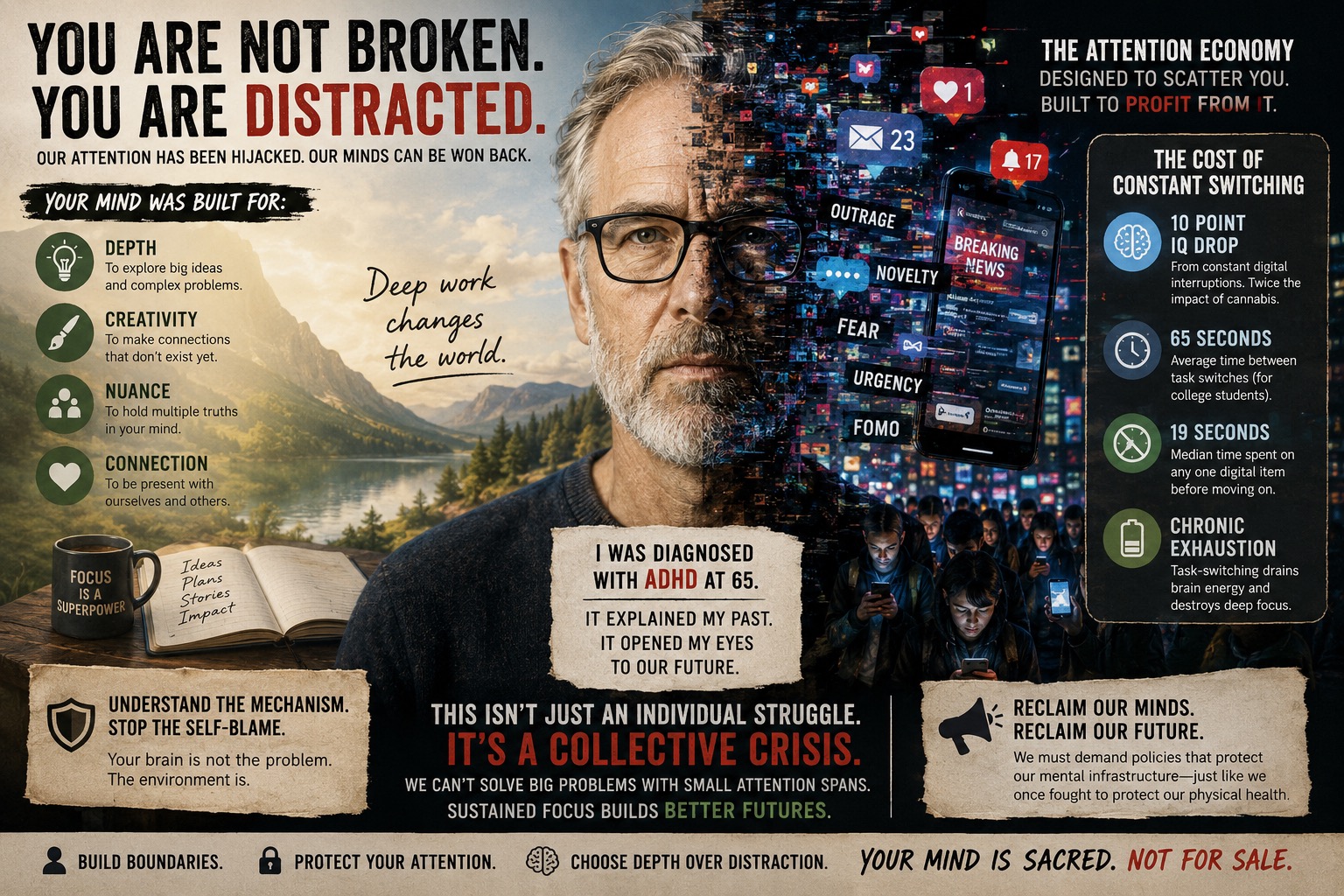
Curator’s Note: At 65, the author. Gary L Fretwell received a diagnosis of ADHD, which reshaped their understanding of a lifelong struggle with focus, revealing that attention issues are not solely personal failings but stem from a societal crisis fueled by the attention economy. This world encourages constant distractions, leading to cognitive fragmentation that impacts everyone, creating a collective inability to maintain deep focus. The author argues that simplistic solutions only address symptoms rather than the systemic causes. Acknowledging individual differences in neurobiology is crucial for reclaiming mental focus, but societal and regulatory changes are vital to protect collective attention from corporate exploitation. The author created the cover image using AI
A diagnosis at 65 revealed a personal truth, but it also exposed a larger one: our attention is no longer failing us; it is being systematically fragmented by a world designed to monetize distraction.
We live in a culture that treats focus like a test of character. If you can’t sit still, finish your work, or resist the gravitational pull of your smartphone, the dominant narrative tells you that you are weak, undisciplined, or simply lazy. We are taught from a young age that our attention span is a muscle entirely under our own control and that a failure to direct it is a failure of personal responsibility.
For 65 years, I lived inside that exact punishing narrative. I spent decades fighting a private, exhausting war against my own mind, assuming that the chaotic buzz in my head, the constant task-switching, and the crushing mental fatigue were just the baseline tax of being a human in the modern world. I assumed everyone else was fighting the exact same level of internal chaos and simply doing a better job of hiding it than I was.
I thought my experience was normal. It wasn’t.
At age 65, a formal diagnosis of Attention-Deficit/Hyperactivity Disorder (ADHD) entirely recontextualized my past. Decades of self-blame, missed details, and fractured projects suddenly made sense under a neurobiological lens. But as someone who has spent years investigating human behavior, addiction, and social systems, I quickly realized that my personal diagnosis was a gateway to a much larger, darker truth: the attention crisis I fought my whole life has quietly become everyone’s problem. The modern world has built an environment that forces the entire population to live in an artificially induced state of cognitive fragmentation.
The Illusion of Personal Failure and “Cruel Optimism”
The realization that a lifelong struggle is rooted in neurobiology is both a profound relief and an intense reckoning. For decades, the mainstream coping mechanism offered to me—and to millions of others with a wandering mind—has been what sociologists call “cruel optimism.” This is the practice of offering simplistic, individual solutions to massive, systemic problems. It’s the act of telling someone they can solve a structural crisis if they just buy the right product or try a little harder.
When you can’t focus, society tells you to download a mindfulness app, lock your phone in a timed kitchen safe, or muster up more raw willpower. But I argue that blaming yourself for losing focus in the modern world is like blaming yourself for getting wet during a category five downpour. It ignores the environment entirely.
The metrics of our collective cognitive decline prove that this is not an individual shortcoming, but a global epidemic. Research tracking human behavior in modern workplaces has revealed that the average office worker can now only focus on a single task for about three minutes before being interrupted or interrupting themselves. Even more alarming, a study of college students found that they switch tasks, on average, every 65 seconds when left to their own devices. The median time spent focused on any one digital item before moving to the next is a mere 19 seconds.
We aren’t failing to pay attention; our attention is actively being mined, processed, and sold to the highest bidder.
The Hidden Cost of the “Switch”
When you live with undiagnosed ADHD, your brain is constantly scrambling to process inputs, leading to a state of chronic, erratic task-switching. But today, the mechanics of the digital economy have forced everyone into this exact cognitive pattern, regardless of their underlying neurobiology. We are all living with a simulated form of attention deficit.
Every time you drop a project to glance at a text message, reply to an urgent email notification, or check a breaking news alert, your brain undergoes what psychologists call the “switch cost effect.” Your brain cannot seamlessly transition from one complex task to another. Instead, it has to pause, discard the current mental framework, reconfigure its neural pathways for the new stimulus, and then attempt to reconstruct the original memory and momentum when you return to the primary task.
The toll of this constant friction is immense and measurable:
- The Functional IQ Drop: Studies conducted at the Institute of Psychiatry in London found that being constantly interrupted by technological distractions causes a temporary drop in functional IQ of about 10 points. To put that into perspective, that is twice the cognitive impact of smoking cannabis and is entirely on par with acute sleep deprivation.
- The Death of Flow: Deep, meaningful human achievement requires entering what psychologist Mihaly Csikszentmihalyi called a “flow state”—a state of effortless, deep immersion where time seems to vanish. Flow requires extended, uninterrupted blocks of time. When we segment our days into 65-second intervals, entering a flow state becomes mathematically and biologically impossible.
- Chronic Cognitive Exhaustion: Task-switching is incredibly energy-intensive for the brain. It drains the brain’s glucose stores. This explains why so many of us feel completely physically and mentally depleted by noon, regardless of how little physical labor we’ve actually performed. We are burning through our fuel reserves just trying to re-orient our minds fifty times an hour.
A Societal Diagnosis
Getting diagnosed with ADHD at 65 provided me with a unique, historic vantage point. It allowed me to see the stark contrast between a world that used to protect human focus and a world that aggressively, systematically destroys it for profit.
Our collective attention span didn’t naturally or accidentally collapse through some weird quirk of human evolution; it was violently stolen. Tech corporations discovered that the most profitable business model in human history is the “attention economy.” They design algorithms specifically to trigger our ancient survival instincts, flooding us with outrage, novelty, fear, and constant pings because engagement keeps our eyes on the screen, and engagement equals ad revenue. We are being fed a cognitive diet of “itching powder,” only to be sold the back-scratcher in the form of wellness apps and premium subscriptions.
This isn’t just an individual tragedy that ruins workplace productivity or makes us bad at finishing books. It is an existential, societal crisis. If we lose the ability to sustain deep, collective attention, we lose the ability to solve complex, long-term problems. We cannot fix broken political systems, resolve deep-seated social injustices, or tackle climate change if our collective attention span is limited to 280 characters or 15-second video clips. Serious problems require serious, sustained thought, and that is exactly what is being engineered out of existence.
Reclaiming the Mind
My diagnosis later in life has taught me that understanding the mechanism of your distraction is the vital first step toward freedom. Knowing that your brain is wired differently allows you to stop punishing yourself and start building scaffolding to support your mind. However, individual lifestyle changes—while incredibly helpful on a personal level—are small, fragile sandbags against a massive global tidal wave.
While medication, therapy, strict lifestyle adjustments, and setting personal boundaries with technology are vital tools for managing focus, the ultimate solution requires looking outward. We have to stop viewing our lack of focus as a personal sin or an individual disease and start viewing it as a systemic design flaw. Just as previous generations realized they had to collectively fight to ban leaded gasoline and lead paint to protect physical health and childhood development, we must eventually demand political and regulatory solutions that protect our collective mental infrastructure. We need to fight for a world where our minds are treated as sacred spaces rather than corporate resources to be strip-mined.
Your mind was built for depth, creativity, nuance, and genuine connection. If you are struggling to hold onto your thoughts today, remember: you are not broken, and you are not weak. You are simply trying to think inside a machine designed to scatter you.
To dive deeper into my exploration of how our attention has been hijacked, what a late-stage diagnosis teaches us about the human brain, and how we can collectively fight to win our minds back, read my full article on Medium:https://medium.com/health-science/i-spent-65-years-thinking-this-was-normal-it-wasnt-adbe9536d327?sk=4f2563f32f00d31958780e3c34a1c165
About the Author
Gary L. Fretwell is a #1 international best-selling author and a student of “Intentional Living.” By blending the rigors of neuroscience with the timeless wisdom of Stoic philosophy, Gary helps creators and leaders build a cognitive architecture of true significance.
As the author of the #1 International Best Seller, The Magic of a Moment, and best-sellers Intentional Retirement and Embracing Retirement, Gary provides definitive field guides for those ready to move from “Output” to “Influence.” His research-driven approach extends into personal wellness in Rewiring the Ring, which explores the intersection of personal experience and cognitive science to understand and overcome tinnitus. His latest work, The Identity Ghost: Ancient Wisdom, Modern Neuroscience, and the Architecture of an Intentional Life, brings these threads together into a blueprint for designing a life of lasting purpose.
Gary is also the founder and editor of two Medium publications: Illumination: Retirement, Aging & Legacy and Illumination Beyond Identity. He serves as an editor for several other publications in the ILLUMINATION network, including ILLUMINATION Book Chapters, ILLUMINATION for India, ILLUMINATION Philosophy and Metaphysics, Health and Science, and ILLUMINATION Scholar.
Whether he is serving as Board President for Prescott Meals on Wheels or mentoring the next generation of MBA thinkers at Western Governors University, Gary’s mission is to help others navigate the “Identity Ghost” and design a life of purpose.
Explore the Second Mile: garyfretwell.com
Weekly Deep Dives: Subscribe to The Wise Effort on Substack.
Latest Articles: Follow on Medium.


Leave a Reply