

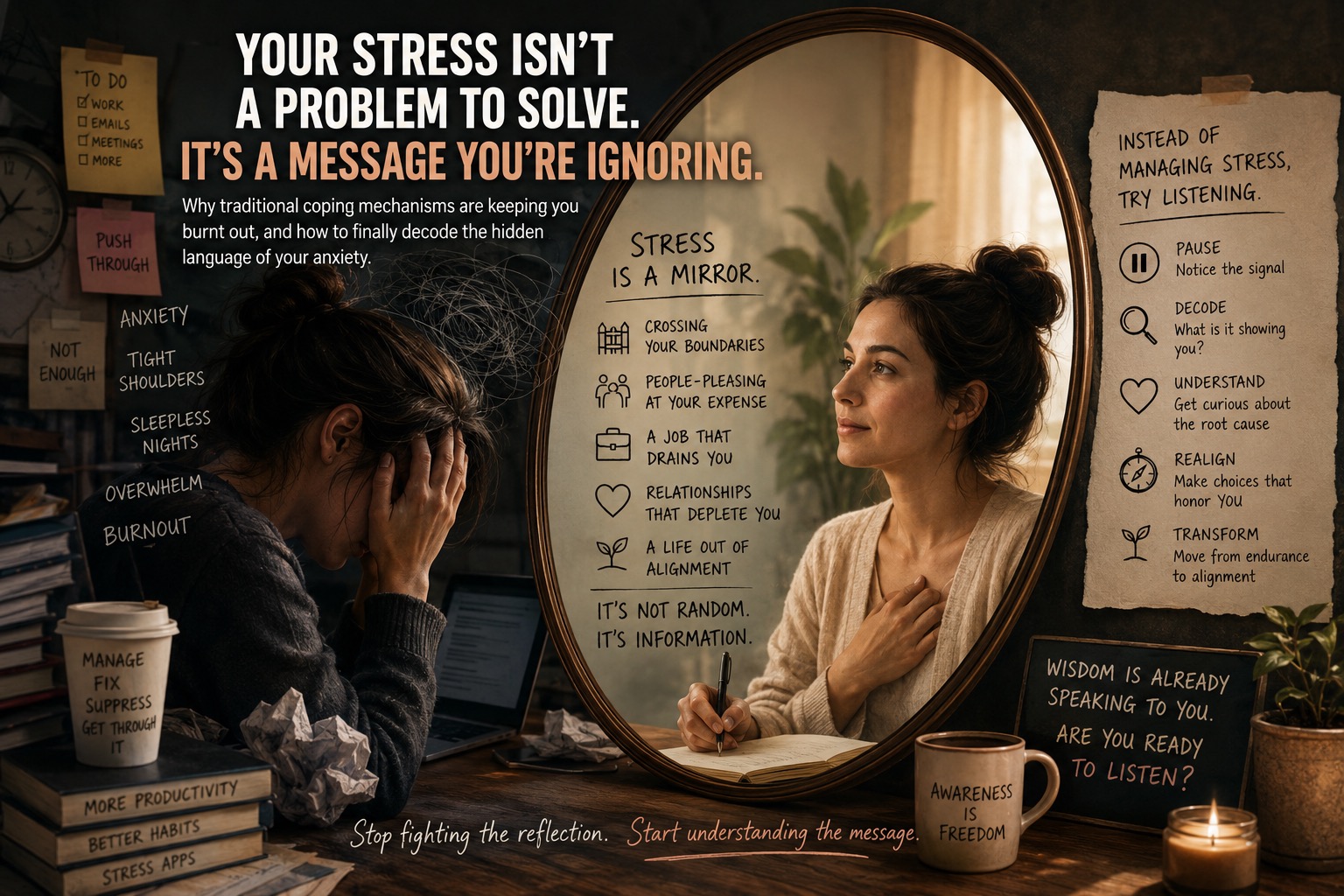
Curator’s Note: Stress should not be seen as an enemy but rather as a reflection of misalignments in life, choices, and values. The author, Gary Frettwerll, once skilled at stress management, realized the true source of stress comes not from external circumstances but from the judgments and demands we place on ourselves. This insight emerged during a challenging period marked by professional and personal difficulties. By documenting thoughts during stressful moments, it became clear that stress stemmed from perceived ultimatums rather than facts. To better manage stress, one should evaluate whether their thinking clarifies or obscures reality, ultimately leading to greater awareness and options.
Stress is not the enemy; it is a mirror reflecting the places where your life, choices, and values have drifted out of alignment.
I used to be very good at managing stress.
I had the tools. The breathing exercises, the journaling habit, the morning routine, carefully designed to keep the worst of it at bay. I could talk fluently about cortisol and nervous system regulation. I believed that managing stress, containing it, routing around it, was the sophisticated response. The thing emotionally intelligent people did.
What I didn’t realize was that I had completely misunderstood what stress actually was.
I had been so focused on turning down the volume that I never once stopped to ask what the sound was trying to tell me.
That realization didn’t arrive cleanly. It arrived through a particular stretch of my life when things were hard in several directions at once. Professionally uncertain. Relationally complicated. Financially tighter than I wanted to admit. By any reasonable measure, I had real things to be stressed about. And I was. Enormously, exhaustingly, constantly stressed.
But here’s what I eventually came to understand: the stress eating me alive wasn’t primarily coming from those circumstances. It was coming from something I was doing to myself, invisibly, automatically, thousands of times a day. Something that felt so much like perception I never once questioned whether it was actually just thought.
The story we mistake for reality
Most of us carry an unexamined theory of stress: hard things happen, stress follows. The timing seems to confirm it perfectly. The hard thing arrives, the stress arrives with it. Case closed.
Except it isn’t.
Think about two people facing the identical situation. The same job loss, the same diagnosis, the same relationship ending the same way. One is flattened for years. The other finds a difficult but navigable path through. If circumstances were the primary engine of stress, that variation would be impossible. The circumstances are the same. The suffering isn’t.
What generates stress is not the event. It is the verdict the mind renders about the event. The meaning it assigns, the story it builds, often in less than a second and far beneath conscious thought. Those answers feel like observations but they are actually interpretations. Change the interpretation and you change the feeling, even when you change nothing else.
The loop nobody warns you about
Stress impairs precisely the cognitive functions you need in order to think clearly about whether your stress is warranted.
Under significant stress, the part of the brain responsible for perspective and flexible thinking becomes less effective. The part that insists the worst outcome is the most likely one gets louder. You become simultaneously more alarmed and less equipped to examine whether the alarm is telling you something true.
This is why the 2 a.m. calculation always comes out wrong. The problem isn’t unsolvable. You’re trying to solve it with a mind compromised by the very distress the problem is generating. You are not falling apart. You are experiencing something neurologically predictable. Understanding that makes suffering slightly less personal.
What I found when I started looking
During that difficult period, I started writing down not what was happening but what I was actually thinking in the moments when stress spiked hardest.
What I found stopped me cold.
Underneath every spike, I found the same thing wearing slightly different clothes. Not descriptions of reality. Demands placed on it.
This has to work out the way I need it to.
If I fail at this, I cannot recover.
If this falls apart, it confirms the thing I’ve always been afraid is true about who I am.
None of those were facts. Every single one was an ultimatum my own mind was delivering to a reality that had no obligation to comply. The stress wasn’t arriving from outside me. It was being manufactured by the collision between those demands and a world that wasn’t arranging itself to meet them.
When I started challenging those thoughts honestly, something shifted. Not because my circumstances changed. Because the story loosened. And in that small opening, I could suddenly see options I genuinely could not see before.
The question that changes everything
Stress is not the problem. It is a mirror. And most of us spend enormous energy trying to look away from what it’s showing us.
The next time stress arrives, before you manage it or breathe through it or distract yourself from it, try asking one question: is my thinking right now helping me see reality more clearly, or less clearly?
That question creates distance. It positions you as someone observing your thinking rather than being carried away by it.
I wrote about this in much greater depth, including the neuroscience, behind why stress hijacks your thinking and the specific journal practice that changed how I relate to pressure entirely.
Read the full piece here: https://medium.com/illumination/stress-is-a-mirror-27adb2f6d475?sk=a3a9afde44f2c602a8ad2e25040c60ac
Stress has been trying to tell you something. It might be worth finally listening.
About the Author
Gary L. Fretwell is a #1 international best-selling author and a student of “Intentional Living.” By blending the rigors of neuroscience with the timeless wisdom of Stoic philosophy, Gary helps creators and leaders build a cognitive architecture of true significance.
As the author of the #1 International Best Seller, The Magic of a Moment, and best-sellers Intentional Retirement and Embracing Retirement, Gary provides definitive field guides for those ready to move from “Output” to “Influence.” His research-driven approach extends into personal wellness in Rewiring the Ring, which explores the intersection of personal experience and cognitive science to understand and overcome tinnitus. His latest work, The Identity Ghost: Ancient Wisdom, Modern Neuroscience, and the Architecture of an Intentional Life, brings these threads together into a blueprint for designing a life of lasting purpose.
Gary is also the founder and editor of two Medium publications: Illumination: Retirement, Aging & Legacy and Illumination Beyond Identity. He serves as an editor for several other publications in the ILLUMINATION network, including ILLUMINATION Book Chapters, ILLUMINATION for India, ILLUMINATION Philosophy and Metaphysics, Health and Science, and ILLUMINATION Scholar.
Whether he is serving as Board President for Prescott Meals on Wheels or mentoring the next generation of MBA thinkers at Western Governors University, Gary’s mission is to help others navigate the “Identity Ghost” and design a life of purpose.
Explore the Second Mile: garyfretwell.com
Weekly Deep Dives: Subscribe to The Wise Effort on Substack.
Latest Articles: Follow on Medium.


Leave a Reply