

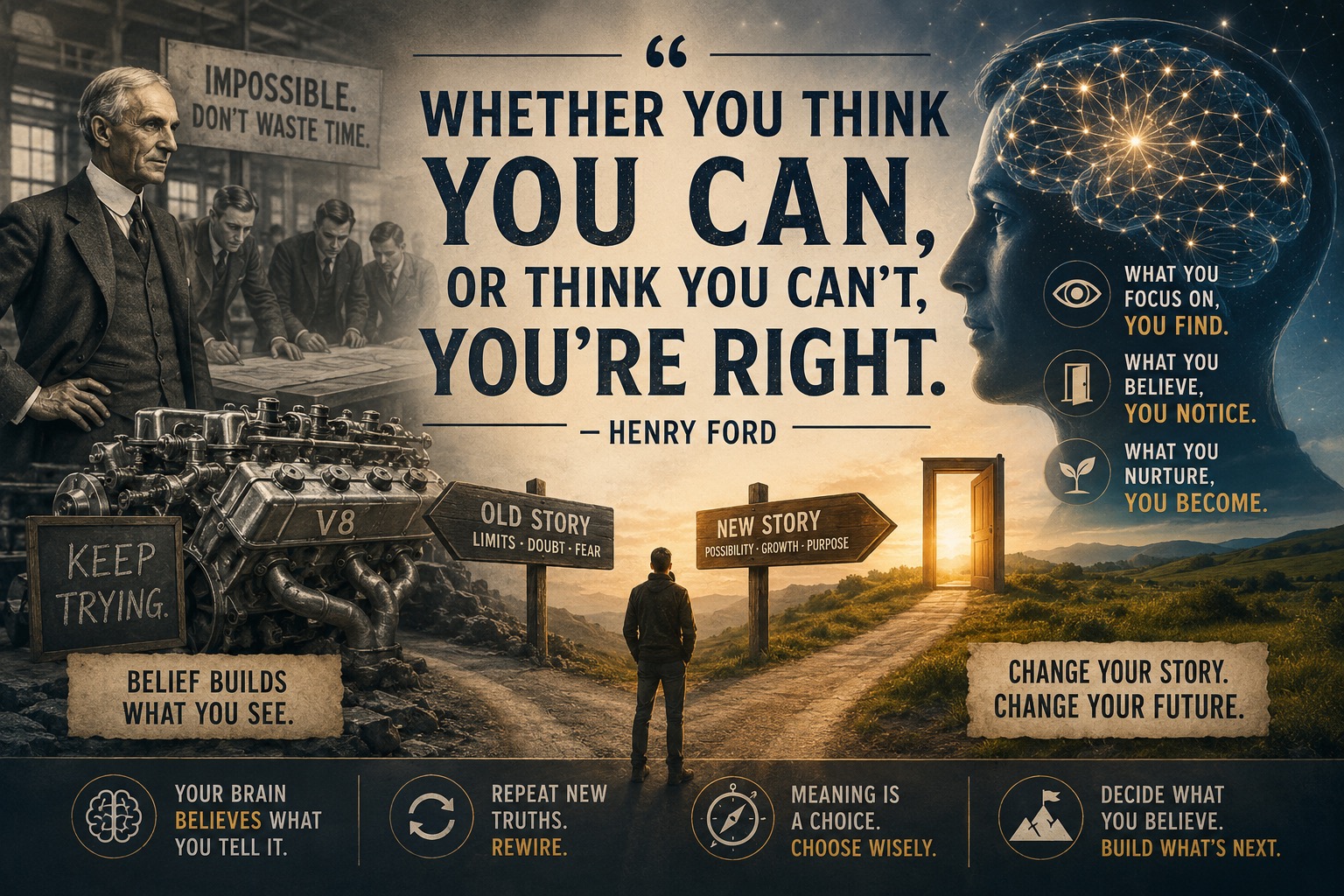

Curator’s Notes: This story emphasizes the profound impact of self-belief on perception and reality, citing Henry Ford’s V8 engine as a case study of how unwavering belief can lead to groundbreaking achievements despite what seemed impossible. Neuroscience supports this, revealing that our brains filter information based on pre-existing beliefs, effectively shaping our experiences and outcomes. Most individuals operate on unexamined mental scripts formed in childhood, which can limit potential. The article encourages readers to reassess their beliefs and rewrite their internal narratives to foster growth, underscoring that the key to transformation lies in the stories we tell ourselves about our abilities and possibilities.
The story you tell yourself becomes the reality your brain learns to see. Change the belief, and you change what becomes possible. / Author created image using AI
There’s a quote I’ve carried around for most of my adult life. Twelve words. Simple enough to fit on a sticky note, deep enough to reshape how you see every decision you’ll ever make.
“Whether you think you can, or think you can’t, you’re right.” — Henry Ford
Most people nod at that and move on. But if you stop and actually sit with it, really examine the machinery behind it, it stops being a motivational poster and starts being a diagnosis.
Your brain is not a neutral observer of your life. It is an active architect. And it builds exactly what you tell it to.
The V8 Story Most People Miss
In the early 1930s, Henry Ford had an idea: cast all eight cylinders of a new engine into a single block of steel. His engineers, brilliant, credentialed, experienced men, told him it was impossible. Not difficult. Not risky. Impossible.
Ford told them to keep trying.
A year later, they had the V8 engine, one of the most consequential innovations in automotive history.
The engineers weren’t lazy or incompetent. They were operating from a belief. And that belief organized everything: what they looked for, what they dismissed, what they even bothered to attempt. Their conclusion wasn’t just wrong. It was a perfect demonstration of how powerfully conviction shapes outcome.
Ford’s genius wasn’t technical. It was cognitive. He refused to let “impossible” become the operating system.
What Your Brain Is Actually Doing
Here’s what neuroscience has confirmed about the way belief shapes perception: your brain processes an estimated 11 million bits of information per second. You’re consciously aware of roughly 40 to 50 of them.
The rest? Your brain filters, discards, or suppresses based on what it has already decided matters. This is the reticular activating system at work, a neural gatekeeper that essentially tells your brain what to look for. Buy a red car and suddenly red cars are everywhere. Start believing you’re not good with money and your brain begins cataloguing every piece of evidence that confirms it. Decide you’re capable of building something extraordinary and your brain begins noticing the doors, the people, and the resources that support that story.
This is not positive thinking in the soft, feel-good sense. This is hard neuroscience. Your beliefs are literally determining what reality your brain lets through.
The Story You’re Running On
Most of us are operating on a mental script we didn’t consciously write. It was assembled in childhood, reinforced by criticism, shaped by failure, and calcified by years of repetition. We call it “being realistic.” We call it “knowing ourselves.” But often, it’s just an old story that never got questioned.
The problem isn’t that the script is negative. The problem is that the brain treats it as true and then goes about proving it.
Tell yourself you’re not creative long enough and your brain stops noticing creative solutions. Tell yourself leadership isn’t for people like you and your brain filters out every invitation to lead. Tell yourself the best years are behind you and your neural architecture begins building a life that confirms exactly that.
Ford’s engineers weren’t wrong because they lacked intelligence. They were wrong because they had already decided.
Rewriting the Operating System
The Stoics understood this long before brain scans existed. Marcus Aurelius wrote that the quality of your life is shaped by the quality of your thoughts, not your circumstances. Epictetus, born a slave, built a philosophy of radical inner freedom on the same premise: you cannot always control what happens, but you can always choose the meaning you assign to it.
That choice, the meaning you assign, is the first act of rewriting your neural script.
It doesn’t happen with a single declaration or a morning affirmation. It happens through intentional repetition, through the discipline of catching the old story mid-sentence and replacing it with a more accurate one. Not a blindly optimistic one. An accurate one, one that leaves room for possibility rather than foreclosing it before you begin.
The Question Worth Sitting With
Your brain is listening to every word you say about yourself and right now, it is building your future accordingly.
So the real question isn’t whether you can. The real question is: what story have you given your brain to work from?
Because whether you think you can, or think you can’t, you’re right.
And that means the most important thing you’ll do today isn’t on your to-do list. It’s deciding what you actually believe.
Read the entire article on Medium:
About the Author
Gary L. Fretwell is a #1 international best-selling author and practitioner of Intentional Living — blending neuroscience with Stoic philosophy to help creators and leaders build a life of lasting significance.
His books include the #1 international best seller The Magic of a Moment, Intentional Retirement, Embracing Retirement, and Rewiring the Ring, which explores the cognitive science of tinnitus. His latest, The Identity Ghost, is a blueprint for designing a life of purpose through ancient wisdom and modern neuroscience.
On Medium, Gary founded and edits Illumination: Retirement, Aging & Legacy and Illumination Beyond Identity, and serves as an editor across the broader ILLUMINATION network.
Off the page, he serves as Board President for Prescott Meals on Wheels and mentors MBA students at Western Governors University.
📖 garyfretwell.com · 📬 The Wise Effort on Substack · ✍️ Follow on Medium


Leave a Reply