

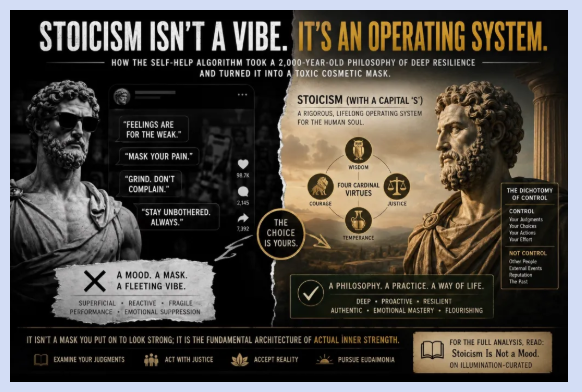
How social media transformed a philosophy of wisdom into a performance of emotional suppression
Curator’s Note: Social media has misrepresented Stoicism, transforming it from a philosophy of emotional resilience into a façade of emotional suppression. This modern portrayal emphasizes emotional detachment and an unbothered demeanor, diverging from the teachings of ancient Stoics like Marcus Aurelius and Seneca, who acknowledged and processed their emotions. True Stoicism promotes understanding what we can control and developing emotional discipline rather than denying feelings. It encourages facing reality and maintaining inner stability in a culture that values appearances. Ultimately, authentic Stoicism is about profound strength through emotional alignment, not superficial toughness, making it increasingly valuable in today’s fast-paced, reactive society.
Stoicism has become one of the most misunderstood philosophies of the modern era.
Scroll through social media for more than a few minutes and you will likely encounter the now-familiar aesthetic: grayscale Roman statues, aggressive motivational quotes, declarations about suppressing emotion, and endless reminders to “stay unbothered.” In many corners of the internet, Stoicism has been repackaged into a performance of emotional detachment, a personality style built around appearing cold, unaffected, and invulnerable.
But that version of Stoicism would have been almost unrecognizable to the ancient philosophers who actually practiced it.
The truth is that Stoicism was never designed to make human beings emotionally numb. It was designed to make them emotionally resilient.
That distinction matters more than ever.
The modern self-help ecosystem often turns deep philosophies into shallow slogans because slogans are easier to consume. It is easier to sell the image of toughness than the difficult internal work required to build genuine character. So Stoicism gets reduced to emotional suppression disguised as strength.
But emotional suppression is not strength.
Pretending you do not care is not wisdom.
And burying your emotions beneath productivity and performance eventually creates a psychological debt that always comes due.
The ancient Stoics understood this far better than many modern influencers do.
Marcus Aurelius, arguably the most famous Stoic in history, openly grieved the deaths of loved ones. Seneca wrote extensively about sorrow, fear, anger, and anxiety. Epictetus taught that emotions themselves were not the enemy; the problem was becoming enslaved to distorted perceptions and destructive reactions.
The goal was never to become a stone.
The goal was to become stable.
This is where the philosophy becomes deeply practical for modern life.
Most people today are exhausted not because they feel emotions, but because they are constantly controlled by them. Anxiety dictates decisions. Frustration ruins entire days. External events determine internal peace. A difficult email, a delayed flight, a critical comment online, or an unexpected setback can completely hijack a person’s mental state.
Stoicism offered a radically different framework.
The Stoics taught what is often called the “Dichotomy of Control”, the recognition that some things are within our control and many things are not. We cannot control external events, other people, the economy, aging, or random misfortune. But we can control our judgments, our responses, our values, and the meaning we assign to events.
That idea sounds simple on paper.
Living it is transformational.
When Stoicism becomes an operating system instead of a social media vibe, life changes at the foundational level. You stop obsessing over appearances and begin focusing on character. You stop trying to dominate circumstances and begin learning how to govern yourself. You stop asking, “How do I avoid discomfort?” and begin asking, “How do I respond honorably when discomfort arrives?”
That shift creates a kind of inner stability that external success alone can never provide.
And perhaps this is why Stoicism continues to resonate after more than two thousand years. Human technology has evolved dramatically, but human nature has not changed nearly as much as we think. We still struggle with fear, ego, uncertainty, anger, comparison, disappointment, and mortality. The battlefield simply moved from the Roman forum to the digital feed.
Unfortunately, the algorithm rewards performance more than wisdom.
It rewards the appearance of control rather than the disciplined cultivation of it.
The result is a generation of people trying to look emotionally invincible while privately drowning in anxiety and exhaustion.
Real Stoicism moves in the opposite direction.
It asks us to face reality honestly instead of escaping it.
It teaches us to accept uncertainty without surrendering our values.
It reminds us that strength is not found in emotional denial but in emotional discipline.
And perhaps most importantly, it reframes resilience not as hardness, but as alignment.
Wisdom. Courage. Justice. Temperance.
These were the pillars of the Stoic life, not productivity hacks, emotional shutdown, or performative toughness.
In many ways, Stoicism is less about becoming unbreakable and more about becoming deeply grounded. It is not about eliminating emotion; it is about developing the capacity to remain steady within it.
That may be the most needed skill in modern life.
Because in a culture obsessed with appearances, speed, outrage, and constant reaction, genuine inner stability has become increasingly rare.
And rare things become valuable.
The ancient Stoics were never trying to help people look strong.
They were trying to help people become strong.
Read the full analysis here: Stoicism Is Not a Mood on ILLUMINATION-Curated.
This article is adapted from Chapter 13 of my forthcoming book, The Ghost Identity.
About the Author
Gary L. Fretwell is a #1 international best-selling author and a student of “Intentional Living.” By blending the rigors of neuroscience with the timeless wisdom of Stoic philosophy, Gary helps creators and leaders build a cognitive architecture of true significance.
As the author of the #1 International Best Seller: The Magic of a Moment, and best-sellers Intentional Retirement and Embracing Retirement, Gary provides definitive field guides for those ready to move from “Output” to “Influence.” His research-driven approach extends into personal wellness in Rewiring the Ring, available for pre-order now. This book explores the intersection of personal experience and cognitive science to understand and overcome Tinnitus. Rewiring the Ring will be available in all forms on June 16.
Whether he is serving as Board President for Prescott Meals on Wheels or mentoring the next generation of MBA thinkers at Western Governors University, Gary’s mission is to help others navigate the “Identity Ghost” and design a life of purpose.
Explore the Second Mile:garyfretwell.com
Weekly Deep Dives: Subscribe to The Wise Effort on Substack.
Latest Articles: Follow on Medium.


Leave a Reply