

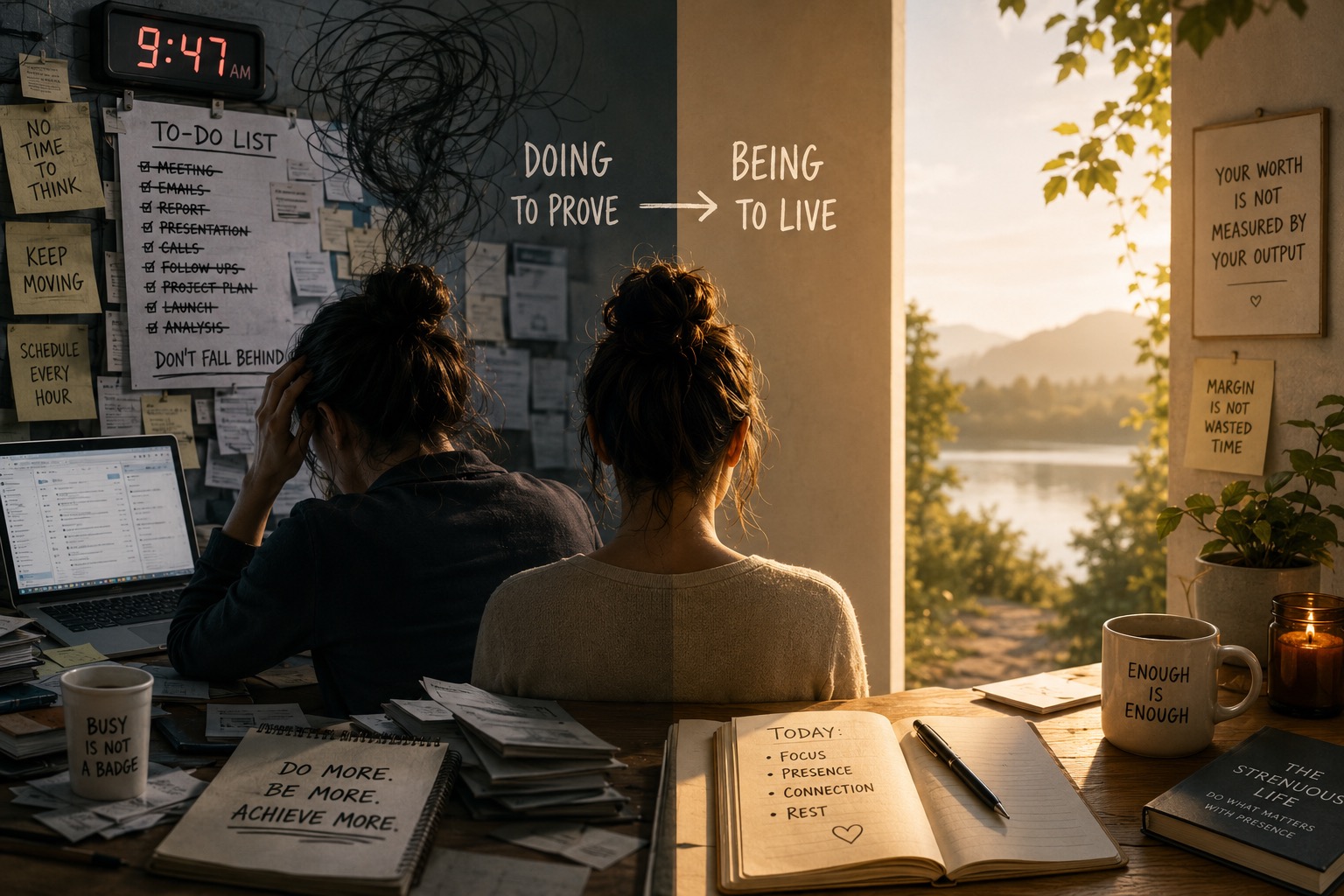
The difference between a life driven by endless tasks and a life guided by intention is not productivity; it is presence.
Curator’s Note: The essence of leading a life driven by intention versus endless tasks lies in presence rather than productivity. Busyness has become a status symbol, misleading us into equating constant activity with importance, while often serving as a defense mechanism to avoid uncomfortable emotions. Although productivity offers an illusion of control and validation, it risks tying our worth to output, leading to burnout. To break this cycle, one must cultivate intentionality by questioning the true purpose behind commitments. Ultimately, a meaningful life is about the quality of attention and relationships, not the quantity of tasks completed, making space for deeper insights and fulfillment.
We live in a culture that worships the checked box. Ask someone how they are doing, and the most common response is no longer “content” or “peaceful.” It is “busy.”
Over time, busyness has become a status symbol. A packed calendar signals importance; a relentless to-do list suggests ambition. We have mistakenly traded a meaningful life for a life of constant activity.
For years, I bought into that narrative.
Like many, I believed structured productivity was the antidote to uncertainty. If I felt overwhelmed, I organized my tasks. If life felt chaotic, I reached for a calendar, a checklist, or a new system to regain control. But there is a distinct line between healthy architecture and emotional survival.
The problem begins when productivity stops being a tool and starts becoming a shield. At that point, doing becomes a defense mechanism.
The Hidden Purpose of Busyness
We like to assume our schedules are simply a realistic reflection of our responsibilities. We have work to finish, people to care for, and obligations to meet. But if we look beneath the surface, a deeper psychological truth emerges: busyness is an incredibly effective way to avoid uncomfortable emotions.
When we keep ourselves perpetually occupied, we never have to sit with stillness. We don’t have to confront the quiet anxieties, the underlying disappointments, or the existential questions that inevitably surface when the noise stops. A full schedule leaves no room for self-examination; the next task becomes a convenient distraction from whatever we would rather not feel.
Psychologists have long recognized that avoidance is one of the most common coping mechanisms we employ. Some people turn to distractions like entertainment or social media. Others turn to productivity.
From the outside, productive avoidance looks admirable. Society rewards it with promotions, and peers praise our work ethic. We receive constant validation for our ability to stay in motion. Yet, beneath that frantic movement, we are often just running from ourselves.
The Illusion of Control
Productivity feels comforting because it creates a temporary illusion of certainty. Life is inherently unpredictable—relationships shift, health fluctuates, and markets change without warning. That lack of control can feel deeply unsettling.
A meticulously planned day offers an immediate, artificial relief. Every task checked off provides a small hit of reassurance. For a brief moment, it feels as if we are managing life itself.
But there is a vast difference between managing our responsibilities and attempting to micro-manage our anxiety through endless activity. The first is sustainable; the second is exhausting.
No matter how many tasks we complete, the finish line keeps moving. Productivity was never designed to provide emotional security. When we depend on accomplishment to feel safe, the race never ends.
When Worth Is Tied to Output
Perhaps the most damaging aspect of chronic busyness is how easily it consumes our identity. Many of us unconsciously tether our human value to our daily output.
- A productive day feels like a successful life.
- An empty day feels like a personal failure.
This mindset creates a constant undercurrent of pressure. Even moments that should be restful begin to feel wasteful. Relaxation becomes a reward we have to earn rather than a biological and mental necessity.
Eventually, burnout becomes inevitable. This exhaustion doesn’t happen because we are doing too much, but because we are asking our productivity tools to perform a psychological job they were never meant to do.
A Different Way Forward
Breaking free from the cycle of over-scheduling does not mean abandoning ambition or adopting a life of passive inertia. It means cultivating intentionality.
Before adding another commitment to your horizon, pause and ask a simple question: Why am I doing this? Is this task aligned with what truly matters, or am I just trying to quiet an uncomfortable inner dialogue?
Protecting our margin is vital. Space is not wasted time. Silence is not laziness. Reflection is not unproductive. In fact, some of the most critical insights in life arrive only when nothing is happening:
- A walk taken without headphones.
- A quiet morning on the porch.
- A few deep breaths before reaching for a digital device.
These moments rarely generate measurable data, yet they produce the exact clarity we spend years searching for.
The Real Goal
The ultimate objective is not to eliminate productivity, but to stop using it as proof of our worth.
A well-designed life is not measured by the quantity of the boxes we check, but by the quality of our attention, the depth of our relationships, and our willingness to be fully present. The most meaningful lives are rarely the busiest ones. They are the most intentional.
When we stop hiding behind the armor of endless tasks, we discover something surprising. Life does not become smaller; it becomes richer. And in that newfound space, we finally leave room to experience what all our striving was supposed to help us find in the first place.
To dive deeper into the psychology of the “strenuous list” and discover how to reframe your relationship with daily productivity, read the original piece on Illumination:
Your To-Do List Is Not a Productivity Tool. It Is a Trauma Response Wearing a Planner.
About the Author
Gary L. Fretwell is a #1 international best-selling author and practitioner of Intentional Living — blending neuroscience with Stoic philosophy to help creators and leaders build a life of lasting significance.
His books include the #1 international best seller The Magic of a Moment, Intentional Retirement, Embracing Retirement, and Rewiring the Ring, which explores the cognitive science of tinnitus. His latest, The Identity Ghost, is a blueprint for designing a life of purpose through ancient wisdom and modern neuroscience.
On Medium, Gary founded and edits Illumination: Retirement, Aging & Legacy and Illumination Beyond Identity, and serves as an editor across the broader ILLUMINATION network.
Off the page, he serves as Board President for Prescott Meals on Wheels and mentors MBA students at Western Governors University.
📖 garyfretwell.com · 📬 The Wise Effort on Substack · ✍️ Follow on Medium


Leave a Reply