

Neuroscience has mapped the brain network that creates your inner monologue and the hidden switch that turns it off
Curator’s Note: Neuroscience reveals how the inner monologue, typically seen as an unchangeable aspect of humanity, is driven by a specific brain network known as the Default Mode Network (DMN). This network generates self-referential thoughts, often leading to excessive rumination and anxiety due to its inherent negativity bias. However, there exists another system, the Direct Experience Network, which allows individuals to engage with the present moment by focusing on sensory experiences. By training oneself to activate this network, people can effectively “turn down” their inner critic and achieve mental clarity and peace. Mindfulness practices can facilitate this shift, enabling deliberate detachment from distressing thoughts.
Author created the image using AI
Have you ever sat in a completely quiet room, only to realize that it is not actually quiet at all? Inside your head, an invisible speaker is running a relentless, non-stop commentary. It replays an awkward interaction you had at a grocery store three years ago. It panics about an upcoming deadline next week. It judges your current posture, worries about your finances, and wonders if you said the wrong thing to a coworker during lunch.
For centuries, we treated this constant inner monologue as an unchangeable condition of being human. We assumed that having a mind meant being trapped with whatever thoughts it chose to generate. But modern neuroscience has pulled back the curtain on this mental commentator. It turns out there is a specific, highly active neural network dedicated to inventing the concept of you. More importantly, scientists have located the hidden dial that can turn its volume down.
The Architect of Your Identity
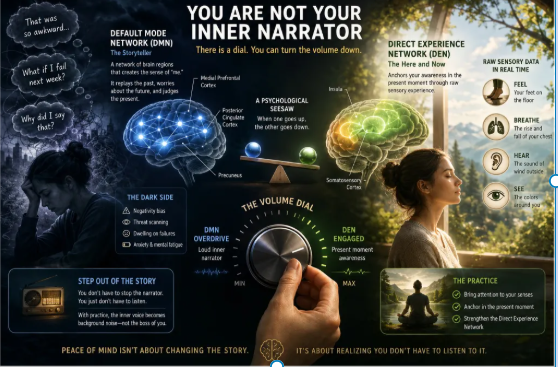
When you stop actively focusing on an external task, like answering an email or assembling furniture, your brain does not simply shut off to rest. Instead, a highly interconnected web of brain regions instantly fires up. Neuroscientists call this the Default Mode Network, or DMN.
The DMN is essentially the storyteller of your mind. It is the system that stitches together your past memories, your future anxieties, and your cultural conditioning to create a coherent sense of self. When you daydream, reflect, or simulate social scenarios, your DMN is working overtime.
In many ways, this network is an evolutionary masterpiece. It allows us to learn from our mistakes, predict consequences, and plan for complex futures. It is the bedrock of human creativity and autobiographical memory.
However, the DMN has a notorious dark side. Left to its own devices, the storyteller easily transforms into a harsh inner critic. Because the human brain evolved with a survival-driven negativity bias, your default narrator spends an exhausting amount of time scanning for emotional threats, dwelling on perceived failures, and generating anxiety. When this network runs on overdrive, it traps us in loops of rumination, leading to deep mental fatigue, stress, and burnout.
Finding the Brain’s Volume Knob
For decades, people assumed they were helpless victims of their own overthinking. However, neuroimaging studies have revealed an opposing force within our biology called the Direct Experience Network, which is largely centered around the insula and somatosensory cortex.
Think of the Default Mode Network and the Direct Experience Network as a psychological seesaw. Because of the way the brain is wired, they operate in a state of reciprocal inhibition: when one goes up, the other naturally goes down. They cannot both dominate your attention at the exact same time.
The Direct Experience Network activates when you bring your awareness entirely into the present moment. It does not think, judge, or analyze; it simply processes raw sensory data in real time. It is active when you notice the physical sensation of your feet resting on the floor, the rhythmic rise and fall of your chest as you breathe, the taste of your morning coffee, or the crisp sound of the wind outside your window.
When you intentionally shift your attention to these immediate sensory inputs, you effectively slide your brain’s internal volume dial. You are not fighting the inner narrator, arguing with your thoughts, or begging your mind to stop talking. Instead, you are simply depriving the storyteller of the neural energy it needs to run. By anchoring yourself completely in the physical reality of the present, the self-referential chatter of the DMN begins to fade into the background.
Stepping Out of the Story
Understanding these mechanics changes everything we know about mental wellness. True peace of mind does not come from forcing your inner voice to say positive things or trying to think your way out of anxiety positively. It comes from realizing that you do not have to listen to the story at all. You can choose to step out of the narrative entirely.
By practicing simple sensory awareness and daily mindfulness, you train your brain to access the Direct Experience Network more fluidly. Over time, you learn to treat the inner critic like a radio playing softly in another room. The noise might still be there, but it no longer dictates your emotional state or controls your day.
To explore the fascinating neuroscience behind this mental switch and learn practical strategies to master your own internal volume knob, read the full, original breakdown here:
About the Author
Gary L. Fretwell is a #1 international best-selling author and practitioner of Intentional Living — blending neuroscience with Stoic philosophy to help creators and leaders build a life of lasting significance.
His books include the #1 international best seller The Magic of a Moment, Intentional Retirement, Embracing Retirement, and Rewiring the Ring, which explores the cognitive science of tinnitus. His latest, The Identity Ghost, is a blueprint for designing a life of purpose through ancient wisdom and modern neuroscience.
On Medium, Gary founded and edits Illumination: Retirement, Aging & Legacy and Illumination Beyond Identity, and serves as an editor across the broader ILLUMINATION network.
Off the page, he serves as Board President for Prescott Meals on Wheels and mentors MBA students at Western Governors University.
📖 garyfretwell.com · 📬 The Wise Effort on Substack · ✍️ Follow on Medium


Leave a Reply