

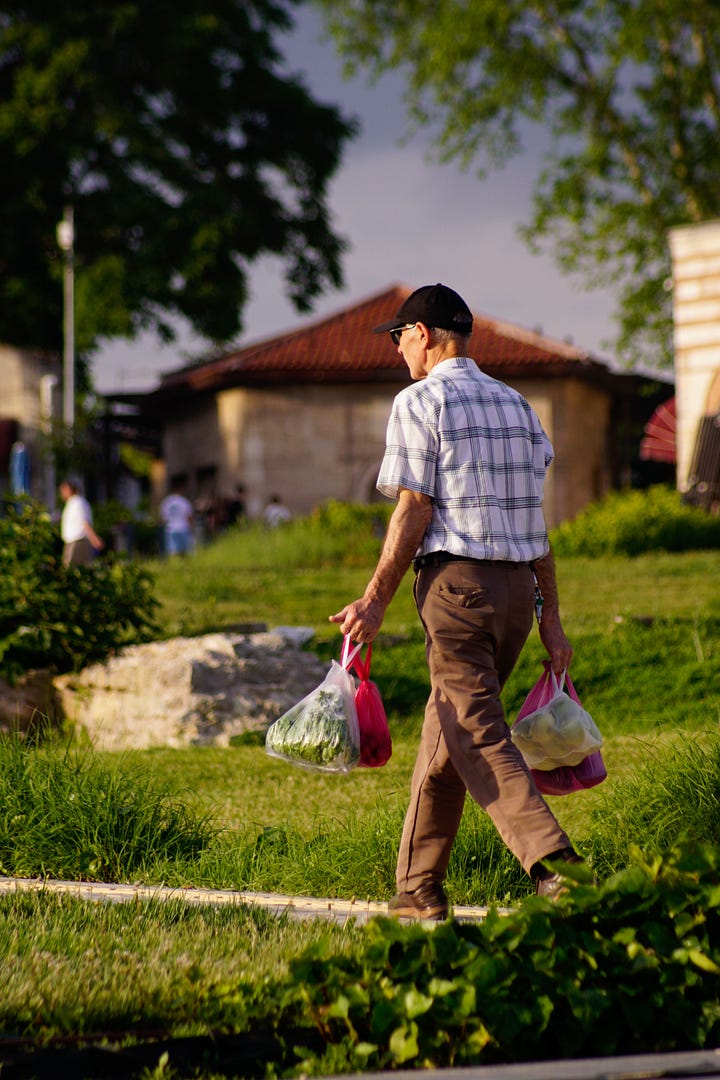
Memoirs of an Old Scientist: Why Carrying Groceries Home Can Feel Easier Than Walking Empty-Handed to the Shops. The older I get, the more I realize that the human body has an excellent sense of humor. Mine certainly has, and yours might as well.
Curator’s Note: In “Memoirs of an Old Scientist,” the author reflects on the surprising experience of finding walking home with groceries easier than the initial walk to the store. He humorously explores this physiological puzzle, relating it to the concept of the “second wind” recognized in exercise physiology, which refers to the body’s delayed adaptation to physical activity. As an older adult, he explains his body requires more time to adjust, highlighting that discomfort initially felt may simply be a need for the body to find its rhythm. Ultimately, he emphasizes that aging doesn’t diminish the body’s capabilities, which continue to adapt and surprise. This story was written by Dr Michael Broadly, a retired health scientist and public health officer in his late 70s.
In the last few months, I experienced a physiological puzzle that would have amused my younger self and confused many of my clients decades ago. I have been walking to my local shops, a journey that takes about ten minutes at a comfortable pace.
There was nothing heroic about it. No mountains were climbed, no Olympic records were threatened, and no wildlife documentaries were filmed. It was simply an elderly Australian walking to the local shops to buy groceries for himself and the family.
Yet by the time I arrived, I was puffing like an aging steam locomotive trying to haul a train up a steep hill. My breathing felt heavier than expected. My legs seemed reluctant to participate. My heart was doing its best to give the impression of an overenthusiastic drummer.
Like many scientifically curious people, I immediately began generating theories. Perhaps it was my lungs. Maybe it was my heart. And most likely it was aging. Worst of all, I began wondering whether I had finally discovered a previously unknown medical condition that would one day bear my name.
Old scientists like me are remarkably good at creating explanations. Sometimes we create too many. After purchasing my groceries, I began the journey home carrying a reasonably heavy bag.
Logic suggested this should make matters worse. The laws of physics certainly thought so. The grocery bag thought so. Even my back thought so. Yet something unexpected happened. I felt better. Yep, much better, not slightly better but noticeably better, and even almost euphoric. I didn’t smoke anything on the way back home.
The return journey was easier despite carrying several kilograms of food. I think it is usually 15 to 20 kilos. Being a retired healthcare professional, I did what many curious people do when confronted by a contradiction. I became fascinated.
For a few weeks, I reflected on the experience. Then an old memory surfaced. Many years ago, when my knees were younger, my hair was darker, and my confidence occasionally exceeded my wisdom, I ran marathons.
One thing I remembered vividly was that the first 15 minutes were the hardest. Everything felt wrong. Breathing felt awkward. Legs felt heavy. The entire enterprise seemed like a terrible idea.
Then, almost mysteriously, everything changed. My breathing settled. My stride became smoother. The discomfort faded. I could continue running comfortably for hours. At the time, I simply accepted this as part of distance running.
Only later did I learn that exercise physiologists had a name for this curious phenomenon. They call it the second wind. It sounds like something invented by poets. In reality, it is a biological concept.
One of the great misconceptions about exercise is that the body behaves like a light switch. We assume that the moment we begin moving, every system instantly adjusts to the new demand.
The body does not work that way. It behaves more like an old diesel engine on a cold Melbourne morning. It starts. It functions. But it takes a little while for everything to begin operating smoothly.
When we first begin walking, countless physiological adjustments occur simultaneously. The heart increases its output. Blood vessels supplying the muscles widen. Breathing becomes deeper. The muscles begin extracting oxygen more efficiently. Hormonal signals shift.
The nervous system coordinates the entire operation. For a brief period, demand rises faster than the body can comfortably accommodate. That mismatch often produces the sensation that exercise is harder than it should be. Then the machinery catches up.
Exercise physiologists sometimes describe this temporary mismatch as an oxygen deficit. As oxygen delivery and aerobic metabolism reach a steady state, movement becomes considerably easier.
During my recent investigations into breathing and exercise, I found myself revisiting a concept I had not seriously considered for decades: beta-2 receptors. Most people have never heard of them. Yet they silently influence every breath we take. I wrote a comprehensive story about it. If you missed it, here is the link for you, as it is a simplified summary of a good post-graduate lecture:
Beta-2 Receptors: The Body’s Airway Control System
Why They Matter More Than Most People Realizemedium.com
These microscopic receptors are found in several tissues, including the smooth muscles surrounding our airways. When stimulated by adrenaline, they encourage those muscles to relax. The result is subtle but important. Airways open slightly. Airflow improves. Breathing becomes more efficient.
The effect is dramatic in asthma, which is why medications such as Ventolin can provide rapid relief. For the rest of us, smaller natural changes occur during exercise as the body releases its own stress hormones. The body is not just responding to movement. It is preparing for it.
This is one reason I find physiology endlessly fascinating. The body is constantly anticipating our needs. Long before we consciously notice what is happening, countless microscopic systems are already making adjustments. We think we are in charge. The evidence suggests otherwise.
From an evolutionary perspective, this gradual adaptation makes perfect sense. Human beings evolved primarily for endurance rather than immediate peak performance. Our ancestors spent far more time walking, climbing, carrying food, and traveling long distances than sprinting from a standing start. The body’s tendency to settle into an efficient rhythm reflects that evolutionary heritage.
Of course, aging introduces additional complexity. As we grow older, most physiological systems remain remarkably capable.
What changes is not the destination but the speed of adaptation. When I was young, the process looked something like this: Start running → feel good. Now it occasionally resembles: Start walking → negotiate terms with lungs, heart, muscles, joints, and several unidentified stakeholders → eventually feel good. The outcome may be similar. The bureaucracy has expanded.
Eventually, I realized that the grocery bag itself was not the explanation. The timing was. By the time I began the return journey, my circulation had adjusted, my breathing had settled, my muscles had warmed, my nervous system had stopped treating a routine shopping trip as a potential emergency. The engine was finally running smoothly. The groceries arrived just in time to receive the credit.
There is a lesson here for many older adults. When the first few minutes of walking feel difficult, it is natural to worry. Sometimes those concerns deserve medical attention. Persistent breathlessness, chest pain, dizziness, or declining exercise capacity should never be ignored.
But sometimes the explanation is less alarming. Sometimes the body needs time to find its rhythm. What feels like weakness may occasionally be adaptation, and what feels like a decline may sometimes be a delayed warm-up.
And what feels like a problem may occasionally be the same second-wind phenomenon that carried us through long walks, sports, adventures, and perhaps even marathons many years ago.
The older I become, the more I appreciate that the human body is not a machine. Machines wear out, but the body adapts. It compensates, and it improvises. And of course, it occasionally confuses us.
And now and then, it teaches us a lesson as we carry a bag of groceries home from the local shops. That, in my view, is one of the reasons growing older never stops being interesting. I even started gaming in my old age and love doing it. How about you?
Thanks for reading and engaging. Have a healthy and happy life!
I started a new series called the World Is Fucked Up. Here are two stories that might entertain and educate you:
In a World F@cked Up, Here’s What Medical Gaslighting Taught Me About Public Health
If you are interested in sex, I have started a sex education series that might educate, inspire, or even entertain you. Here are the links to some sample stories:
The 8 Habits of Sexually Satisfied Couples With Any Sexual Orientation
What Most People Were Never Taught About Female and Male Orgasm
The Neurobiology of Sexual Pleasure and Meaningful Human Connection.
Human Libido: What Most People Were Never Taught About Sexual Desire
Neurocognitive and Affective Differences Between Erotic and Pornographic Stimuli in the Brain [Warning: This one is scholarly!]
What Science Reveals About Anal Pleasure and Orgasm for Both Women and Men [Free access via my community blogs]
Originally published on my blog site. Curators also summarize my stories in short podcasts.
Cheers, Mike!


Leave a Reply