

Thoughts on The American Revolution
Curator’s Note: The American Revolution, spurred by Jefferson’s “Declaration of Independence,” was a historic event in which a fledgling army triumphed over England, the world’s superpower. As the 250th anniversary approaches, questions about the nature of American freedom and government arise. The discussion in this essay emphasizes the importance of shared moral principles over mere legal structures in sustaining a republic. While laws create authority, it is values and civic norms that provide stability and purpose. Effectiveness in governance stems from aligning outcomes with citizen values, illustrating that a successful government must balance efficiency with moral alignment to truly serve the people it governs. This eye-opening essay was penned by Roberto Duffy, an informed and caring citizen of the United States.
The American Revolution was fought after Jefferson wrote the “Declaration of Independence.” It was reviewed, signed, and published by the Patriots in what is now Independence Hall in Philadelphia.
The words in that document resonated across the World and precipitated the American Revolution.
Think about it. A rag-tag Army beat and destroyed what, at the time, was the “World Power,” England.
This 4th of July, we (the American People) will celebrate the 250th Anniversary of the signing of such a document.
But, What Are WE Celebrating?
Do they mean “WE,” the people, are free?
What does FREE mean?
Who wrote the Constitution?
What is Our Government?
Who serves whom?
Are we here serving a government?
Do we have a government to serve us?
What is the Vote?
How are we FREE?
This Fourth of July, celebrate by thinking about this question, and make a resolution:
What do you want to be as an American Citizen?
I have been thinking about it since last year and decided to write a book, soon to be published (I hope). It is about a new way to look at our System of Government, as Jefferson put it.
Here is one of the Appendices that asks a key Question:
Can a Nation Survive Without a Moral Law?
A republic depends on more than laws. When shared civic norms erode, its structural safeguards carry more load than they were designed for — and that strain shows up as instability.
America was founded not just on laws, but on articulated moral principles.

The document articulates the principles upon which the nation justified its independence and the grievances it would no longer accept. Citizens across stations of life responded to that claim.

The Declaration of Independence wasn’t a legal contract — it was a moral declaration of purpose. A nation sustained primarily through control rather than shared principle becomes unstable over time. When power replaces principle, repression replaces governance, and the people become an afterthought.
A Nation Cannot Survive on Laws Alone
Laws structure authority. Without shared moral commitment, they cannot supply direction. Our founders understood this. That is why, before they wrote the Constitution, they signed the Declaration of Independence: a document not of law, but of moral purpose. It told the world America had a right to exist. It continues to articulate the basis of our political legitimacy.
Just as the Constitution defines how government operates, the nation’s moral foundation defines why it operates.
A shared moral foundation provides continuity as society evolves.
Moral alignment is what allows efficiency to serve citizens rather than override them.
EFFECTIVENESS
The difference between a stable republic and an unstable one can be understood through a simple relationship:
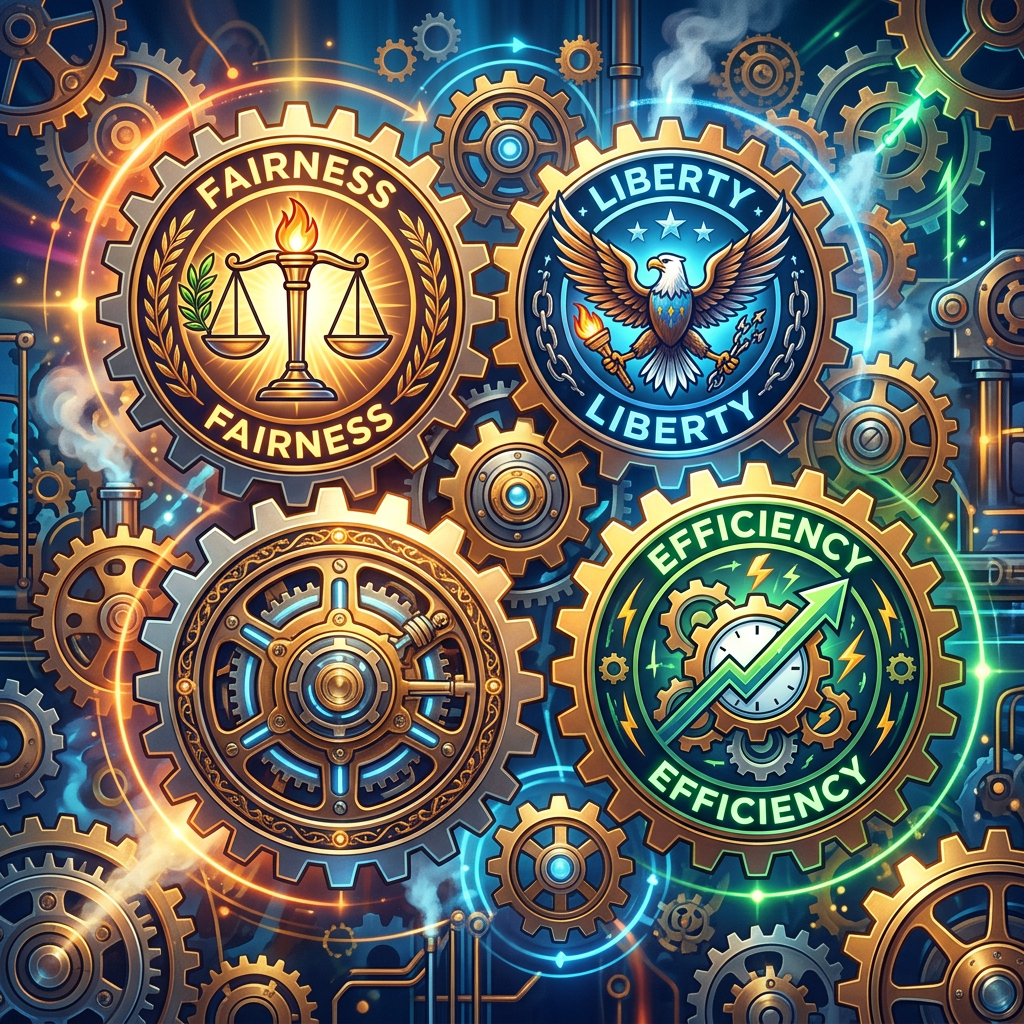
EFFECTIVENESS = EFFICIENCY × VALUE
The citizens being effective gives our government effectiveness. People grow as we walk into the future with innovation, but our values don’t change. A government umbrella of effectiveness that serves the people allows us the freedom to do what we do — Work.
We, the citizens, want an effective government.
Efficiency (How well resources are used)
- speed of execution
- cost control
- administrative simplicity
Value (What outcomes matter to citizens)
- fairness
- liberty
- opportunity
- trust
- dignity
- long-term stability
Value answers:
“Is the machine taking us where we actually want to go?”
And, “at what cost?”
Effectiveness (The Product)
Effectiveness is not speed.
Effectiveness is aligned outcomes over time.
A government can be:
- Efficient and low-value → fast but misaligned
- High-value but inefficient → admirable but unsustainable
- Effective → balanced
Conclusion
A constitutional republic requires more than procedure. It requires purpose.
The Constitution structures power. It defines offices, limits authority, and distributes responsibility. But structure alone does not determine direction.
The Declaration articulated the moral premise upon which the structure rests: equality, natural rights, and government by consent. Its words do not change. Their application has expanded across generations through constitutional process.
Shared civic norms — restraint, responsibility, and mutual obligation — are the living expression of that premise. When those norms weaken, institutions carry more load than they were designed for.
Efficiency is not the same as effectiveness. Efficiency measures how smoothly a system operates. Effectiveness measures whether its outcomes align with enduring values.
Effectiveness requires both discipline and moral alignment. If either collapses, the system continues to function — but not to serve.
That is the foundation upon which self-government rests.
System Thinking Primer:
The system is NOT the parts; it is the pattern of their interactions.
A system of interactive parts satisfies the following conditions:
a. It is a whole that cannot be divided into parts;
b. The essential property of the system is derived from its parts working together;
c. None of the essential parts of the system can do what system does;
d. Therefore, the system is not the sum of its parts, it is the product of them.
For example, an ordinary car:
A car is not “an engine + brakes + steering + electronics.”
A car becomes a working system only when those parts interact under required specifications-and a driver. The driver is the operator. The operator sets direction, chooses speed, responds to risk, and corrects course.
System Rules:
1. Improving the performance of the parts of a system taken separately will not necessarily improve the performance of the whole.
2. Parts interactions drive systems; Therefore, when looking for the solution to problems in a system from the same point of view from which the problem was formulated, it will not solve it. Quoting Einstein: “Without changing our pattern of thought, we will not be able to solve the problems we created with our current patterns of thought.”
3. Systems thinking is holistic; it attempts to derive understanding of parts from the behavior and properties of wholes, rather than derive the behavior and properties of wholes from those of their parts.
4. In systems, the best thing that can be done to solve a problem is to dissolve it through the entity that has it or its environment to eliminate the problem. Solving a problem from the same point of view that created it does not eliminate it.
You can also read this message on Substack and Medium and engage on those platforms.
Roberto Duffy is an independent thinker; Learned by reading; works to improve; loves family; Believes: It’s the truth that makes us one; it’s the center of our sun (“Everybody Cries”).


Leave a Reply