

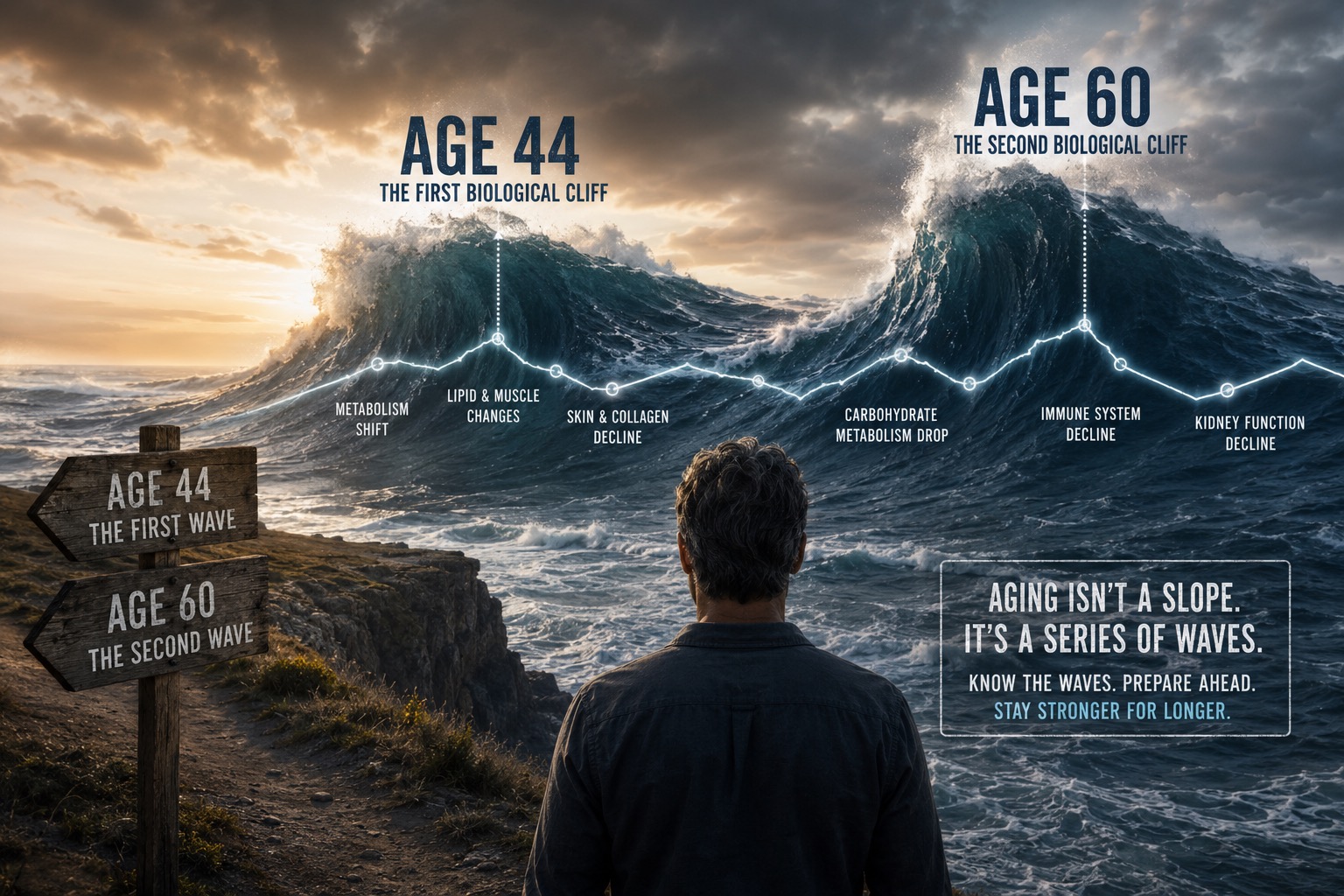
Curator’s Note: Recent research reveals that human aging occurs in significant, non-linear waves rather than a gradual decline. This challenges the traditional view of aging as a consistent process, demonstrating instead that major biological shifts happen around ages 44 and 60. At 44, the body faces an overhaul in metabolism affecting alcohol and caffeine processing, leading to unexpected changes in weight and vitality. By 60, a broader transformation occurs, impacting immune function and metabolic health. Understanding these “biological waves” allows for proactive health measures, turning aging from a passive experience into a manageable journey.
A single photo and a massive wave of new data just shattered everything we knew about how the human body decays.
Aging doesn’t happen one day at a time. New research suggests our biology changes in dramatic waves, with major molecular shifts occurring around ages 44 and 60, transforming how we think about growing older. / Author created image
We have been conditioned to view aging as a slow, predictable countdown. The conventional narrative suggests that starting somewhere in our late twenties, our bodies begin a gradual, linear slide toward old age. We imagine a gentle slope where we lose a tiny fraction of our vitality every single year. It is a neat, orderly, and deeply depressing story.
It also happens to be completely incorrect.
A striking reality came to light recently, sparked by a single, telling photograph and an overwhelming stack of modern scientific research. The realization is clear: our biological timeline does not move in a straight line. Instead, human aging looks much more like a staircase, characterized by long periods of relative stability punctuated by sudden, dramatic drops.
If you have ever woken up in your mid-forties feeling like your body suddenly changed overnight, you are not imagining things. Your molecules just took a dive off a biological cliff.
The two crests of biological aging. Source: NAD.com
Look closely at the graph above. Instead of a flat line or a gradual curve, our bodies experience massive, sudden spikes in molecular fluctuations. Science has finally mapped these exact moments, proving that we do not age gradually. We age in bursts.
Upending the Linear Myth
For generations, the scientific community relied on models like the traditional epigenetic clock, which measured aging as a steady accumulation of cellular wear and tear. However, a profound shift in data tracking has turned that model on its head. Researchers tracking hundreds of billions of molecular data points (including proteins, metabolites, lipids, and the trillions of microbes living inside us) discovered something fascinating. Human biology undergoes massive, synchronized transformations at very specific milestones in life.
The concept of a slow, gradual decay is an illusion. In reality, our bodies experience two massive biological bursts where thousands of molecules shift all at once. The first wave hits us in our mid-forties, usually around age 44. The second wave strikes as we enter our early sixties, averaging around age 60.
This explains why the risks for certain chronic conditions do not climb incrementally. Instead, health challenges related to cardiovascular function, cognitive health, and joint stability tend to spike dramatically after these specific age thresholds.
The Mid-Forties Shift: It Is Not Just Lifestyle
The first major biological overhaul happens when many people are at the peak of their careers and family lives. In our mid-forties, the body undergoes an abrupt transformation in how it processes basic compounds.
The molecular pathways responsible for metabolizing alcohol and caffeine change rapidly during this window. This explains why a late night out or an extra afternoon espresso hits differently at 45 than it did at 35. It is not a matter of willpower or a lack of sleep; your liver and metabolic machinery have fundamentally altered their operational rules.
Simultaneously, major shifts occur in lipid metabolism and the structural integrity of skin and muscle. This is the exact period when people notice unexpected weight gain, changes in cholesterol levels, and a sudden drop in muscle recovery, regardless of how strictly they stick to their routines. For years, these midlife changes in women were chalked up entirely to perimenopause. The latest data reveals a deeper truth: these molecular shifts happen dramatically in both men and women at the exact same time.
The Age 60 Cliff: Immune and Metabolic Reboots
The second wave arrives fifteen years later, and it brings an even broader set of systemic changes. By age 60, the human body initiates a massive reorganization of carbohydrate metabolism and kidney function. The efficiency with which cells utilize glucose takes a noticeable hit, making this a critical window for managing blood sugar and metabolic health.
Perhaps the most significant change during this second burst occurs within immune regulation. The immune system undergoes a sharp decline in its ability to manage inflammation and ward off viral threats. This sudden vulnerability explains why health risks escalate so quickly in our sixties. The protective buffers we relied on for decades experience a rapid, systemic retirement.
Taking Control of the Waves
While this new model of nonlinear aging might sound intimidating, it is actually incredibly empowering. When you know exactly where the bumpy patches on the road are located, you can prepare your vehicle to handle them.
Instead of treating health as a generic, lifelong maintenance project, we can treat it as a series of strategic preparations. The years leading up to age 44 and age 60 are prime opportunities for aggressive, protective interventions. Optimizing sleep, building a reserve of lean muscle mass through resistance training, reducing systemic inflammation, and fine-tuning metabolic flexibility can blunt the impact of these impending biological waves.
The traditional story of aging left us feeling powerless against a slow, inevitable decline. The new story gives us a map with clear markers. If you want to dive into the full breakdown of how this research is reshaping our understanding of longevity, check out the original piece, The Aging Story You’ve Been Told Is Wrong. By changing how we view the timeline of our lives, we can stop dreading a steady slope and start mastering the actual waves of human biology.
About the Author
Gary L. Fretwell is a #1 international best-selling author and practitioner of Intentional Living, blending neuroscience with Stoic philosophy to help creators and leaders build a life of lasting significance.
He’s the author of six books on intentional living and retirement, including the #1 international bestseller The Magic of a Moment, Intentional Retirement, Embracing Retirement, and Rewiring the Ring, which explores the cognitive science of tinnitus. His latest, The Identity Ghost, is a blueprint for designing a life of purpose through ancient wisdom and modern neuroscience.
On Medium, Gary founded and edits Illumination: Retirement, Aging & Legacy and Illumination Beyond Identity, and serves as an editor across the broader ILLUMINATION network.
Off the page, he serves as Board President for Prescott Meals on Wheels and mentors MBA students at Western Governors University.
📖 garyfretwell.com · 📬 The Wise Effort on Substack · ✍️ Follow on Medium


Leave a Reply