

Why telling your anxiety to calm down only makes it louder
Curator’s Note: The article discusses how advocating for forced positivity can exacerbate anxiety rather than alleviate it. The author shares personal experiences where attempts to combat anxiety with positive affirmations and practices led to feeling more overwhelmed. This reflects a broader cultural belief that negative emotions are failures to be corrected. The author emphasizes that healing comes from acceptance and understanding of these emotions rather than suppression. Genuine hope can arise when we listen to our feelings instead of dismissing them, allowing for genuine healing. The piece encourages those struggling with anxiety to seek therapeutic support and emphasizes that they are not alone in their experiences.
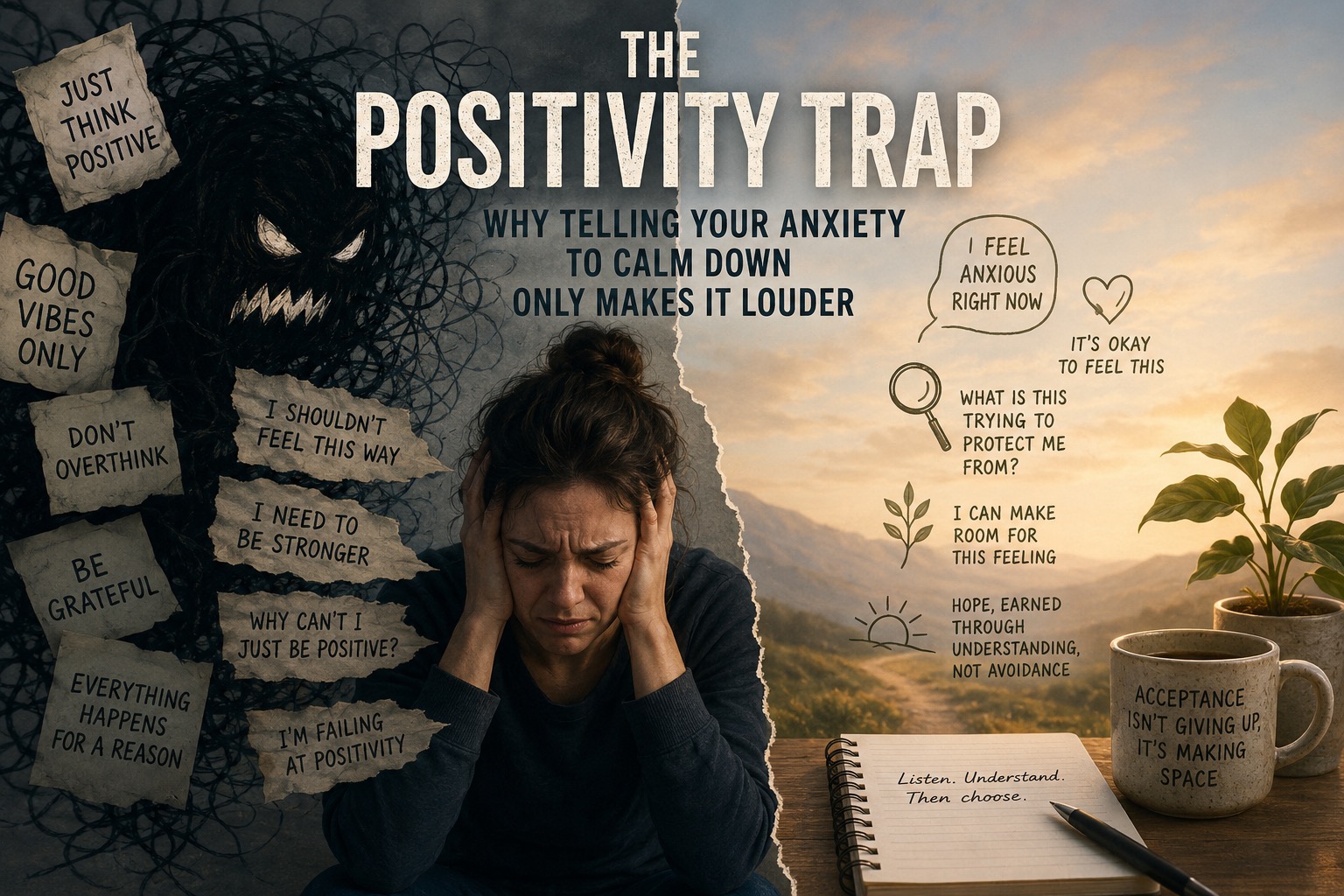
The Positivity Trap: Anxiety rarely gets quieter when it’s argued with. Real healing begins when we stop forcing positive thoughts and start making room for honest emotions. / Author created image using AI
There’s a particular kind of despair that comes from doing everything you’re supposed to do and still feeling worse. I meditated. I journaled gratitude lists. I repeated affirmations in the mirror. Every time a dark thought crept in, I told myself, “just think positive.” And somehow, the anxiety didn’t shrink. It grew teeth.
That experience is what led me to write I Did Everything Right. My Anxiety Got Worse., and it names something I think a lot of people quietly suspect but rarely say out loud: forced positivity doesn’t calm anxiety. It often feeds it.
For a long time, I assumed I was simply doing the work wrong. I read the books. I followed the routines. So when the anxiety kept climbing anyway, my first instinct wasn’t to question the advice. It was to question myself. Maybe I wasn’t grateful enough. Maybe I just needed to try harder at being positive. That instinct, I’ve come to believe, is exactly where the trap closes.
The Trap of “Just Be Positive”
We live in a culture that treats optimism like a moral obligation. Struggling? Reframe it. Anxious? Breathe and smile. The message, often well meaning, is that negative emotions are a personal failing to be corrected rather than information to be understood.
I used to think of my anxiety as a glitch, something to patch over quickly so I could get back to feeling normal. Looking back, that framing was part of the problem. It taught me to treat my own nervous system as an enemy rather than something trying to communicate with me.
The problem is that anxiety doesn’t respond well to being told to leave. When I met a racing heart and a spiraling mind with “I shouldn’t feel this way, I need to think positive,” I wasn’t soothing the anxious part of myself. I was arguing with it. And anxiety, by its nature, is very good at winning arguments. It simply generated a new fear: fear that I was failing at positivity too.
This is sometimes called the “second arrow” in Buddhist psychology. The first arrow is the original pain, but the second arrow is the suffering we add by resisting or judging the first. Forced positivity was, for me, that second arrow, dressed up as self-help.
Why Suppression Backfires
There’s a well documented psychological phenomenon behind this: thought suppression tends to increase the frequency and intensity of the very thoughts you’re trying to avoid. Tell someone not to think about a white bear, and the bear shows up everywhere. I told my own mind not to feel anxious, and the anxiety got louder, fighting past a layer of denial just to be acknowledged.
Positivity, when it’s used as a tool for avoidance rather than genuine perspective, functions the same way. It doesn’t process the emotion. It buries it, and buried emotions tend to resurface with interest.
I noticed this pattern most clearly late at night, when the affirmations I’d repeated all day would suddenly stop working. My worst anxiety attacks often came after my most determinedly positive days. I had spent all day telling a part of myself to be quiet, and it simply waited for a moment I couldn’t ignore.
What Actually Helped
The alternative wasn’t wallowing or pessimism. It was something closer to acceptance, not the passive kind that means giving up, but the active kind that means making room for a feeling instead of fighting it. Naming the anxiety instead of scolding it. Asking what it might be trying to protect me from instead of demanding it disappear. Letting “I feel anxious right now” be a complete sentence, rather than a problem that needed immediate fixing.
This doesn’t mean positivity itself is the enemy. Genuine hope, earned through actually working with my emotions rather than around them, is different from the performative kind that says “good vibes only” while quietly telling you your real feelings are unwelcome.
The Real Work
Healing isn’t a performance, and anxiety isn’t a moral test you pass by smiling hard enough. Sometimes the most useful thing you can do for an anxious mind is to listen to it, without immediately trying to talk it out of existing.
If you’ve ever done “everything right” and still felt worse, you’re not broken, and you’re not doing self-improvement wrong. You may just be arguing with a part of yourself that needed to be heard, not silenced.
You can read the full original piece here: I Did Everything Right. My Anxiety Got Worse.
If anxiety is something you’re navigating right now, it can help to talk with a therapist or counselor who can work through it with you directly.
About the Author
Gary L. Fretwell is a #1 international best-selling author and practitioner of Intentional Living, blending neuroscience with Stoic philosophy to help creators and leaders build a life of lasting significance.
He’s the author of six books on intentional living and retirement, including the #1 international bestseller The Magic of a Moment, Intentional Retirement, Embracing Retirement, and Rewiring the Ring, which explores the cognitive science of tinnitus. His latest, The Identity Ghost, is a blueprint for designing a life of purpose through ancient wisdom and modern neuroscience.
On Medium, Gary founded and edits Illumination: Retirement, Aging & Legacy and Illumination Beyond Identity, and serves as an editor across the broader ILLUMINATION network.
Off the page, he serves as Board President for Prescott Meals on Wheels and mentors MBA students at Western Governors University.
📖 garyfretwell.com · 📬 The Wise Effort on Substack · ✍️ Follow on Medium


Leave a Reply