

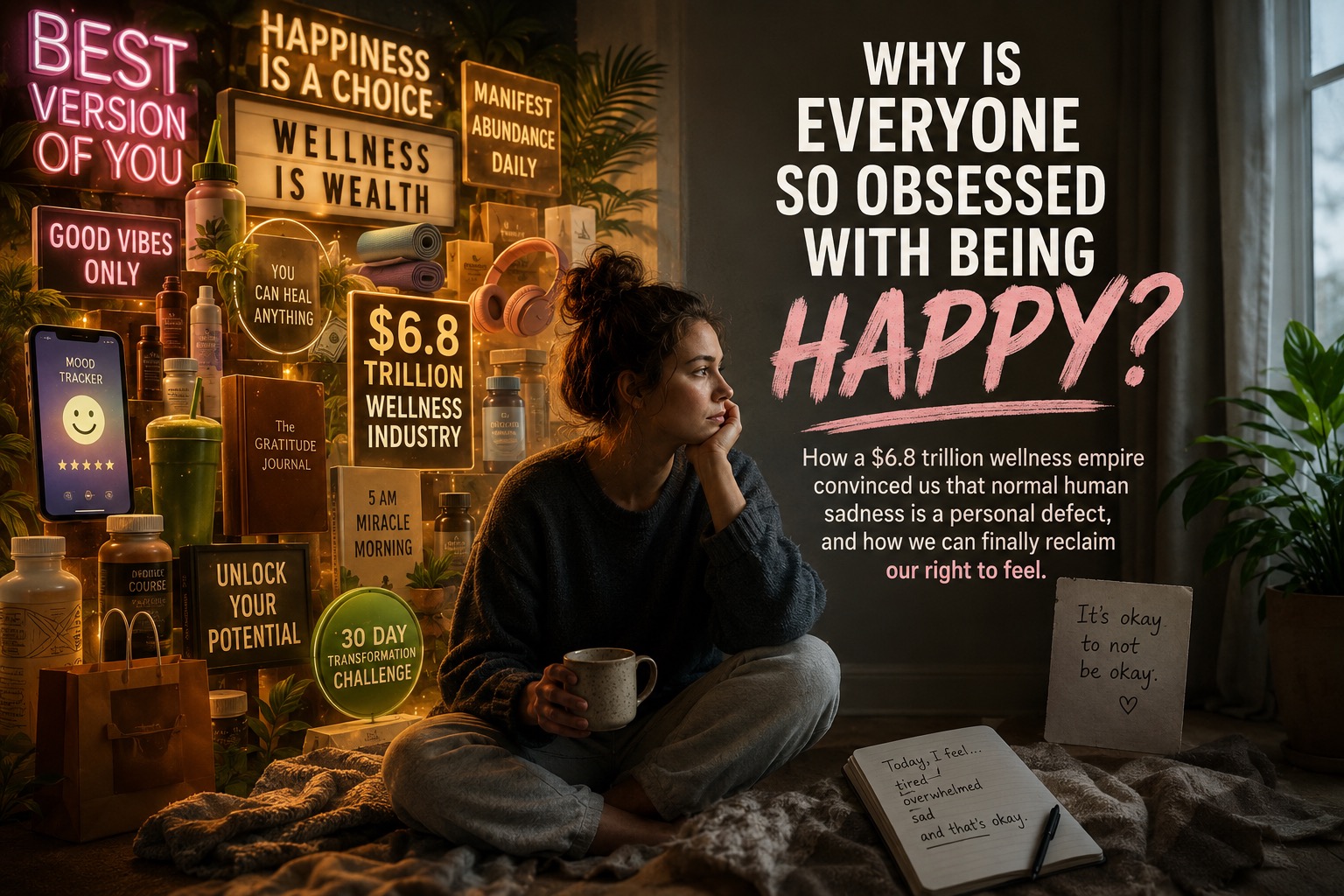
How a $6.8 trillion wellness empire convinced us that normal human sadness is a personal defect, and how we can finally reclaim our right to feel.

Curator’s Note: The wellness industry, valued at $6.8 trillion, promotes an unrealistic standard of constant happiness, labeling normal emotions like sadness and grief as personal failures. This pervasive culture encourages individuals to seek quick fixes through apps and positive affirmations, neglecting systemic issues such as overwork and economic instability. The phenomenon of toxic positivity burdens individuals, suggesting their struggles stem from personal deficiencies rather than external realities. It is essential to reclaim the right to feel a full spectrum of emotions, recognizing that sadness and frustration are natural responses to life’s complexities. Authentic self-care involves acknowledging these feelings without guilt.
The wellness industry promises constant happiness. Real healing begins when we stop treating normal human emotions as something that needs to be fixed.
If you have spent any time online over the last few years, you have probably felt the overwhelming pressure. We are constantly told to manifest our dreams, optimize our morning routines, and aggressively embrace a growth mindset. There is a sleek smartphone app to track every shift in your mood, an aesthetic journal to record your daily gratitude, and an endless stream of wellness influencers ready to sell you the secret formula for perpetual joy.
On paper, it looks like we are living in a golden age of self-care and human flourishing. Yet, if that is true, why does nearly everyone I talk to feel so incredibly exhausted, burnt out, and quietly inadequate?
The answer lies in a topic I recently explored in an article I published on Medium, titled “The Dark Side of the Happiness Industry.” In that piece, I pull back the shiny curtain on the massive, $6.8 trillion global wellness business to reveal a subtle and insidious trick it has quietly pulled on all of us. Over decades, it has systematically convinced us that feeling bad, experiencing grief, or simply having a hard day is a direct personal failure.
Think about how our modern culture approaches mental health and everyday human struggle. If you are drowning in burnout from a relentless corporate job, the standard advice is rarely to restructure work hours or demand better working conditions. Instead, you are told to download a guided meditation app and practice mindfulness on your fifteen minute break. If you feel chronic anxiety about inflation and the rising cost of living, you are advised to fix your scarcity mindset and practice positive affirmations.
This mechanism is what researchers call toxic positivity, and it has proven to be an astonishingly profitable business model.
By shifting the heavy burden of well-being entirely onto the individual, the happiness industry accomplishes something extremely convenient for the powers that be. It takes deep systemic, structural, and societal problems, such as overwork, social isolation, economic instability, and environmental stress, and neatly repackages them as internal personal defects.
Under this framework, if you are unhappy or overwhelmed, the cultural narrative suggests it is not because life is genuinely hard right now. It is simply because you are not trying hard enough. You are not drinking enough water, meditating frequently enough, exercising correctly, or buying the right array of adaptogenic supplements. The system itself is never allowed to be at fault; only your effort is.
We desperately need to reclaim an essential truth: feeling down, stressed, angry, or utterly exhausted is not a glitch or a flaw in your human programming. It is a completely rational, natural, and healthy response to a complex and often painful world.
When we elevate happiness as the only acceptable default setting for human life, we inadvertently pathologize our standard emotional range. Heavy feelings like grief, frustration, and sadness are not bugs in our system that need to be patched. They are vital, evolutionary signals that tell us when something in our life or environment is wrong and requires attention.
Trying to force a smile or positive vibe our way through genuine hardship does not actually heal our pain. Instead, it places a heavy, suffocating layer of guilt right on top of it. Suddenly, we are no longer just feeling sad; we are actively ashamed of ourselves for being sad in the first place.
Reclaiming our fundamental right to feel the full spectrum of human emotion, without feeling like we have failed an invisible test, is one of the most rebellious acts available to us today. True self care is not about constant optimization or forcing an artificial smile. Sometimes, the healthiest choice you can make is to pause, acknowledge that things are genuinely tough, and give yourself full permission to feel whatever you are feeling without judgment.
If you are tired of the relentless pressure to be perfectly fine all the time, I invite you to read my full essay. It serves as a validating sanity check in a world that keeps trying to sell us a cure for simply being human.
You can read my full piece on Medium here: The Dark Side of the Happiness Industry
Over to you: Has the pressure to stay positive ever made you feel worse about what you are going through? How do you protect your mental space from the constant demands of the wellness industry? I would love to hear your story in the comments below. If this piece brought you a sense of relief, please consider subscribing and sharing it with a friend who needs a reminder that it is okay not to be okay.
About the Author
Gary L. Fretwell is a #1 international best-selling author and practitioner of Intentional Living, blending neuroscience with Stoic philosophy to help creators and leaders build a life of lasting significance.
He’s the author of six books on intentional living and retirement, including the #1 international bestseller The Magic of a Moment, Intentional Retirement, Embracing Retirement, and Rewiring the Ring, which explores the cognitive science of tinnitus. His latest, The Identity Ghost, is a blueprint for designing a life of purpose through ancient wisdom and modern neuroscience.
On Medium, Gary founded and edits Illumination: Retirement, Aging & Legacy and Illumination Beyond Identity, and serves as an editor across the broader ILLUMINATION network.
Off the page, he serves as Board President for Prescott Meals on Wheels and mentors MBA students at Western Governors University.
📖 garyfretwell.com · 📬 The Wise Effort on Substack · ✍️ Follow on Medium
Interview with Dr. Mehmet Yildiz:


Leave a Reply